Remote Legal Staffing
How to Hire a Remote Paralegal: U.S. and International Hiring Options
Compare the three main ways law firms can hire remote paralegal support: domestic remote hiring, traditional virtual staffing, and international hiring through an EOR.
·
Founder, LegalBasis · President & Principal Attorney, American Visa Law Group
·
·
7 min read

Introduction
Hiring a remote paralegal can dramatically increase a law firm's capacity without requiring additional office space or significantly increasing overhead. Today, firms generally have three ways to hire remote legal support:
A U.S.-based remote employee
A traditional virtual staffing company
An international remote professional hired through an Employer of Record (EOR)
Each option offers different advantages in terms of cost, compliance, supervision, flexibility, and long-term scalability. Understanding these differences is essential before investing in your next legal hire.
What Is a Remote Paralegal?
A remote paralegal performs substantive legal support work outside of your firm's physical office while remaining integrated into your firm's daily workflow. Depending on qualifications, practice area, jurisdiction, and attorney supervision, remote paralegals may assist with:
Legal research
Drafting pleadings
Discovery preparation
Case management
Document review
Client communication
File organization
Trial preparation
Records management
Deadline tracking
Modern cloud-based practice management software allows remote paralegals to work almost seamlessly alongside attorneys and in-office staff.
Step 1: Define the Work You Need Done
Before deciding where to hire, determine exactly what responsibilities the position will include.
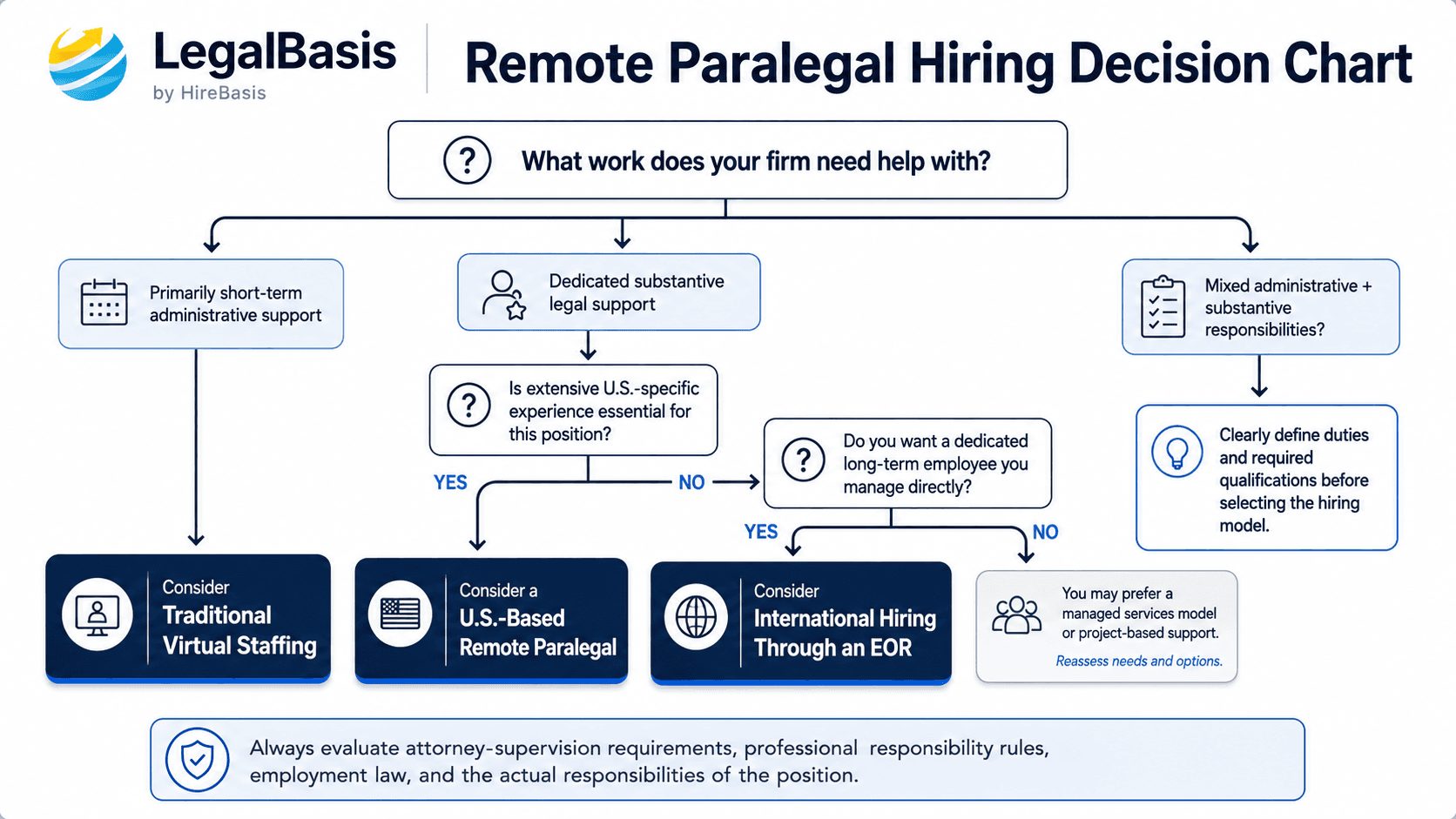
Questions to consider:
Will the role require drafting legal documents?
Does the work require experience in a specific practice area?
Will the employee communicate directly with clients?
Is U.S. legal experience required?
Will the person work full-time or part-time?
Does your practice need someone long-term?
Many firms discover they need a combination of administrative support and substantive legal work, making role definition the most important step in the hiring process.
Current market conditions make capacity planning especially relevant. Legal recruiter Justine Donahue told Reuters, “Litigation is as high as it's been — complex civil litigation in particular.” For growing firms, that kind of workload pressure makes it even more important to determine which responsibilities truly require attorney time and which can be delegated to qualified legal support.
Option 1: Hiring a U.S.-Based Remote Paralegal
Hiring a domestic employee provides the most traditional employment model.
Advantages
Familiar with U.S. legal procedures
Similar business hours
Easier communication with clients
May already know common legal software
No international employment considerations
Considerations
Highest salary expectations
Payroll taxes
Employee benefits
Workers' compensation
HR administration
Recruiting competition
Highly specialized positions can also become difficult recruiting searches, making a structured approach to recruiting for hard-to-fill roles especially useful. For firms seeking experienced litigation or corporate paralegals, domestic hiring remains an excellent choice—but often comes with the highest overall employment cost.
Option 2: Traditional Virtual Staffing Companies
Many law firms turn to virtual staffing agencies that assign assistants to multiple clients.
These arrangements typically involve contractors working through the staffing company rather than becoming integrated members of your firm.
Advantages
Fast onboarding
Lower cost than domestic hiring
Administrative tasks handled by the staffing company
Potential Limitations
Less direct control
Higher turnover
Shared resources
Limited ability to build long-term team culture
Contractors may support multiple firms
This model works well for firms seeking short-term administrative assistance but may be less suitable for firms building a permanent legal team.
Option 3: International Hiring Through an Employer of Record (EOR)
An Employer of Record allows your law firm to hire an international professional while the EOR manages local employment compliance.
Your firm still:
Interviews candidates
Selects the employee
Determines compensation
Assigns work
Supervises performance
Builds the long-term working relationship
The Employer of Record manages local employment responsibilities such as payroll, tax withholding, statutory benefits, employment agreements, and labor law compliance.
Advantages
Significant labor cost savings
Access to a larger global talent pool
Long-term dedicated employees
Greater employment stability
Simplified international compliance
Ability to scale your team across multiple countries
For many growing law firms, this model offers an attractive balance between cost savings and operational control.
Comparing the Three Hiring Models
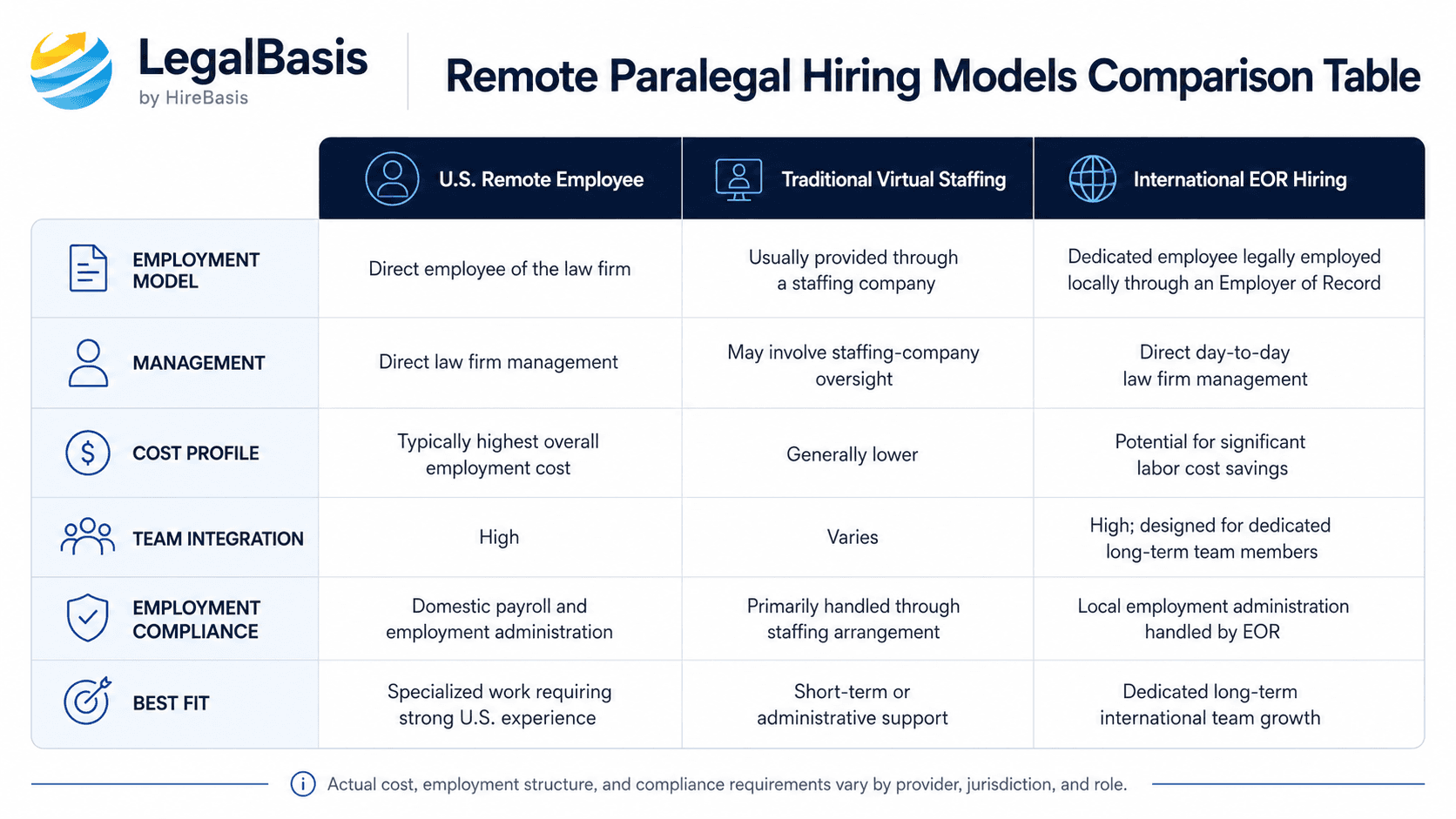
U.S. Remote Employee
Best for:
Highly specialized legal work
Client-facing roles
Firms prioritizing domestic experience
Traditional Virtual Staffing
Best for:
Administrative assistance
Short-term support
Smaller budgets
International EOR Hiring
Best for:
Long-term team growth
Dedicated legal professionals
Firms seeking significant cost savings while maintaining direct management
The right option depends on your firm's priorities, budget, and long-term staffing strategy.
Cost Considerations
Employment costs extend beyond salary.
Consider expenses such as:
Recruiting
Payroll processing
Benefits
Employment taxes
HR administration
Compliance
Turnover costs
Training
While domestic employees often command higher total employment costs, international hiring through an Employer of Record can substantially reduce overall expenses without sacrificing dedicated supervision or quality.
Cost pressure is arriving alongside unusually strong demand for legal services. The Thomson Reuters Institute's Law Firm Financial Index described the market this way: “Measured against two already powerful years rather than a recovery, this is as close to strong as legal demand gets.” In that environment, evaluating the total cost of adding capacity—not simply base salary—becomes increasingly important.
Compliance Matters
Hiring internationally requires compliance with local employment laws.
Attempting to hire foreign workers as independent contractors when local law requires employment can create legal and tax risks.
An Employer of Record helps address these issues by becoming the legal employer in the worker's country while allowing your firm to manage the employee's day-to-day work. Firms considering a contractor arrangement instead should also understand the distinction between a contractor vs. employee in a remote hiring relationship.
Which Hiring Option Is Right for Your Firm?
Every law firm has different staffing needs.
Consider:
Practice area
Budget
Growth plans
Required legal experience
Client interaction
Management preferences
Firms that want support defining the position, recruiting candidates, and structuring the hiring process can also review LegalBasis hiring support.
Some firms benefit most from domestic hiring, while others achieve greater scalability by building an international legal team through an Employer of Record.
The best hiring model is the one that aligns with your firm's long-term operational goals rather than simply the lowest upfront cost.
Frequently Asked Questions
Can remote paralegals perform substantive legal work?
Yes. Under appropriate attorney supervision and consistent with applicable rules governing the unauthorized practice of law, remote paralegals may assist with legal research, drafting, discovery, document management, and many other substantive support functions.
Is international hiring legal?
Yes. Many law firms hire internationally through Employer of Record providers that manage local employment compliance.
Does my firm still supervise the employee?
Yes. Regardless of where the employee is located, your firm directs the employee's day-to-day responsibilities, priorities, workflow, and performance.
Which option is the most cost-effective?
International hiring through an Employer of Record often offers the greatest long-term cost savings while allowing firms to build dedicated team members rather than relying on rotating contractors.
Final Thoughts
Remote hiring has transformed how modern law firms build legal teams. Whether you hire domestically, work with a traditional virtual staffing company, or expand internationally through an Employer of Record, the right strategy depends on your firm's objectives, budget, and desired level of control.
For firms seeking scalable growth, international hiring through an Employer of Record provides an opportunity to access highly qualified legal professionals while maintaining direct supervision and reducing administrative complexity.
About the Author
Hasan Abdullah is the Founder of LegalBasis and President & Principal Attorney of American Visa Law Group. LegalBasis grew out of his firsthand experience building and managing a U.S. law firm with both local and international team members.
Through that experience, he saw that law firms can expand capacity by recruiting talented professionals globally while still retaining control over who they hire, how those professionals are trained, and how the work is managed.
LegalBasis was built around that model: helping law firms define the roles they need, recruit qualified international professionals, and support compliant international employment structures where appropriate.
Continue Reading
More practical guidance for building a stronger legal team.

Remote Legal Staffing
Is Virtual Staffing Legit? Review and LegalBasis Comparison for Law Firms
Virtual Staffing is a legitimate legal staffing provider offering pre-vetted remote professionals to U.S. law firms. This review examines how its managed staffing model works, what it costs, its key strengths and limitations, and how it compares with LegalBasis for firms deciding between virtual staffing and directly managed global remote hiring.
Read Article →
Remote Legal Staffing
Is Stafi Legit? Remote Legal Staffing vs. LegalBasis
Is Stafi legit? This Stafi review examines its remote legal staffing services, training, 24/7 intake, pricing model, and reputation, then compares Stafi with LegalBasis to help law firms decide between managed virtual staffing and directly managed international remote hiring.
Read Article →

Remote Legal Staffing
Is LegalSoft Legit? Honest LegalSoft Review for Law Firms
Is LegalSoft legit? This LegalSoft review examines its virtual legal staffing model, current pricing, candidate pool, advantages, potential drawbacks, and how LegalSoft compares with LegalBasis for law firms considering international remote talent.
Read Article →
Build the Remote Team Your Law Firm Actually Needs.
Tell us what work your firm needs help with. LegalBasis can help define the role, recruit qualified international candidates, and explore an employment structure that fits your firm.