International Hiring
What Is an Employer of Record (EOR)? A Guide for Law Firms Hiring Internationally
An Employer of Record can provide the local employment infrastructure for an international team member while your law firm continues to direct the person’s day-to-day work. Here’s how the model works.
·
Founder, LegalBasis · President & Principal Attorney, American Visa Law Group
·
·
8 min read

Introduction
As law firms increasingly build remote teams, many are discovering that the best candidate for a position may not live in the United States. International hiring opens access to a much larger talent pool, but it also introduces new legal, tax, and employment compliance challenges.
An Employer of Record (EOR) offers a practical solution by allowing law firms to hire international employees without establishing a legal entity in the employee's country. The EOR becomes the legal employer for local compliance purposes, while your firm continues to manage the employee's daily work.
Understanding how an Employer of Record works can help your firm expand globally while minimizing administrative complexity and compliance risk.
What Is an Employer of Record?
An Employer of Record is a company that legally employs a worker on behalf of another business.
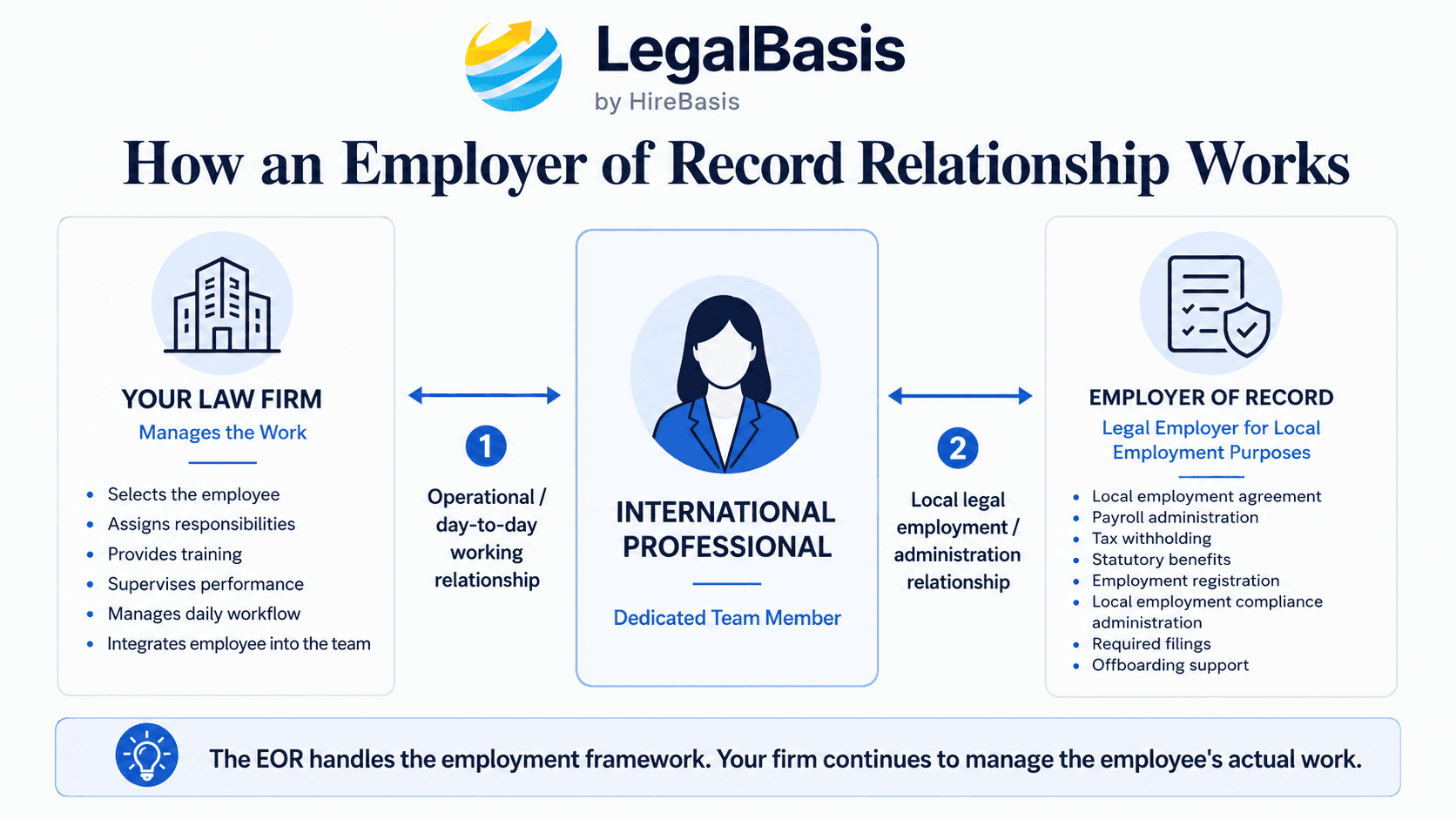
The EOR assumes responsibility for local employment obligations, while your law firm remains responsible for the employee's day-to-day work.
Typically, the EOR manages:
Employment contracts
Payroll administration
Tax withholding
Statutory employee benefits
Labor law compliance
Employment registration
Required government filings
Offboarding when employment ends
Meanwhile, your law firm continues to:
Recruit candidates
Conduct interviews
Select the employee
Set compensation
Assign work
Supervise performance
Provide training
Evaluate results
The employee functions as a dedicated member of your team, even though the EOR serves as the legal employer in the worker's home country.
Why Law Firms Use Employer of Record Services
International hiring can be complicated.
Without an EOR, firms often need to:
Establish a foreign legal entity
Register with local tax authorities
Understand local employment laws
Manage country-specific payroll systems
Comply with mandatory employee benefits
Navigate termination requirements
For most law firms hiring only a handful of international professionals, building this infrastructure is impractical.
An Employer of Record simplifies the process by handling these responsibilities on the firm's behalf.
The alternative can carry significant administrative and compliance exposure, particularly when firms attempt to build overseas teams without first understanding the legal risks of hiring overseas employees without an EOR.
How the EOR Relationship Works
Many firms initially misunderstand the Employer of Record model.
A typical hiring process looks like this:
Your firm identifies the role.
Candidates are recruited.
Your attorneys interview applicants.
Your firm chooses the employee.
The Employer of Record prepares local employment documentation.
The employee joins your team.
Your firm manages all day-to-day work.
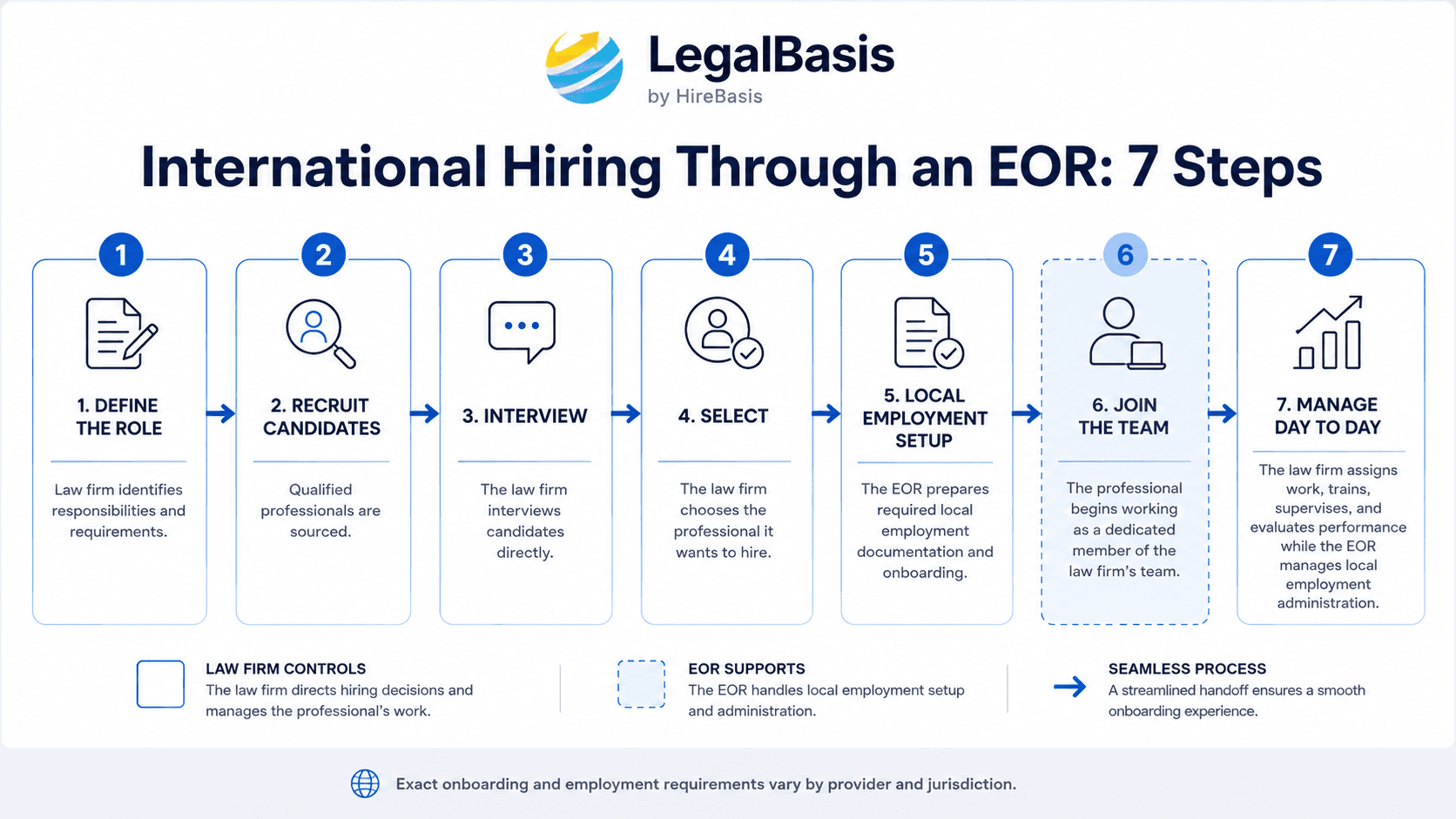
From the employee's perspective, they work with your law firm—not the EOR—for their daily responsibilities.
What Does the Employer of Record Handle?
Although services vary slightly by provider, most EORs manage:
Payroll
Employees receive locally compliant payroll in their home country. Firms building distributed teams should also understand the broader options for paying remote employees internationally and legally.
Employment Contracts
Contracts comply with applicable local employment laws.
Tax Compliance
The EOR withholds and remits required payroll taxes.
Mandatory Benefits
The EOR administers statutory benefits required under local law.
Employment Compliance
The EOR monitors compliance with local labor regulations and employment requirements.
Employee Offboarding
If employment ends, the EOR assists with locally compliant termination procedures where applicable.
What Your Law Firm Continues to Control
Using an Employer of Record does not mean giving up management authority.
Your firm continues making virtually every operational decision.
This includes:
Hiring decisions
Compensation recommendations
Daily supervision
Performance evaluations
Workflow management
Training
Quality control
Team integration
The EOR manages employment administration—not your legal operations.
Benefits of Hiring Through an Employer of Record
Access to Global Talent
Instead of recruiting only within commuting distance, firms can hire qualified professionals worldwide. The shift toward recruiting beyond traditional geographic boundaries is increasingly visible in global hiring. Deel co-founder and CEO Alex Bouaziz told The Economic Times, “If companies can't bring the best people in the world to them, they will go to where the talent is.” For law firms, an EOR is one structure that can make that broader geographic talent search operationally possible when an employment relationship is appropriate.
Faster Hiring
An EOR eliminates the need to establish a foreign legal entity before hiring.
Reduced Administrative Burden
Payroll, tax compliance, and employment documentation are handled by specialists.
Lower Compliance Risk
Local employment laws differ significantly between countries.
An EOR helps ensure employment complies with applicable local requirements.
Easier International Expansion
As staffing needs grow, firms can hire across multiple countries without building separate legal entities. Once a firm begins adding multiple international hires, the next challenge is learning how to scale an offshore team efficiently without losing quality.
Employer of Record vs. Independent Contractors
Some businesses attempt to hire international workers as independent contractors instead of employees.
While contractors are appropriate in some circumstances, misclassification can create significant legal and tax risks if local law considers the worker an employee.
Factors often considered include:
Degree of supervision
Full-time work
Exclusive services
Long-term engagement
Integration into business operations
An Employer of Record provides a compliant employment framework where an employee relationship is appropriate.
Worker classification remains an actively evolving area of employment law. When the U.S. Department of Labor proposed a new federal classification standard, Wage and Hour Division Administrator Andrew Rogers said, “Generally, if a worker is in business for him or herself and isn't dependent on an employer for work, the worker is an independent contractor.” That proposed U.S. federal standard should not be treated as a universal test for international hiring, however; classification still depends on the applicable laws and the substance of the actual working relationship.
Which Law Firm Roles Can Be Hired Through an EOR?
Many support functions are well suited to international employment.
Examples include:
Remote paralegals
Legal assistants
Case managers
Client intake specialists
Marketing coordinators
Bookkeepers
Administrative support staff
Every position should still be evaluated based on the firm's workflow, client expectations, and applicable professional responsibility rules. For a broader breakdown of the positions involved, see law firm roles that can be performed remotely.
Is an Employer of Record Right for Every Firm?
Not necessarily.
Firms hiring only domestic employees may have little need for an EOR.
However, firms looking to:
Expand internationally
Reduce staffing costs
Build long-term remote teams
Recruit specialized professionals
Scale efficiently
often find that an Employer of Record provides a practical and compliant hiring solution.
Frequently Asked Questions
Does the Employer of Record supervise my employee?
No. Your law firm supervises the employee's work. The Employer of Record manages employment administration and compliance.
Who chooses the employee?
Your firm does. You recruit, interview, and select the candidate.
Does the employee work for my law firm?
Operationally, yes. The employee performs work exclusively for your firm, while the Employer of Record serves as the legal employer for local employment purposes.
Can I hire in multiple countries?
Yes. Many Employer of Record providers support employment across dozens or even hundreds of jurisdictions.
Final Thoughts
International hiring has become a practical growth strategy for many law firms. An Employer of Record allows firms to access qualified professionals around the world without navigating the complexities of establishing foreign entities or managing country-specific employment compliance on their own.
For firms seeking dedicated international team members, the Employer of Record model combines operational control with administrative simplicity, making global hiring far more accessible than it once was.
Firms that want support moving from role definition through candidate recruitment can learn more about LegalBasis hiring support.
About the Author
Hasan Abdullah is the Founder of LegalBasis and President & Principal Attorney of American Visa Law Group. After building and managing a growing U.S. law firm with both domestic and international team members, he founded LegalBasis to help law firms recruit, manage, and scale high-performing legal teams.
Drawing on firsthand experience with international staffing, Employer of Record (EOR) solutions, and law firm operations, Hasan writes about practical strategies that help firms grow while maintaining compliance, operational control, and exceptional client service.
Continue Reading
More practical guidance for building a stronger legal team.

Remote Legal Staffing
Is Virtual Staffing Legit? Review and LegalBasis Comparison for Law Firms
Virtual Staffing is a legitimate legal staffing provider offering pre-vetted remote professionals to U.S. law firms. This review examines how its managed staffing model works, what it costs, its key strengths and limitations, and how it compares with LegalBasis for firms deciding between virtual staffing and directly managed global remote hiring.
Read Article →

Remote Legal Staffing
Is Stafi Legit? Remote Legal Staffing vs. LegalBasis
Is Stafi legit? This Stafi review examines its remote legal staffing services, training, 24/7 intake, pricing model, and reputation, then compares Stafi with LegalBasis to help law firms decide between managed virtual staffing and directly managed international remote hiring.
Read Article →

Remote Legal Staffing
Is LegalSoft Legit? Honest LegalSoft Review for Law Firms
Is LegalSoft legit? This LegalSoft review examines its virtual legal staffing model, current pricing, candidate pool, advantages, potential drawbacks, and how LegalSoft compares with LegalBasis for law firms considering international remote talent.
Read Article →
Build the Remote Team Your Law Firm Actually Needs.
Tell us what work your firm needs help with. LegalBasis can help define the role, recruit qualified international candidates, and explore an employment structure that fits your firm.