Remote Legal Staffing
Which Law Firm Roles Can Be Performed Remotely? A Practical Guide to Building a Remote Legal Team
Many law firm functions no longer require a physical desk in the office. Explore which legal, administrative, client-service, marketing, and financial roles can realistically be performed remotely.
·
Founder, LegalBasis · President & Principal Attorney, American Visa Law Group
·
·
8 min read

Introduction
Remote work has permanently changed how modern law firms operate. While courtroom appearances and certain client meetings still require an in-person presence, many legal functions can now be performed effectively from virtually anywhere.
Cloud-based case management systems, secure document platforms, video conferencing, and collaborative software have made it possible for law firms to build highly productive remote teams without sacrificing quality or client service.
Understanding which positions are well-suited for remote work can help your firm expand capacity, reduce overhead, improve hiring flexibility, and access a broader talent pool.
Why Law Firms Are Expanding Remote Teams
Many firms initially adopted remote work out of necessity. Today, it has become a long-term staffing strategy.
Benefits include:
Access to larger talent pools
Reduced office overhead
Greater scheduling flexibility
Improved scalability
Lower recruiting costs
Business continuity
Easier geographic expansion
Remote staffing also allows firms to recruit specialized professionals who may not be available locally.
Some major firms continue to treat geographic flexibility as a recruiting advantage. Quinn Emanuel's current Work From Anywhere policy states, “Our lawyers should work from wherever they do their best work.” The firm says eligible U.S. associates and of counsel can, with approval, work from anywhere in the country, illustrating how remote work can function as a deliberate talent strategy rather than simply an accommodation.
Legal Roles Commonly Performed Remotely
While every practice area is different, many legal support positions can operate successfully outside the office.
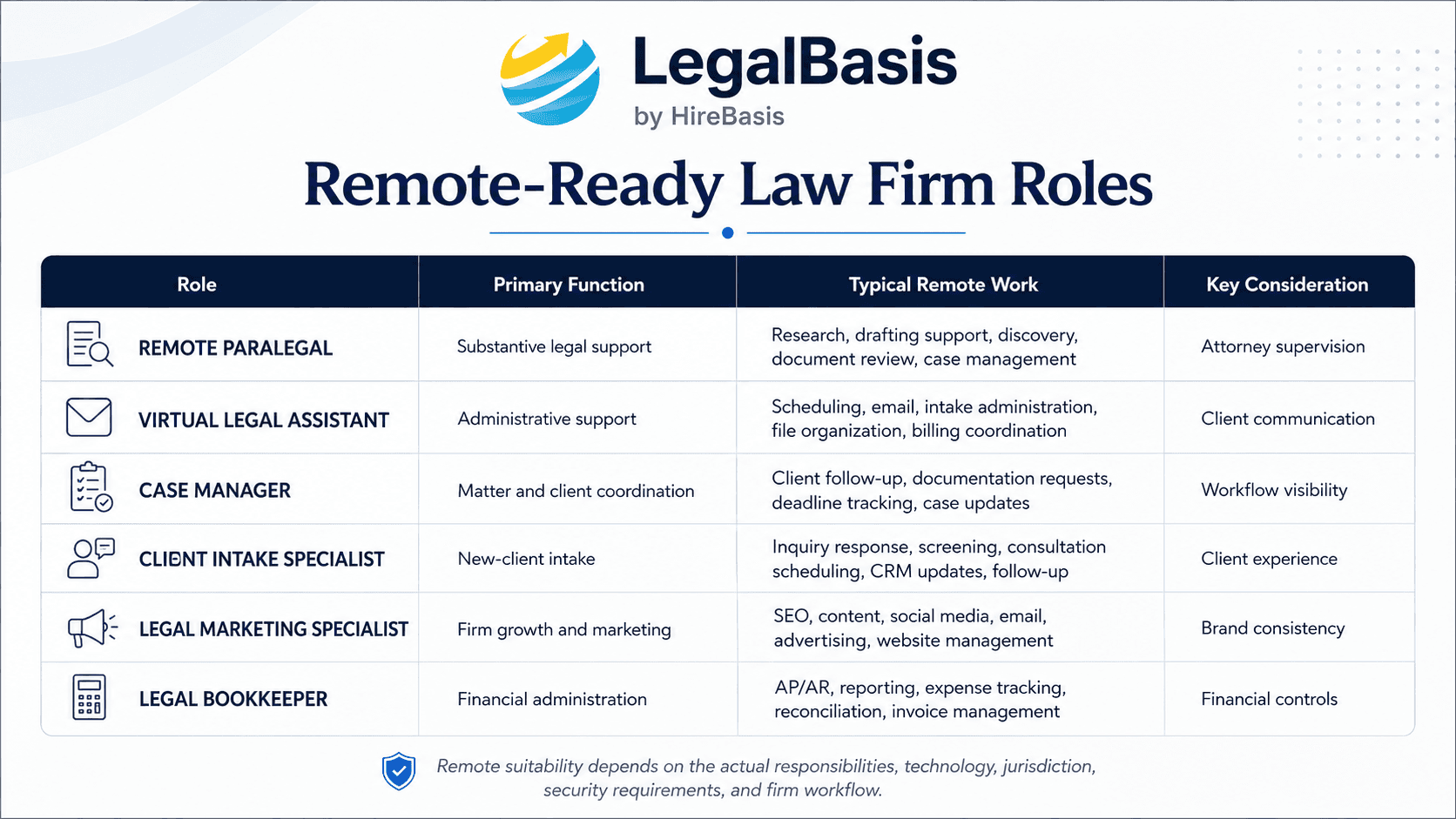
Remote Paralegals
Paralegals are among the most common remote legal professionals.
Typical responsibilities include:
Legal research
Drafting pleadings
Discovery organization
Document review
Trial preparation
File management
Deadline tracking
Client communication under attorney supervision
Many litigation, immigration, family law, estate planning, and corporate firms successfully employ remote paralegals on a full-time basis.
Firms considering this position can use this guide to hiring a remote paralegal to compare domestic, staffing-company, and international hiring approaches.
Virtual Legal Assistants
Virtual legal assistants typically focus on administrative support that keeps attorneys productive.
Common duties include:
Calendar management
Client intake
Scheduling
Phone support
Email management
Document formatting
File organization
Billing coordination
Because these tasks rely primarily on cloud-based software and communication tools, they are often well suited to remote work.
Because the two positions are sometimes confused, firms should also understand the differences between a virtual legal assistant vs. remote paralegal.
Remote Case Managers
Case managers coordinate client communication and ensure matters continue moving forward.
Responsibilities often include:
Following up with clients
Requesting documentation
Monitoring deadlines
Updating case management systems
Coordinating attorney meetings
Tracking case progress
This role can significantly improve client experience while freeing attorneys to focus on legal work.
Client Intake Specialists
The first impression many prospective clients have of a law firm comes from the intake team.
Remote intake professionals frequently handle:
Responding to inquiries
Scheduling consultations
Collecting preliminary information
Screening leads
CRM updates
Consultation reminders
Follow-up communication
Because intake relies heavily on phone, email, and CRM systems, it can often be performed entirely remotely.
Legal Marketing Specialists
Many marketing functions no longer require an in-office presence.
Remote marketing professionals may assist with:
Website updates
Search engine optimization (SEO)
Blog publishing
Social media management
Email campaigns
Paid advertising
Graphic design
Video coordination
For growing firms, marketing is increasingly managed by distributed teams.
Legal Bookkeepers
Bookkeeping and accounting functions are also commonly handled remotely.
Typical responsibilities include:
Accounts payable
Accounts receivable
Payroll coordination
Financial reporting
Trust account reconciliation
Expense tracking
Invoice management
Secure accounting platforms allow bookkeepers to work efficiently while maintaining appropriate financial controls.
Roles That May Still Require In-Person Presence
Although many positions are remote-friendly, some responsibilities remain difficult to perform virtually.
Examples include:
Court appearances
Physical filing with certain courts
Process service
Mail handling
Office reception
Certain notarizations
In-person client meetings
Physical evidence management
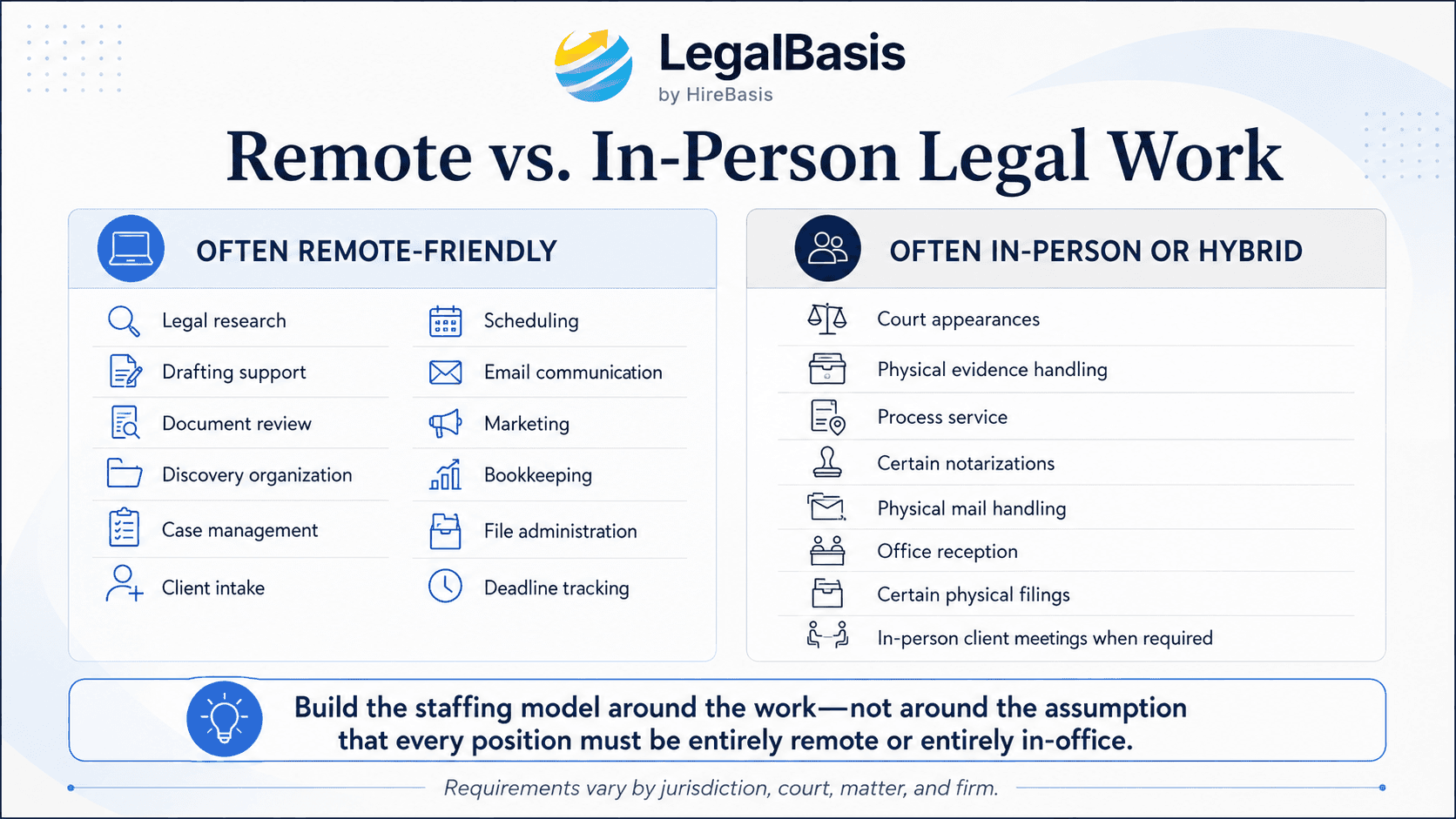
Many firms use hybrid staffing models where only these functions remain office-based. At the same time, remote capability should not be confused with a universal move toward remote-first law firms. Legal recruiter Rachel Nonaka told Reuters, “The pendulum is absolutely swinging back toward the majority of partners' and associates' time being in person, in the office.” That distinction is important: a particular role may be technically well suited to remote work even when an individual firm's culture or attendance policy favors a hybrid model.
Technology Makes Remote Legal Teams Possible
Successful remote firms rely on secure technology rather than physical proximity.
Common tools include:
Practice management software
Secure cloud document storage
E-signature platforms
Video conferencing
Timekeeping software
Secure messaging
Task management systems
Client portals
When implemented properly, these systems often provide greater transparency than traditional office workflows.
Building an Effective Remote Legal Team
Remote staffing succeeds when firms establish clear expectations from the beginning.
Best practices include:
Documented workflows
Regular team meetings
Defined communication channels
Performance metrics
Secure access controls
Standard operating procedures
Ongoing training
Attorney supervision where required
Successful remote teams prioritize accountability rather than physical presence. These systems can be reinforced with deliberate virtual team-building practices for remote employers and managers, especially as the team becomes more distributed.
Domestic vs. International Remote Hiring
Once a firm decides a position can be performed remotely, the next question becomes where to recruit.
Many firms choose between:
U.S.-Based Remote Employees
Ideal for:
Highly specialized legal work
Domestic client-facing positions
Practice areas requiring extensive U.S. experience
International Professionals Through an Employer of Record (EOR)
Many administrative and legal support roles can also be filled by highly qualified international professionals.
Using an Employer of Record allows firms to:
Recruit globally
Maintain direct supervision
Build dedicated long-term employees
Simplify international employment compliance
Scale more efficiently
The Employer of Record manages local payroll, employment contracts, tax compliance, and statutory benefits while your firm directs the employee's day-to-day work.
Which Roles Usually Deliver the Greatest ROI?
Many firms find the greatest return from remotely hiring positions that free attorneys to focus on higher-value legal work.
Examples include:
Paralegals
Legal assistants
Intake specialists
Case managers
Marketing coordinators
Bookkeepers
As firms grow, combining several remote roles often produces significantly greater operational efficiency than hiring additional attorneys alone.
Once multiple international positions are involved, the challenge shifts from simply hiring talent to learning how to scale an offshore team without losing quality.
Frequently Asked Questions
Can legal work really be performed remotely?
Yes. Many legal support functions—including drafting, research, case management, intake, and administrative work—can be performed remotely using secure cloud-based systems and appropriate attorney supervision.
Are remote employees less productive?
Not necessarily. Many firms report equal or higher productivity when clear expectations, communication systems, and performance metrics are in place.
Can international professionals work as part of a law firm?
Yes. Many firms hire international professionals through Employer of Record providers that manage local employment compliance while allowing the firm to supervise the employee's daily work.
Which role should firms hire first?
Many growing firms begin with either a remote legal assistant or remote paralegal, as these positions often provide immediate relief for attorneys while improving client responsiveness.
Final Thoughts
Building a remote legal team is no longer simply a cost-saving strategy—it has become a competitive advantage for many modern law firms.
From paralegals and legal assistants to intake specialists, case managers, marketers, and bookkeepers, numerous roles can now be performed effectively outside the traditional office.
The firms that thoughtfully identify which responsibilities can be delegated remotely often gain greater flexibility, improve efficiency, and position themselves for sustainable long-term growth.
About the Author
Hasan Abdullah is the Founder of LegalBasis and President & Principal Attorney of American Visa Law Group. After building and managing a growing U.S. law firm with both domestic and international team members, he founded LegalBasis to help other law firms implement scalable staffing strategies.
Drawing on firsthand experience recruiting, training, and managing remote legal professionals, Hasan writes about law firm operations, international hiring, Employer of Record (EOR) solutions, and practical approaches to building high-performing legal teams.
Continue Reading
More practical guidance for building a stronger legal team.

Remote Legal Staffing
Is Virtual Staffing Legit? Review and LegalBasis Comparison for Law Firms
Virtual Staffing is a legitimate legal staffing provider offering pre-vetted remote professionals to U.S. law firms. This review examines how its managed staffing model works, what it costs, its key strengths and limitations, and how it compares with LegalBasis for firms deciding between virtual staffing and directly managed global remote hiring.
Read Article →
Remote Legal Staffing
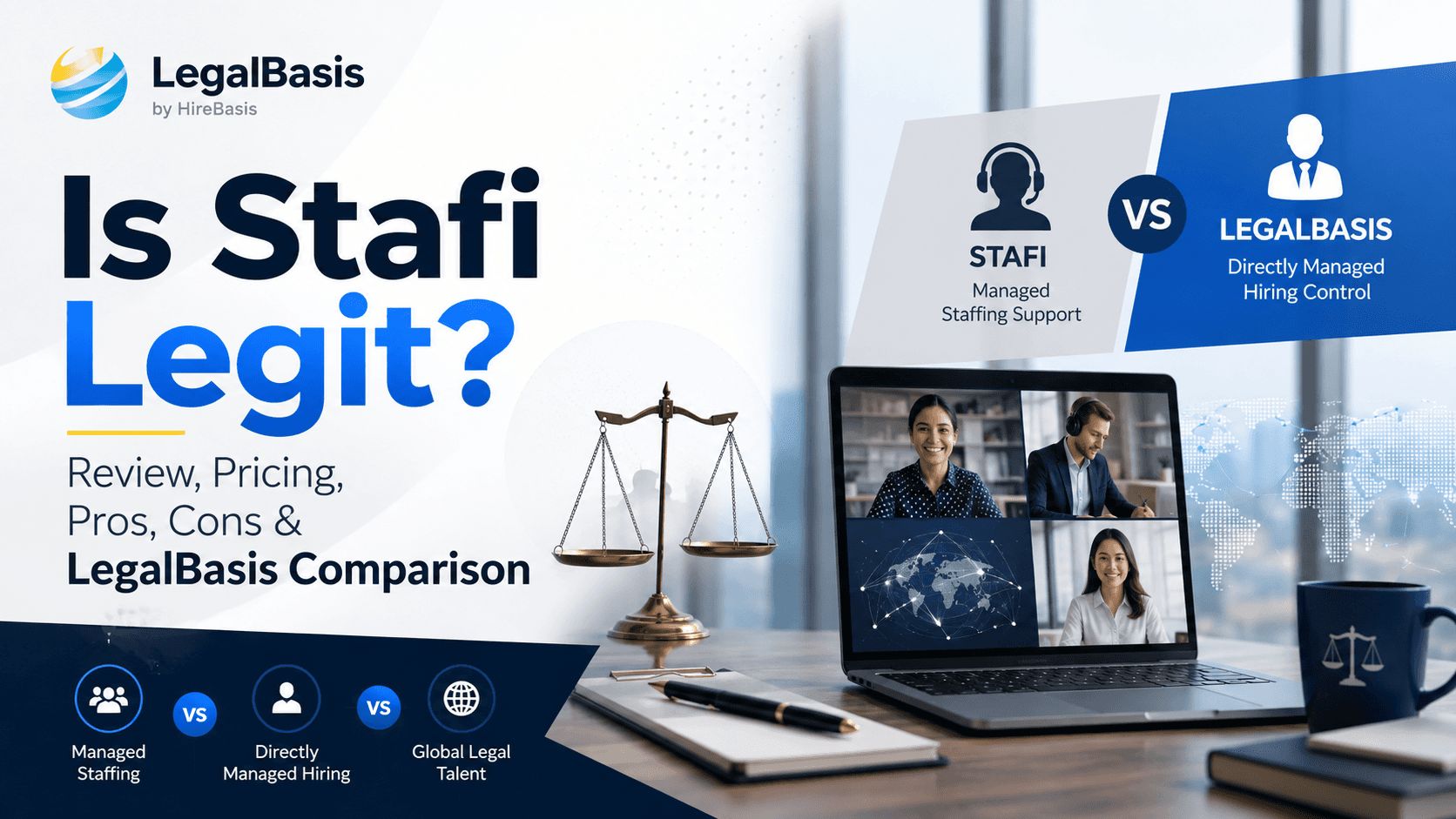
Is Stafi Legit? Remote Legal Staffing vs. LegalBasis
Is Stafi legit? This Stafi review examines its remote legal staffing services, training, 24/7 intake, pricing model, and reputation, then compares Stafi with LegalBasis to help law firms decide between managed virtual staffing and directly managed international remote hiring.
Read Article →

Remote Legal Staffing
Is LegalSoft Legit? Honest LegalSoft Review for Law Firms
Is LegalSoft legit? This LegalSoft review examines its virtual legal staffing model, current pricing, candidate pool, advantages, potential drawbacks, and how LegalSoft compares with LegalBasis for law firms considering international remote talent.
Read Article →
Build the Remote Team Your Law Firm Actually Needs.
Tell us what work your firm needs help with. LegalBasis can help define the role, recruit qualified international candidates, and explore an employment structure that fits your firm.