Remote Legal Staffing
Virtual Legal Assistant vs. Remote Paralegal: What Does Your Law Firm Actually Need?
A virtual legal assistant and a remote paralegal can both add capacity to a law firm, but they are usually best suited to different kinds of work. Here’s how to decide which role your firm actually needs.
·
Founder, LegalBasis · President & Principal Attorney, American Visa Law Group
·
·
6 min read

Introduction
Many law firms use the terms virtual legal assistant and remote paralegal interchangeably. While both roles allow work to be performed remotely, they generally serve very different functions within a legal practice.
Understanding the distinction is important because hiring the wrong role can lead to inefficiencies, unmet expectations, and unnecessary costs. This guide explains the differences between virtual legal assistants and remote paralegals, the work each is best suited for, and how to determine which position will add the most value to your firm.
What Is a Virtual Legal Assistant?
A virtual legal assistant primarily handles administrative and operational work that keeps a law firm running efficiently.
Typical responsibilities include:
Managing calendars
Scheduling consultations
Answering client inquiries
Email management
Preparing intake packets
Organizing digital files
Updating case management software
Billing support
Data entry
Administrative follow-up
Although many virtual legal assistants have legal industry experience, their primary focus is supporting the business operations of the firm rather than performing substantive legal work.
What Is a Remote Paralegal?
A remote paralegal performs substantive legal support under attorney supervision while working outside the firm's physical office.
Responsibilities often include:
Legal research
Drafting pleadings
Discovery preparation
Document review
Case chronology preparation
Trial preparation
Case management
Preparing exhibits
Filing assistance
Reviewing evidence
Remote paralegals generally possess greater legal training and experience than administrative assistants and are involved much more closely in the legal work itself.
If this is the type of support your firm needs, the next step is understanding how to hire a remote paralegal and which employment model makes the most sense.
The Biggest Difference
The simplest way to think about these two positions is:
Virtual Legal Assistant
Supports running the law firm.
Remote Paralegal
Supports practicing law.
Every firm needs both administrative efficiency and legal production, but not every firm needs them in the same proportion. Firms evaluating a broader range of positions can also review other law firm roles that can be performed remotely.
Typical Responsibilities Compared
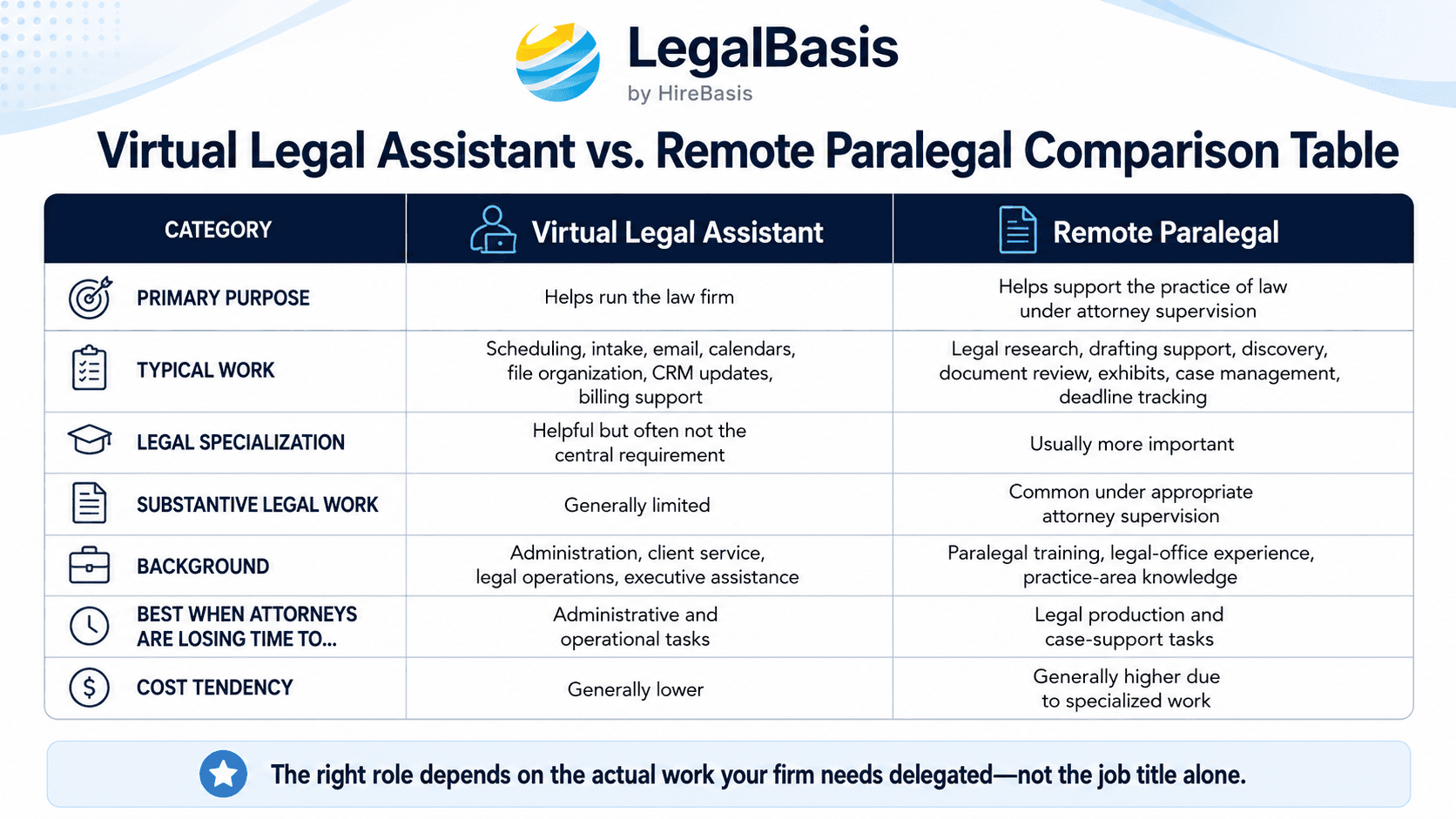
Virtual Legal Assistant
Common tasks include:
Appointment scheduling
Client communication
CRM updates
Calendar management
File organization
Administrative document preparation
Billing support
Intake coordination
Office workflow support
Remote Paralegal
Common tasks include:
Drafting legal documents
Legal research
Discovery assistance
Preparing exhibits
Reviewing evidence
Organizing litigation files
Drafting correspondence
Managing deadlines
Supporting attorneys throughout active cases
Education and Experience
Virtual legal assistants often have backgrounds in:
Legal administration
Executive assistance
Client service
Office management
Administrative support
Remote paralegals typically have:
Formal paralegal education or certification
Significant legal office experience
Practice-area knowledge
Experience working directly with attorneys
Familiarity with legal drafting and procedural rules
The broader legal hiring market is also putting a premium on readiness. A Firm Prospects report cited by Reuters said the hiring shift “points to an industry-wide focus on experience” and noted firms' preference for people who can “hit the ground running.” For a firm comparing a virtual legal assistant with a remote paralegal, that reinforces the importance of task-specific experience rather than relying on job titles alone.
The qualifications required depend on your firm's practice area and the complexity of the work.
Which Role Costs More?
Remote paralegals generally command higher compensation because they perform more specialized legal work.
Virtual legal assistants are often a more cost-effective solution for firms needing operational support rather than substantive legal assistance.
Pressure to match work with the appropriate level of resource is showing up elsewhere in legal services as well. Former Cleary Gottlieb managing partner Michael Gerstenzang told Business Insider, “Clients aren't going to continue to pay first and second year associates these very high rates for due diligence.” Although his comments concerned technology and BigLaw pricing, the broader operational lesson is relevant: firms benefit from deciding deliberately which work requires their most expensive legal capacity and which work can appropriately be delegated.
For firms expanding internationally, both positions can often be hired through an Employer of Record (EOR), allowing firms to access experienced professionals while maintaining direct management and local employment compliance.
Which Role Does Your Firm Need?
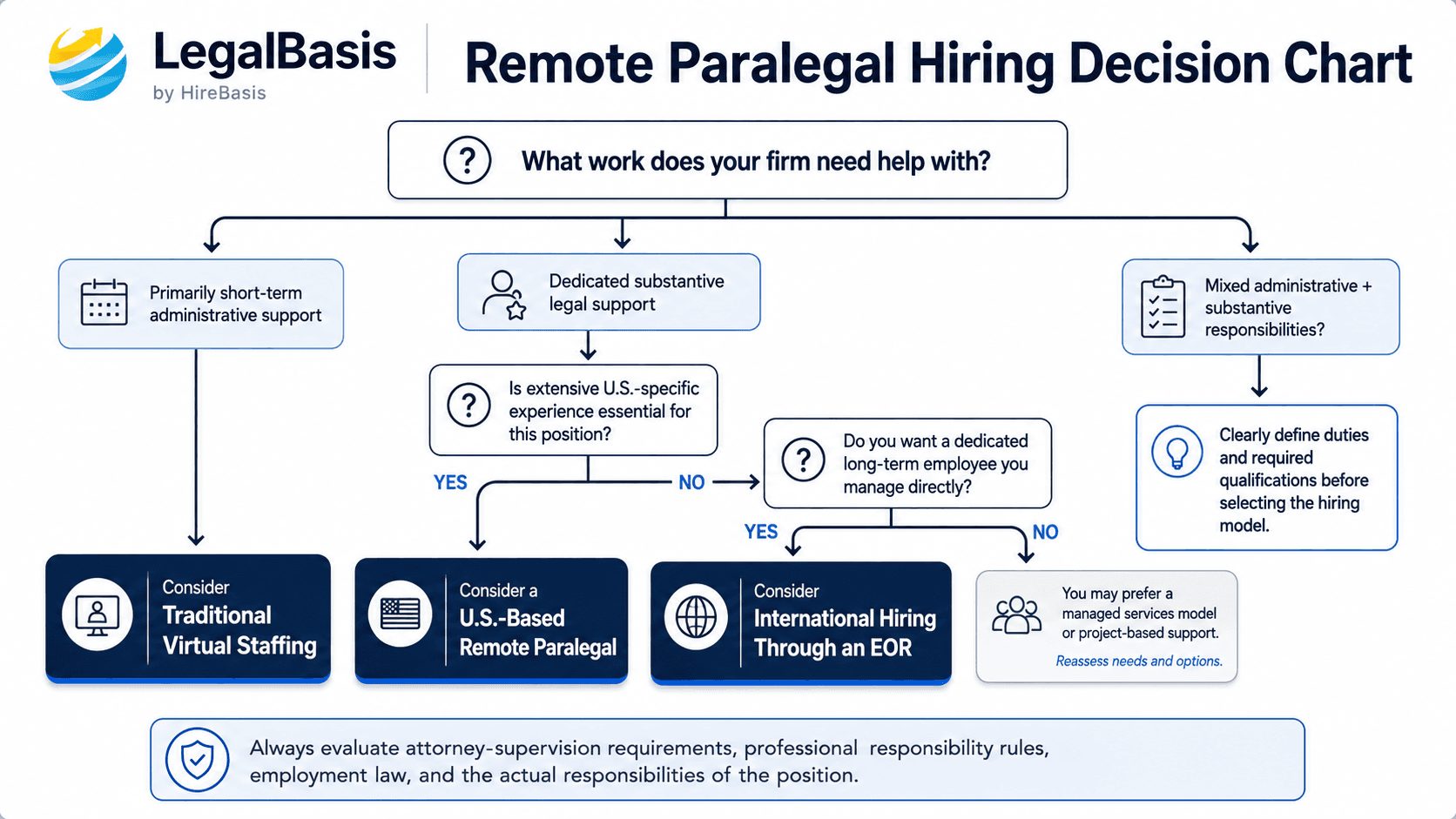
Ask yourself a simple question:
Where are attorneys spending too much time?
If attorneys spend hours:
Scheduling appointments
Answering emails
Managing calendars
Following up with clients
Organizing files
then a virtual legal assistant may provide the greatest immediate return.
If attorneys spend hours:
Drafting documents
Conducting research
Managing discovery
Preparing litigation materials
Organizing case strategy
then a remote paralegal is likely the better investment.
Can One Person Perform Both Roles?
Sometimes.
In smaller firms, one experienced professional may perform both administrative and substantive legal support.
However, as firms grow, separating these responsibilities often leads to:
Better efficiency
Clearer accountability
Improved specialization
Higher productivity
Easier scaling
Many successful firms eventually employ both positions as complementary members of the same legal team.
Domestic vs. International Hiring
Both virtual legal assistants and remote paralegals can be hired:
As U.S.-based remote employees
Through traditional virtual staffing companies
Internationally through an Employer of Record (EOR)
The hiring model affects employment compliance, payroll administration, and overall staffing costs—but it does not fundamentally change the responsibilities of the role.
Firms focused on long-term growth often choose dedicated international professionals through an Employer of Record because they retain direct management while simplifying local employment compliance.
Firms moving from ad hoc contractor support toward stable long-term staffing may also benefit from understanding when to switch from freelancers to full-time remote employees.
Frequently Asked Questions
Is a virtual legal assistant the same as a paralegal?
No. A virtual legal assistant generally focuses on administrative and operational support, while a remote paralegal performs substantive legal work under attorney supervision.
Can a virtual legal assistant draft legal documents?
Some may assist with standardized forms or document preparation, but substantive legal drafting is typically handled by a paralegal under attorney supervision.
Which role should a solo attorney hire first?
It depends on where time is being lost. If administrative work is limiting growth, begin with a virtual legal assistant. If legal production is the bottleneck, consider hiring a remote paralegal.
Can both roles work remotely?
Yes. Modern legal software allows both virtual legal assistants and remote paralegals to integrate effectively into a firm's daily operations regardless of location.
Final Thoughts
Virtual legal assistants and remote paralegals both play valuable roles in building an efficient law firm, but they solve different problems.
A virtual legal assistant helps keep the business running smoothly by handling administrative responsibilities, while a remote paralegal expands your firm's legal production capacity through substantive legal support.
Choosing the right role starts with understanding where your attorneys' time is best spent. Once that need is identified, selecting the appropriate hiring model—whether domestic, traditional virtual staffing, or international employment through an Employer of Record—becomes much easier. For firms that want help identifying the right position and recruiting candidates, LegalBasis hiring support is designed around that process.
About the Author
Hasan Abdullah is the Founder of LegalBasis and President & Principal Attorney of American Visa Law Group. LegalBasis grew out of his firsthand experience building and managing a U.S. law firm with both local and international team members.
Through that experience, he saw that law firms can expand capacity by recruiting talented professionals globally while still retaining control over who they hire, how those professionals are trained, and how the work is managed.
LegalBasis was built around that model: helping law firms define the roles they need, recruit qualified international professionals, and support compliant international employment structures where appropriate.
Continue Reading
More practical guidance for building a stronger legal team.

Remote Legal Staffing
Is Virtual Staffing Legit? Review and LegalBasis Comparison for Law Firms
Virtual Staffing is a legitimate legal staffing provider offering pre-vetted remote professionals to U.S. law firms. This review examines how its managed staffing model works, what it costs, its key strengths and limitations, and how it compares with LegalBasis for firms deciding between virtual staffing and directly managed global remote hiring.
Read Article →
Remote Legal Staffing
Is Stafi Legit? Remote Legal Staffing vs. LegalBasis
Is Stafi legit? This Stafi review examines its remote legal staffing services, training, 24/7 intake, pricing model, and reputation, then compares Stafi with LegalBasis to help law firms decide between managed virtual staffing and directly managed international remote hiring.
Read Article →

Remote Legal Staffing
Is LegalSoft Legit? Honest LegalSoft Review for Law Firms
Is LegalSoft legit? This LegalSoft review examines its virtual legal staffing model, current pricing, candidate pool, advantages, potential drawbacks, and how LegalSoft compares with LegalBasis for law firms considering international remote talent.
Read Article →
Build the Remote Team Your Law Firm Actually Needs.
Tell us what work your firm needs help with. LegalBasis can help define the role, recruit qualified international candidates, and explore an employment structure that fits your firm.