International Hiring
Hiring and Using Virtual Paralegals in US Law Firms: A Practical Guide
Hiring and using virtual paralegals in US law firms can help attorneys expand their talent pool, control staffing costs, and delegate more legal support work without sacrificing quality. Learn how to hire, supervise, secure, and integrate international remote paralegals effectively.
·
Founder, LegalBasis · President & Principal Attorney, American Visa Law Group
·
·
11 min read

Hiring and Using Virtual Paralegals in US Law Firms: A Practical Guide
For a growing law firm, one of the most expensive problems is not necessarily a lack of clients. It is having more legal work than attorneys and existing staff can efficiently handle.
Case files need to be organized. Documents need to be reviewed. Clients need updates. Deadlines need to be tracked. Research needs to be completed. Drafts need to be prepared for attorney review. Intake needs to keep moving.
When attorneys spend too much of their day handling work that could appropriately be delegated, the firm can lose both capacity and profitability.
That is why hiring and using virtual paralegals in US law firms has become a practical staffing option worth considering. A virtual paralegal can work from another city, another state, or another country while supporting the firm's attorneys through the same cloud-based case management, communication, document, and workflow systems already used by modern legal teams.
Remote does not automatically mean less qualified. International does not automatically mean lower quality.
The real question is whether the law firm hires the right person, defines the role correctly, protects confidential information, provides appropriate supervision, and builds a workflow in which that person can succeed.
What Is a Virtual Paralegal?
A virtual paralegal is a paralegal or legal support professional who performs appropriate legal support work remotely rather than working every day from the law firm's physical office.
Depending on the person's experience, the firm's practice area, applicable rules, and attorney supervision, responsibilities might include organizing case files, preparing document summaries, conducting research support, proofreading and formatting drafts, maintaining chronologies, assisting with discovery organization, communicating with clients about administrative matters, calendaring deadlines, maintaining case-management systems, and preparing materials for attorney review.
The U.S. Bureau of Labor Statistics describes paralegals and legal assistants as professionals who support lawyers with activities including maintaining files, conducting legal research, drafting documents, gathering facts, and organizing legal materials.
The important word is support.
A virtual paralegal does not replace the attorney responsible for the legal matter. Attorneys still decide legal strategy, provide legal advice, exercise professional judgment, and supervise work performed on their behalf.
There can also be meaningful differences between a paralegal and someone focused primarily on administrative support. Law firms unsure which role they need should first understand the distinction between a virtual legal assistant and remote paralegal.
Why US Law Firms Are Looking Beyond Their Local Hiring Market
Traditionally, a small or midsized law firm needing another paralegal might advertise within commuting distance of its office.
Remote work changes that equation.
That pressure is visible across the wider legal economy as well. Reuters reported that U.S. legal-sector employment had increased for an 18th consecutive month, with Fairfax Associates principal Kristin Stark describing legal work as “a high-opportunity and high-growth sector.” For growing firms, that means staffing strategy matters even in a strong market: demand for legal services can increase at the same time competition for capable support professionals becomes more intense.
Once the position does not require the employee to sit physically next to the attorney, the potential candidate pool becomes dramatically wider. Firms can recruit nationally and, for responsibilities that can appropriately be performed internationally, globally.
The hiring difficulty is not theoretical. Robert Half's 2026 research found that “61% of legal leaders say finding skilled professionals is more challenging than it was a year ago.” The same research found that 51% expected to add contract talent, which helps explain why legal employers are reconsidering rigid assumptions about where members of their teams must be located.
Expanding geographically therefore is not simply a strategy for reducing costs. It can also help a firm search a much larger talent pool.
A firm struggling with a difficult position can apply many of the same principles described in HireBasis's guide to recruiting for hard-to-fill roles: define the actual skills required, remove unnecessary restrictions, assess candidates consistently, and broaden sourcing when the local pool is too limited.
Can an International Virtual Paralegal Really Produce the Same Quality of Work?
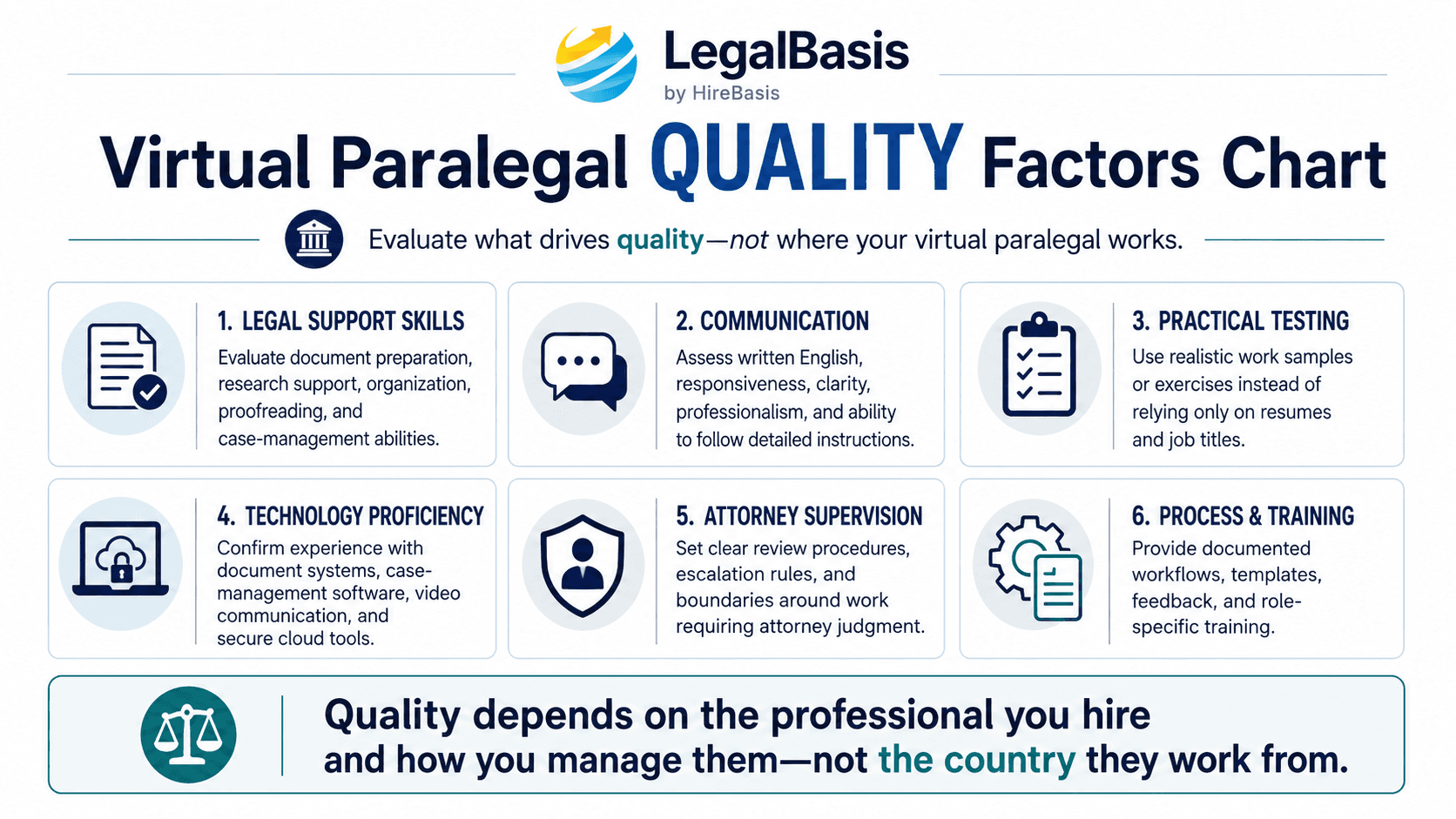
Yes, an international professional can produce work of the same standard as a domestic remote professional when the individual has the right skills, communication ability, experience, training, technology, and supervision.
Large U.S. firms have already demonstrated that physical location does not automatically determine whether legal professionals can contribute effectively. When Fennemore Craig introduced a formal remote program, CEO James Goodnow told Reuters, “We think other firms are making a huge mistake by requiring everyone, regardless of their circumstances, to come in the office.” At the time, the program included 35 remote legal professionals in addition to its remote lawyers.
Their location does not determine whether they are detail-oriented.
Their country does not determine whether they can follow instructions.
And their salary does not determine the quality of their written communication, organization, research ability, reliability, or capacity to learn a firm's processes.
Quality is primarily a hiring and management issue.
A weak hiring process can produce a poor employee five miles from the office. A strong hiring process can identify an excellent professional thousands of miles away.
Law firms considering international candidates should therefore resist hiring primarily on cost. Instead, candidates can be assessed using work samples, structured interviews, writing exercises, document-organization exercises, research assignments, communication assessments, references, technology proficiency, and practice-area-relevant experience where that experience can be verified.
If a role requires particular U.S. legal knowledge, filing experience, software familiarity, or other specialized experience, those qualifications should be assessed directly rather than assumed from a job title.
The purpose of global recruiting should be to expand the quality talent pool, not lower the hiring bar.
Why International Virtual Paralegals Can Be More Cost-Effective
The business case becomes especially interesting when a firm needs full-time support but finds traditional U.S. staffing expensive.
According to the U.S. Bureau of Labor Statistics, the median annual wage for paralegals and legal assistants was $61,010 in May 2024. That represents wages alone and does not by itself include every additional expense an employer may incur when employing staff.
International labor markets can have substantially different prevailing compensation levels and living costs.
As a result, a law firm may be able to offer a strong professional opportunity in another country at compensation that is competitive in that person's local market while still spending less than it might spend recruiting an equivalent position in a high-cost U.S. market.
That difference does not require the firm to accept inferior work.
The better model is to use the larger cost envelope intelligently: recruit carefully, hire for skills rather than the lowest possible salary, provide good equipment and software access, offer appropriate compensation in the professional's market, train the employee properly, and build a relationship intended to last.
For firms that have reached the point where recurring work justifies a dedicated hire, HireBasis also explains when switching from freelancers to full-time remote employees may make more operational sense.
What Work Can a Virtual Paralegal Handle?
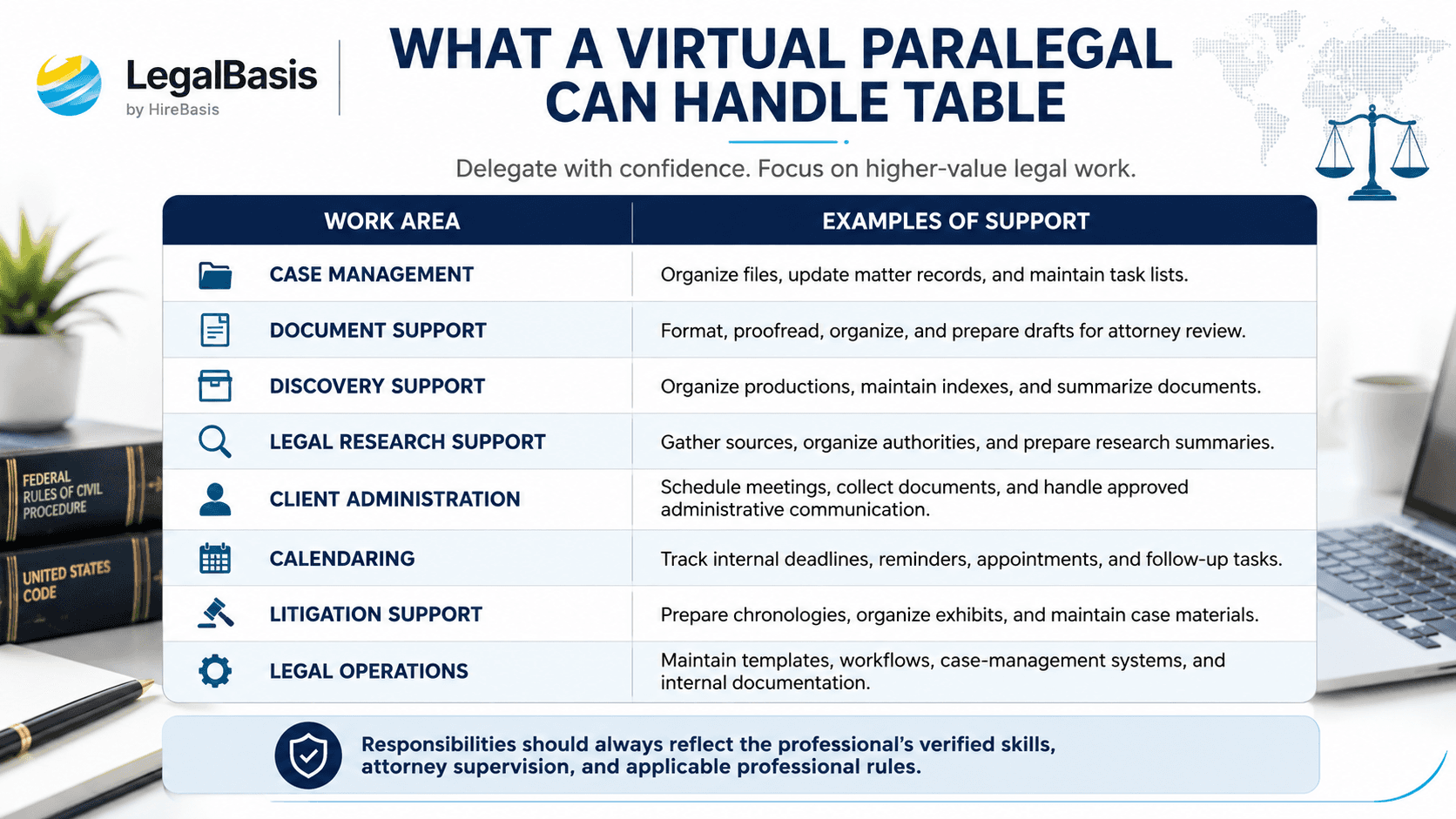
The exact responsibilities should depend on the candidate's verified abilities, the firm's practice area, attorney supervision, applicable professional rules, and the requirements of the relevant jurisdiction.
A virtual paralegal may potentially support work involving:
Area | Examples of Support |
|---|---|
Case management | Organizing files, updating matter records, maintaining task lists |
Document support | Formatting, proofreading, organizing and preparing drafts for attorney review |
Discovery | Organizing productions, maintaining indexes, summarizing documents |
Research support | Gathering sources, preparing research summaries, organizing authorities |
Client administration | Scheduling, collecting documents, sending attorney-approved administrative communications |
Calendaring | Maintaining internal deadlines and reminders |
Intake | Organizing prospective-client information and following established intake procedures |
Litigation support | Preparing chronologies, exhibit organization and case-file maintenance |
Transactional support | Organizing contracts, checklists, closing materials and document repositories |
Legal operations | Maintaining templates, workflows, case-management systems and internal documentation |
Not every remote role requires a paralegal. Intake specialists, legal administrative professionals, bookkeepers, marketing staff, case coordinators, and other positions may also be performed remotely depending on the firm. LegalBasis has a broader guide to law firm roles that can be performed remotely.
The Ethical Responsibilities Do Not Disappear Because Someone Works Remotely
This is one of the most important parts of hiring internationally.
A U.S. lawyer cannot simply delegate work and delegate responsibility along with it.
The American Bar Association's guidance on outsourced paralegal services emphasizes attorney supervision, confidentiality, conflicts, and avoiding unauthorized practice of law concerns.
ABA Model Rule 5.3 also addresses lawyers' responsibilities regarding nonlawyer assistance, including reasonable efforts to ensure that the person's conduct is compatible with the lawyer's professional obligations. Applicable state rules and ethics opinions must ultimately be reviewed because the ABA Model Rules themselves are models rather than the controlling rules in every jurisdiction.
In practice, firms should establish clear boundaries around what the employee may do, what requires attorney review, what communications require approval, how confidential information is accessed, and what should be escalated immediately.
An internationally based employee should not be presented to clients as a U.S.-licensed attorney or permitted to independently provide legal advice.
The attorney remains the attorney.
Protecting Client Confidentiality With an International Team
Physical distance does not have to mean weak security.
A well-managed remote environment can use tightly controlled access to firm systems rather than scattering files across individual computers and email accounts.
Firms should consider controls such as multifactor authentication, company-managed accounts, role-based permissions, secure document-management systems, approved communication channels, password-management policies, confidentiality agreements, device requirements, restrictions on local downloads, and clear procedures for removing access when an employee leaves.
The same principle applies when scaling the team. HireBasis's guide to scaling an offshore team without losing qualityemphasizes documented processes, structured communication, measurable expectations, and deliberate management rather than simply adding people.
Legal practices should apply an even higher level of discipline because the information involved may be privileged, confidential, commercially sensitive, or personally identifiable.
Employee, Contractor, or Employer of Record?
Hiring someone abroad can create another important question: How will that person legally work for the firm?
A professional working full time under a firm's direction should not automatically be labeled an independent contractor simply because they live overseas.
Worker classification depends on applicable law and the actual working relationship.
HireBasis provides a broader explanation of contractor versus employee considerations for remote workers, while firms considering direct international employment should also understand the potential legal risks of hiring overseas employees without an EOR.
One potential structure is an Employer of Record.
An EOR generally employs the worker locally and handles relevant employment administration while the law firm directs the professional's day-to-day work. Firms unfamiliar with this arrangement can read LegalBasis's explanation of what an Employer of Record is.
The appropriate structure depends on the country, working relationship, duration of the engagement, and legal advice applicable to the firm. Payment is also only one part of international employment; HireBasis has a separate guide covering how to pay remote employees internationally.
How to Hire a High-Quality International Virtual Paralegal
Successful international hiring begins with the job description.
Instead of starting with a generic title such as "virtual paralegal," write down what the person will actually be expected to do each week.
A litigation practice may need someone exceptional at document organization, chronologies, discovery support, case-management software, and deadline tracking.
An immigration practice may prioritize document collection, client communication, form preparation support, case-file management, and attention to detailed processes.
An estate planning practice might prioritize document preparation support, proofreading, client coordination, data organization, and maintaining repeatable workflows.
Once the requirements are clear, recruiting should test them directly.
A strong hiring process might include resume screening, a structured interview, English communication assessment where relevant, a practical skills exercise, technology assessment, reference checking, and a final interview with the attorney who will actually supervise the employee.
LegalBasis has a dedicated guide explaining how to hire a remote paralegal from role definition through onboarding.
Do Not Hire Someone Just Because They Are Cheaper
International recruiting creates a dangerous temptation: comparing applicants primarily by salary.
That can defeat the entire purpose.
A $1,000-per-month employee who requires constant corrections, misses deadlines, communicates poorly, or leaves after two months is not cheaper than a stronger employee who costs more.
Law firms should evaluate the total value produced by a candidate.
Can this person remove meaningful work from an attorney's day?
Can they learn?
Can they follow detailed processes?
Can they communicate clearly?
Can they recognize when something needs attorney review rather than making an assumption?
Can they become more valuable six months after joining than they were on day one?
Those questions are much more important than finding the lowest possible monthly number.
Managing a Virtual Paralegal Like a Real Member of the Firm
Another mistake is treating international professionals like anonymous outsourced labor.
Remote work is also no longer unusual among paralegals themselves. NALA reported that “approximately 71% of paralegals have some type of flexible work arrangement, such as hybrid or remote work.” That does not mean every paralegal role should be remote, but it does show that managing legal support outside a traditional five-day office environment has already become familiar across the profession.
A dedicated virtual paralegal works better when integrated into the firm's operations.
They should understand who they report to, how tasks are assigned, what deadlines mean, where documents belong, when questions should be asked, how work will be reviewed, and what success looks like.
Regular one-on-one meetings can help. So can written standard operating procedures, shared task systems, documented templates, structured feedback, and clear response-time expectations.
Remote employees should also know the people with whom they work.
Even simple practices such as including remote staff in appropriate team meetings, sharing firm updates, recognizing strong work, and creating opportunities for professional growth can help turn a remote hire into a long-term member of the organization.
For additional ideas, HireBasis's guide to virtual team building for remote employers covers ways managers can strengthen communication and connection across distributed teams.
Time Zones Can Be an Advantage—or a Problem
International hiring creates another variable that domestic hiring may not: time-zone differences.
For many law firms, several hours of overlap with U.S. business hours may be necessary for client communication, attorney collaboration, hearings, deadlines, or urgent assignments.
That requirement should be stated before hiring.
Some professionals prefer working hours aligned with U.S. teams. Others may provide a partial overlap. In certain roles, asynchronous work may be perfectly acceptable.
The right model depends on the firm.
What matters is establishing the expectation before the employment relationship begins rather than discovering afterward that the attorney and paralegal are rarely online at the same time.
Virtual Paralegals Are Not a Replacement for Attorneys
International remote staffing works best when firms delegate the right work rather than trying to transfer attorney responsibility.
Attorneys remain responsible for legal strategy, legal advice, professional judgment, client representation, and work that applicable rules reserve for licensed lawyers.
A virtual paralegal's value comes from giving attorneys more time to perform those higher-value activities.
Imagine an attorney beginning the morning with the relevant documents organized, a chronology updated, requested client records properly saved, routine case-management information current, and research sources collected for review.
The attorney still makes the legal decisions.
But the attorney no longer has to personally perform every operational step required to reach those decisions.
That is leverage.
A Domestic and International Team Can Work Together
Law firms do not necessarily have to choose between an American team and an international team.
A hybrid staffing model can be extremely practical.
A firm might maintain attorneys and certain senior or client-facing positions domestically while adding international professionals for appropriate remote support functions. Other firms may maintain an experienced U.S. paralegal and build additional international capacity around that person.
The objective is not to replace an existing team merely because workers elsewhere cost less.
It is to determine which work genuinely requires local presence, which work requires specialized U.S. experience, which responsibilities can be trained, and which positions can be performed effectively from anywhere.
LegalBasis's hybrid hiring model is built around giving firms flexibility rather than assuming every position should be filled in the same way.
How LegalBasis Helps Law Firms Hire International Professionals
LegalBasis helps attorneys and law practices recruit remote international professionals for appropriate positions within their firms.
The law firm remains in control of the hiring decision.
Rather than being handed an unknown worker, the firm can define what it needs, interview candidates, evaluate their experience, choose whom it wants to hire, train the person according to its procedures, and manage their work directly.
LegalBasis assists with the recruiting process and can help coordinate an appropriate international employment structure, including through an Employer of Record where appropriate.
That distinction matters.
The goal is not temporary task outsourcing in which work disappears into an external company and returns completed.
The goal is to help a firm identify a dedicated professional who can become part of its team.
Firms interested in that process can learn more about LegalBasis's international hiring support.
Is Hiring an International Virtual Paralegal Right for Your Firm?
It may make sense if attorneys are routinely performing delegable work, the local candidate market is limited, the firm needs additional capacity but wants to control staffing costs, most responsibilities can be performed through digital systems, and the firm is prepared to properly train and supervise a remote employee.
It may make less sense when the position requires frequent physical court attendance, regular handling of original materials that cannot be digitized, substantial in-person responsibilities, or credentials and experience that the available candidates cannot demonstrate.
Remote hiring should never be forced onto a role simply because it appears cheaper.
Start with the work.
Then determine where the person performing that work actually needs to be.
Frequently Asked Questions
Can a US law firm hire a paralegal who lives in another country?
Potentially, yes. Firms can employ or engage professionals internationally, but the appropriate employment structure, tax, labor, classification, confidentiality, supervision, and professional-responsibility requirements should be evaluated for the specific circumstances.
Are international virtual paralegals qualified to work for US law firms?
Some are and some are not—just as with domestic candidates. Firms should verify each candidate's education, experience, skills, English proficiency where relevant, technology ability, references, and any specific legal experience required by the position rather than making assumptions based on location.
Can a virtual paralegal give clients legal advice?
A nonlawyer paralegal should not independently provide legal advice. The supervising attorney should establish clear limits around communications, assignments, and work requiring attorney judgment, consistent with applicable professional rules. ABA guidance also emphasizes supervision of outsourced nonlawyer professionals.
Are international virtual paralegals cheaper than US paralegals?
They can be more cost-effective because compensation levels vary significantly between labor markets. However, firms should compare total employment costs and candidate quality rather than hiring solely on the lowest salary.
How should a law firm supervise a virtual paralegal?
The same management fundamentals apply remotely: defined responsibilities, clear attorney supervision, controlled system access, documented procedures, deadlines, regular communication, work review, feedback, and escalation rules.
Should a virtual paralegal be an independent contractor?
Not automatically. Classification depends on the actual relationship and applicable laws. A firm should evaluate whether employment, independent contracting, or an EOR arrangement is appropriate rather than choosing a classification based simply on convenience.
Final Thoughts
Hiring and using virtual paralegals in US law firms is not fundamentally about finding the cheapest person who can complete legal tasks.
It is about expanding where a law firm searches for talent.
An excellent professional does not stop being excellent because they live outside the United States. With careful recruiting, appropriate role design, direct attorney supervision, strong security practices, compliant employment arrangements, and proper integration into the firm, an international virtual paralegal can become a valuable long-term part of a U.S. legal team.
The strongest firms will not ask only, "How much can we save?"
They will ask a better question:
How much more could our attorneys accomplish if the right person were handling the work they should no longer be doing?
About the Author
Hasan Abdullah is the Founder of LegalBasis and President & Principal Attorney of American Visa Law Group. After building and managing a growing U.S. law firm with both domestic and international team members, he founded LegalBasis to help law firms recruit, manage, and scale high-performing legal teams.
Drawing on firsthand experience with international staffing, Employer of Record (EOR) solutions, and law firm operations, Hasan writes about practical strategies that help firms grow while maintaining compliance, operational control, and exceptional client service.
Continue Reading
More practical guidance for building a stronger legal team.

Remote Legal Staffing
Is Virtual Staffing Legit? Review and LegalBasis Comparison for Law Firms
Virtual Staffing is a legitimate legal staffing provider offering pre-vetted remote professionals to U.S. law firms. This review examines how its managed staffing model works, what it costs, its key strengths and limitations, and how it compares with LegalBasis for firms deciding between virtual staffing and directly managed global remote hiring.
Read Article →
Remote Legal Staffing
Is Stafi Legit? Remote Legal Staffing vs. LegalBasis
Is Stafi legit? This Stafi review examines its remote legal staffing services, training, 24/7 intake, pricing model, and reputation, then compares Stafi with LegalBasis to help law firms decide between managed virtual staffing and directly managed international remote hiring.
Read Article →

Remote Legal Staffing
Is LegalSoft Legit? Honest LegalSoft Review for Law Firms
Is LegalSoft legit? This LegalSoft review examines its virtual legal staffing model, current pricing, candidate pool, advantages, potential drawbacks, and how LegalSoft compares with LegalBasis for law firms considering international remote talent.
Read Article →
Build the Remote Team Your Law Firm Actually Needs.
Tell us what work your firm needs help with. LegalBasis can help define the role, recruit qualified international candidates, and explore an employment structure that fits your firm.