Remote Legal Staffing
Is LegalSoft Legit? Honest LegalSoft Review for Law Firms
Is LegalSoft legit? This LegalSoft review examines its virtual legal staffing model, current pricing, candidate pool, advantages, potential drawbacks, and how LegalSoft compares with LegalBasis for law firms considering international remote talent.
·
Founder, LegalBasis · President & Principal Attorney, American Visa Law Group
·
·
12 min read

Is LegalSoft Legit? Honest LegalSoft Review for Law Firms
If you are researching virtual legal staffing, there is a good chance Legal Soft—also commonly searched as “LegalSoft”—has appeared on your radar.
The company makes a compelling pitch: pre-vetted virtual legal professionals, more than 10 legal roles, fast placement, built-in staffing support, and substantially lower costs than hiring comparable employees domestically.
So, is LegalSoft legit?
Based on the public information available today, yes. Legal Soft appears to be a legitimate, established virtual legal staffing company with a real operating history, published pricing, an active talent platform, and a substantial presence in the legal industry.
The more useful question for law firms is not whether LegalSoft is legitimate.
It is whether LegalSoft's managed virtual staffing model is the right staffing model for your firm—or whether you would be better served by recruiting a remote professional who becomes a more directly integrated member of your own team.
That is where LegalSoft and LegalBasis begin to look quite different.
Disclosure: LegalBasis is itself a legal staffing company and therefore competes with Legal Soft. This review is intended to compare the two models fairly. LegalSoft's service descriptions, pricing, placement figures, and performance statistics referenced below are attributed to LegalSoft's publicly available materials rather than presented as independently verified results.
The Short Answer: Is LegalSoft Legit?
Yes.
LegalSoft is not an anonymous virtual-assistant website with no visible organization behind it.
LegalSoft says it was founded in 2015 and currently works with more than 1,000 law firms. Its website says its platform has facilitated more than 2,500 virtual-staff placements and currently gives firms access to 600+ pre-screened candidates.
There are also independent signs that the company has been operating for years. The Better Business Bureau lists Legal Soft Solution as having approximately 10 years in business and identifies Hamid Kohan as CEO/owner. It is worth noting that the business is not BBB accredited and is currently not rated by BBB because BBB says it lacks sufficient information to issue a rating. BBB accreditation itself is voluntary, so lack of accreditation is not evidence that a company is illegitimate. Legal Soft's Better Business Bureau profile
LegalSoft also maintains current pricing, client testimonials, staffing profiles, events, media appearances, and an active staffing platform.
So if the question is simply, “Is LegalSoft a real company?” the answer is clearly yes.
Whether it offers the best structure for your particular law firm requires a deeper look.
What Is LegalSoft?
LegalSoft is a managed virtual legal staffing provider.
Law firms can select from pre-vetted professionals for positions such as:
Legal Assistant
Intake Specialist
Document Collector
Lien Negotiator
Bookkeeper
Case Manager
Paralegal
Demand Writer
Marketing Specialist
Remote Attorney
Unlike a generic virtual-assistant service, LegalSoft is focused specifically on the legal industry.
Its website says candidates are trained for legal environments and may already have experience with functions such as client intake, calendaring, document management, legal research, case management, and legal software.
There is also an important distinction between LegalSoft and some traditional VA companies: LegalSoft allows firms to view and choose from its candidate pool rather than simply accepting an unidentified assistant assigned by an agency.
That makes its model more attractive to firms that still want some control over who joins their team.
LegalSoft then provides much of the surrounding staffing infrastructure. According to the company, it handles HR, onboarding, payroll, and ongoing support, while its platform lets law firms monitor hours, tasks, performance, invoices, bonuses, and other staffing functions.
This is a legitimately useful model—especially for firms that do not want to build international hiring infrastructure themselves.
LegalSoft Pricing in 2026
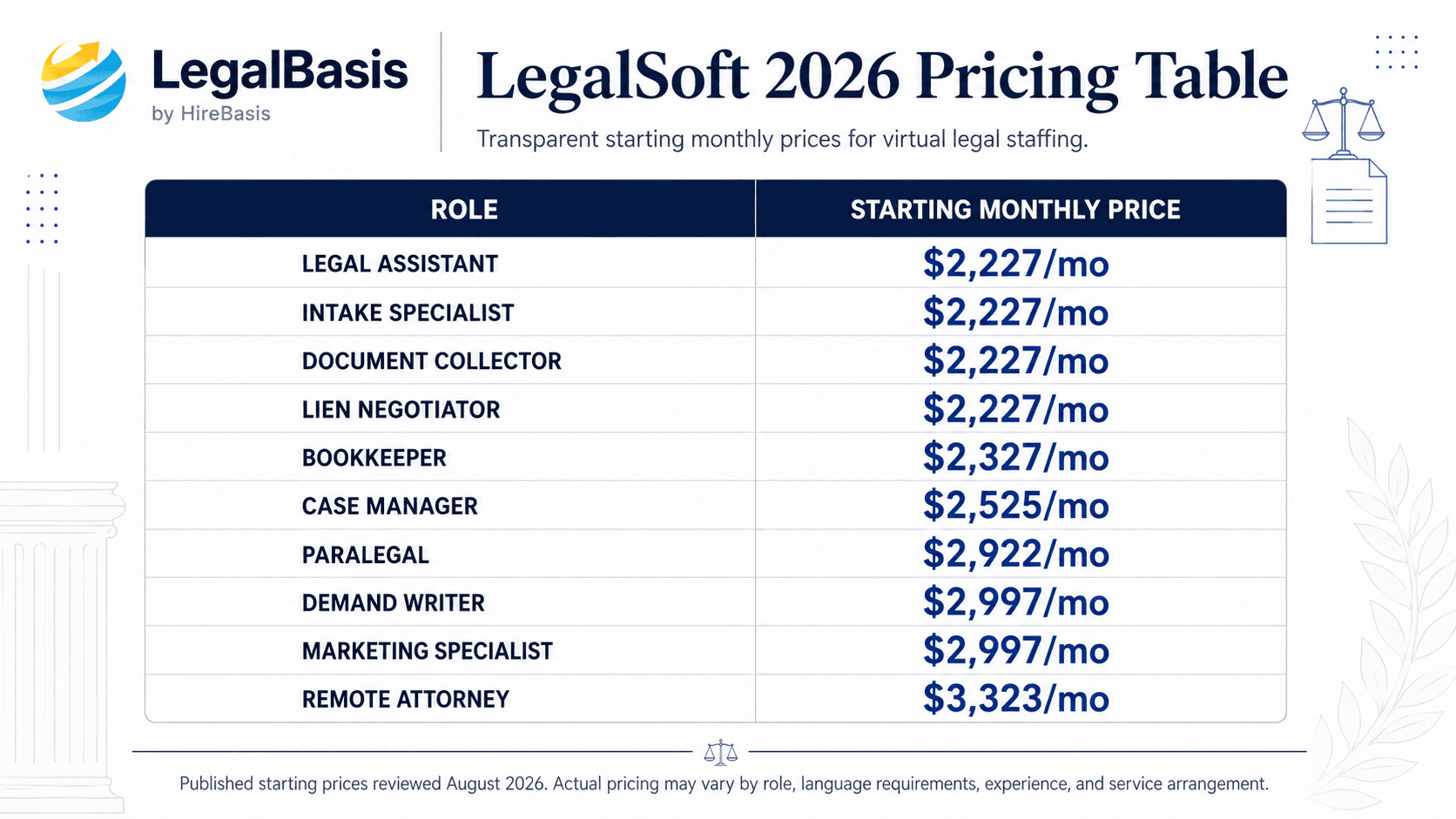
One thing LegalSoft does particularly well is make its starting prices relatively easy to understand.
As of August 2026, its published starting monthly pricing includes:
Role | LegalSoft Starting Price |
|---|---|
Legal Assistant | $2,227/month |
Intake Specialist | $2,227/month |
Document Collector | $2,227/month |
Lien Negotiator | $2,227/month |
Bookkeeper | $2,327/month |
Case Manager | $2,525/month |
Paralegal | $2,922/month |
Demand Writer | $2,997/month |
Marketing Specialist | $2,997/month |
Remote Attorney | $3,323/month |
LegalSoft says these are flat monthly rates and that firms are not charged setup fees or unexpected additional fees. It also advertises month-to-month flexibility rather than requiring a long-term commitment.
Bilingual candidates may cost more. For example, LegalSoft currently lists a full-time English legal assistant at $2,227 per month and a bilingual option at $2,527 per month.
LegalSoft also advertises staffing starting at approximately $12 per hour on its pricing page.
For firms that want a predictable staffing bill, this simplicity is a real advantage.
Why Virtual Legal Staffing Has Become So Popular
LegalSoft's growth is part of a much bigger change in the legal industry.
Law firms are under pressure to handle more work without allowing staffing expenses to consume every additional dollar of revenue.
That pressure has not disappeared because of artificial intelligence.
In fact, the opposite has happened so far.
In July 2026, Reuters reported that U.S. legal-sector employment had reached an all-time high for the third consecutive month, with 1,243,500 legal-sector jobs recorded in June.
When asked whether AI-driven legal job cuts had arrived, legal recruiter Justine Donahue told Reuters, “We're not there yet.” She later summarized the strength of the market even more simply: “Deals are up and money is flowing.” Reuters: U.S. legal sector jobs continued to climb in June 2026
In other words, technology may change what people do, but law firms still need people.
The question is how those people should be organized.
LegalSoft's Model: Managed Virtual Staffing
The biggest advantage of LegalSoft is convenience.
A firm can identify a relatively standard role, choose among pre-vetted professionals, and potentially begin working with someone quickly.
LegalSoft advertises placements in less than three days.
That is considerably faster than a conventional recruiting process.
LegalSoft is therefore especially compelling when the problem sounds like:
“We need an intake specialist now.”
or:
“We need another case manager, and I don't want to spend the next six weeks recruiting one.”
LegalSoft has already built the candidate pool, screening process, infrastructure, billing system, and support layer.
Its virtual professionals can then operate as dedicated staff for the law firm while LegalSoft remains involved behind the scenes.
The Philosophy Behind LegalSoft Makes Sense
Interestingly, LegalSoft founder Hamid Kohan has articulated a view of legal operations that is difficult to disagree with.
In a June 2026 interview discussing AI and law-firm operations, Kohan said:
“The biggest opportunity in AI is not replacing professionals. It is reducing operational friction so professionals can focus on higher-value work.” Authority Magazine interview with Legal Soft founder Hamid Kohan
That principle applies just as well to staffing.
A partner should not be spending half the day chasing documents, organizing calendars, following up with leads, fixing CRM records, or performing administrative work someone else could competently handle.
The right staffing structure creates leverage.
And that is not merely a staffing-company talking point.
In August 2026, the Thomson Reuters Institute reported that law-firm associate demand leverage had reached historically high levels. Its analysis concluded that “firms are increasingly structuring themselves around non-equity leverage rather than treating those FTEs as a temporary response to demand.” Thomson Reuters Institute: Law firm leverage breaks a 17-year record
Although that analysis primarily concerns lawyers at larger firms, the underlying management principle translates well to smaller practices:
The highest-value people in a firm should not be doing every task themselves.
LegalSoft vs. LegalBasis: What Is Actually Different?
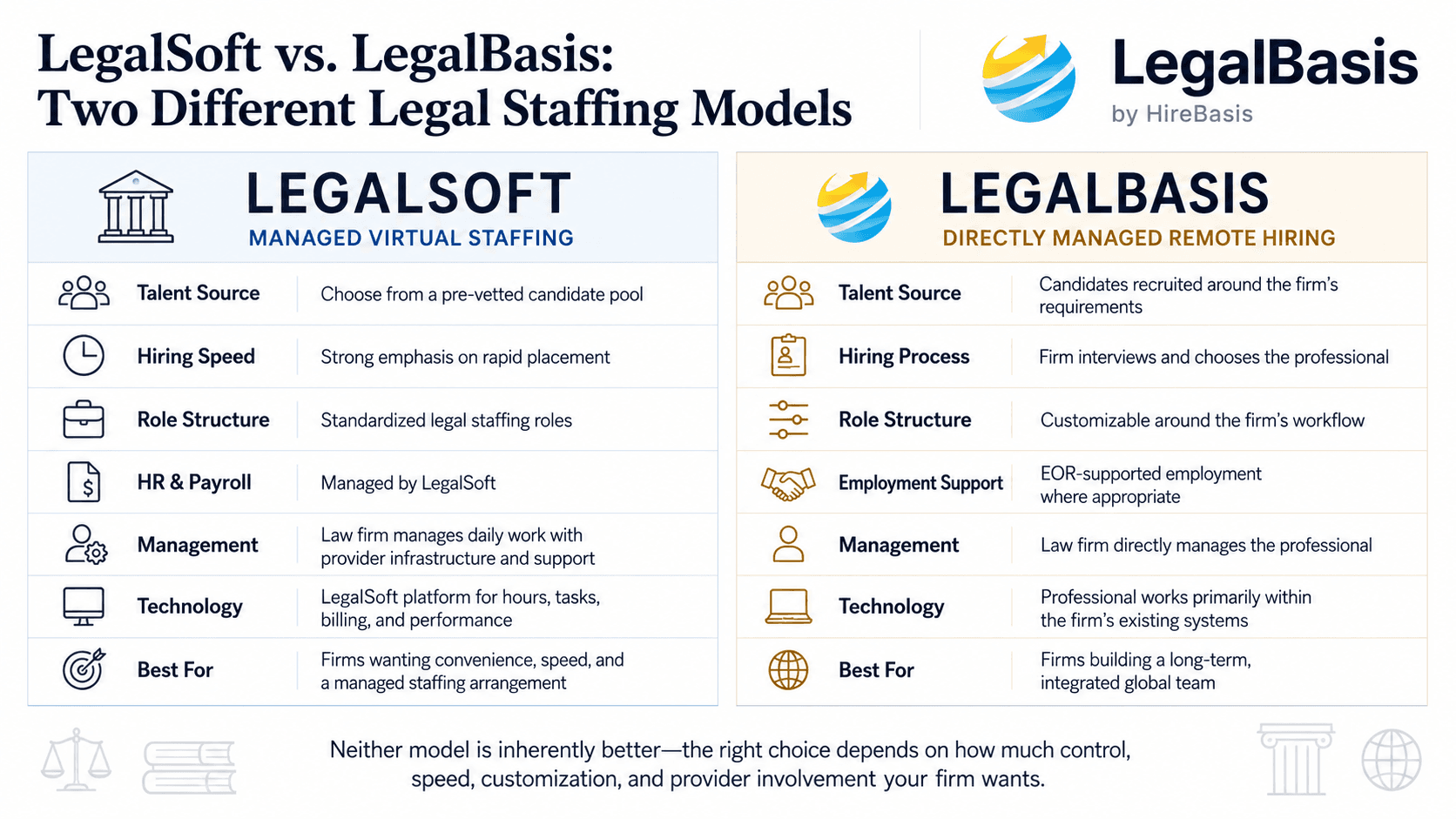
This is where the comparison becomes more interesting.
Both companies can help a U.S. law firm add international remote talent.
But they approach the problem differently.
LegalSoft | LegalBasis | |
|---|---|---|
Primary model | Managed virtual staffing | International remote hiring |
Candidate sourcing | Select from existing pre-vetted talent pool | Candidates recruited and screened around your firm's role |
Candidate selection | Firm chooses among available candidates | Firm interviews and chooses candidates |
Day-to-day management | Law firm manages work, with LegalSoft support/infrastructure around the placement | Law firm directly manages professional inside its own systems |
HR/payroll | LegalSoft handles HR, onboarding, payroll and support | EOR-supported employment where available |
Systems | LegalSoft staffing platform plus firm's legal systems | Primarily firm's existing systems and workflows |
Pricing model | Predetermined monthly staffing rates | Candidate compensation + employment/EOR costs |
Speed | Strong emphasis on very rapid placement | Search is customized around the firm's requirements |
Role structure | Defined virtual legal staffing positions | Role can be designed around the firm's actual workflow |
Best fit | Firms wanting a managed, fast, standardized staffing solution | Firms wanting to build a directly managed global team |
Neither model is inherently better.
They solve slightly different problems.
Where LegalSoft Has the Advantage
1. LegalSoft is extremely easy to understand
Pick a position.
See a starting monthly price.
Interview available candidates.
Hire.
That simplicity matters.
Not every law-firm owner wants to think about compensation benchmarks in Argentina versus Colombia versus Bosnia versus the Philippines, international employment structures, EOR arrangements, or recruiting strategy.
Some simply want another paralegal.
LegalSoft makes that process straightforward.
2. LegalSoft may be faster for standard roles
LegalSoft advertises being able to place virtual personnel in less than three days.
If an experienced intake specialist or legal assistant is already sitting in its candidate pool and matches the firm's requirements, there is little reason to launch an entirely new recruiting search.
For firms hiring common, repeatable positions, maintaining a large ready-made talent pool is a meaningful advantage.
3. LegalSoft provides more staffing infrastructure
LegalSoft's platform allows firms to manage functions including hours, tasks, performance, billing, raises, and bonuses.
For law firms that want their staffing provider to remain actively involved, that is valuable.
LegalSoft also says it can quickly replace a virtual assistant when a placement is not the right fit.
This is one reason a managed VA model remains attractive: there is a company standing between the firm and much of the employment administration.
4. The company understands law-firm workflows
This is not a general VA service attempting to sell assistants to dentists, ecommerce companies, real-estate agents, accountants, and lawyers simultaneously.
LegalSoft focuses heavily on law firms.
Its published candidate roles include positions as specific as lien negotiators, demand writers, legal case managers, paralegals, and remote attorneys.
That specialization can reduce the learning curve.
Where LegalBasis Is Different
LegalBasis starts from a different question.
Instead of:
“Which LegalSoft position do you need?”
the process is closer to:
“What work needs to get done inside your firm, and what person should we recruit to do it?”
That distinction can become important as a remote team matures.
A virtual legal assistant and a remote paralegal may initially appear interchangeable. In practice, differences in responsibility, experience, substantive legal work, compensation, and supervision can become significant.
LegalBasis therefore focuses on helping the firm define the role and then recruiting around it.
You can also review which law-firm roles can realistically be performed remotely before determining what should remain with the firm's local core team.
LegalBasis Is Designed Around Building Your Team
The simplest way to describe the difference is this:
LegalSoft helps you add managed virtual staff.
LegalBasis helps you recruit an international employee-like team member whom your firm selects and manages directly, supported by EOR infrastructure where appropriate.
Under the LegalBasis hybrid staffing model, attorney judgment, supervision, leadership, and core client relationships remain with the local firm.
Remote professionals then provide capacity where physical presence is unnecessary.
That could include:
paralegal support,
legal administration,
case management,
intake,
reception,
bookkeeping,
marketing,
operations,
or firm-specific positions that do not fit neatly into a standardized VA category.
For firms considering more substantive legal support, our guide on how to hire a remote paralegal covers the process in more detail.
The Biggest Difference May Be What Happens After Year One
A standard virtual-assistant arrangement can work extremely well when the job remains relatively stable.
But good employees rarely remain static.
Imagine hiring someone primarily for client intake.
Six months later, she understands the firm's CRM, clients, referral sources, workflows, scheduling process, and reporting.
A year later, perhaps she is supervising another intake employee.
Eventually, she might be closer to an intake manager or operations coordinator than the “virtual intake specialist” originally hired.
That progression is easier when the organization thinks of the worker as part of the firm's own team rather than as a fixed outsourced service.
This is the logic behind LegalBasis's approach to remote hiring.
The staffing provider helps make the match and provides employment infrastructure.
The law firm builds the relationship.
For businesses moving beyond temporary or narrowly scoped outsourced work, a similar decision often appears when determining when to switch from freelancers to full-time remote employees.
What About Cost?
This may be the largest practical difference.
LegalSoft's pricing includes a staffing-services layer.
For example, its published starting prices are:
$2,227/month for a legal assistant
$2,525/month for a case manager
$2,922/month for a paralegal
$3,323/month for a remote attorney
LegalBasis instead structures international hiring around the actual compensation required to hire the selected professional, plus applicable employment and EOR support.
LegalBasis currently provides an illustrative receptionist example of approximately:
$1,040/month in remote compensation
plus
$350/month in EOR and employment support
for an illustrative total of approximately:
$1,390/month.
That should not be interpreted as a universal LegalBasis price. Salaries vary substantially according to country, position, English proficiency, specialization, experience, schedule, benefits, and market conditions.
Likewise, LegalSoft's advertised savings should be treated as marketing estimates rather than guarantees. LegalSoft currently advertises 60% savings compared with local hiring and a 40% increase in profits reported by law firms. Firms should model their own economics before relying on either number.
Why the Cheapest Person Is Not Always the Cheapest Hire
Global hiring can generate dramatic savings.
But optimizing exclusively for the lowest hourly rate is usually a mistake.
Communication ability, relevant experience, turnover, training time, management burden, reliability, legal-software familiarity, security, and cultural fit all affect the true cost of a hire.
The objective should be to find the strongest employee the firm's budget can support—not simply the lowest-priced candidate available.
This is particularly important for hard-to-fill positions, where a broader international search can create access to candidates a local labor market might not provide.
Remote Staff Still Require Attorney Supervision
Whether a firm chooses LegalSoft, LegalBasis, an independent contractor, or an ordinary domestic employee, outsourcing does not outsource the lawyer's ethical responsibilities.
The American Bar Association's guidance on nonlawyer assistants points lawyers back to Model Rule 5.3 and emphasizes appropriate instruction, supervision, confidentiality, and responsibility for work product. ABA guidance on lawyers' use of legal assistants
This becomes even more important as law firms combine remote staff with artificial intelligence.
A striking example surfaced in May 2026, when attorney Jason Greaves apologized after AI-generated “phantom” quotations appeared in a federal filing. His firm's managing partner described the incident as “unacceptable, inexcusable, and an embarrassment to this firm.” Reuters: Lawyer apologizes for phantom AI quotations
The lesson is broader than AI.
Technology, virtual assistants, paralegals, overseas professionals, and outside vendors can all increase capacity.
Attorney supervision and quality control still belong to the law firm.
Technology Is Changing Staffing—Not Eliminating It
There is sometimes an assumption that firms should avoid hiring because AI will soon perform most administrative and legal-support work.
Current industry activity suggests a more complicated future.
Just this week, Google expanded Gemini Enterprise specifically for law firms and lawyers. Major firms including Weil Gotshal, Cleary Gottlieb, Freshfields, and Williams & Connolly are collaborating with Google on legal AI initiatives. Cleary managing partner Jeffrey Karpf said the collaboration would let the firm “be involved in the creation of useful tools for law firms deploying AI.” Reuters: Google expands Gemini Enterprise for law firms
Yet legal employment has simultaneously reached record levels.
That suggests firms may increasingly build teams in which technology handles repetitive work while people handle communication, judgment, review, supervision, strategy, and increasingly complex workflows.
Even small firms are taking a measured approach.
Clio's research found that smaller firms are experimenting with AI, virtual receptionists, automation, and other technologies selectively rather than replacing their teams wholesale. Clio Lawyer-in-Residence Joshua Lenon explained: “They're not ignoring AI, they're simply prioritizing tools that make sense for their practice models.” Clio's Legal Trends for Solo and Small Law Firms report
The same principle should guide staffing.
Choose the structure that makes sense for your practice model.
LegalSoft Pros and Cons
Pros
Legal-specific staffing
LegalSoft is purpose-built around law firms rather than general administrative outsourcing.
Large candidate pool
The company advertises 600+ pre-vetted candidates and more than 10 specialized legal positions.
Fast placement
LegalSoft advertises placement in less than three days for available positions.
Straightforward pricing
Published monthly starting prices make budgeting relatively easy.
Provider-managed infrastructure
LegalSoft handles payroll, HR, onboarding, and ongoing staffing support.
Built-in platform
Firms can monitor time, tasks, performance, invoices, bonuses, and related staffing activity.
Replacement flexibility
The company says it can provide replacements if a VA is not the right fit.
No long-term lock-in
LegalSoft says firms can scale staffing up or down without long-term contracts.
Potential Drawbacks
You are paying for a managed staffing layer
The convenience, recruiting, infrastructure, training, platform, support, and replacement model are incorporated into what the firm pays.
Candidate selection begins with LegalSoft's existing pool
That is excellent for speed but different from opening a search across a broader international talent market specifically for your firm's requirements.
Standardized roles may not fit every firm
A rapidly evolving position may eventually extend beyond the original staffing category.
The relationship remains provider-supported
Some firms prefer this. Others ultimately want a professional who functions more like a conventional member of their organization.
None of these makes the LegalSoft model bad.
They simply describe what you are buying.
Who Should Choose LegalSoft?
LegalSoft probably makes more sense if:
You need someone quickly.
The position is relatively standardized.
You want predictable monthly pricing.
You do not want to handle international payroll or employment administration.
You value an existing legal-specific candidate pool.
You want a provider-managed dashboard and support system.
You value easy replacement and scaling.
You prefer a virtual-staffing relationship rather than building international hiring infrastructure.
For that buyer, LegalSoft has a strong proposition.
Who Should Consider LegalBasis Instead?
LegalBasis is likely a stronger fit if:
You want to search internationally for the best candidate rather than primarily browse an existing VA pool.
You want to define a custom role around your firm's workflow.
You want the professional deeply integrated into your firm's systems and culture.
You expect responsibilities to expand over time.
You want direct control over interviewing, selection, training, compensation strategy, and management.
You want EOR-supported international employment rather than a conventional managed-VA arrangement.
You already have management systems and do not need another staffing platform between your firm and the employee.
You are building a long-term hybrid team rather than simply adding outsourced capacity.
If a firm plans to build several positions internationally, it is also worth thinking about how to scale an offshore team without losing quality.
And when international professionals are engaged as employees, firms should understand what an Employer of Record is and how employment structure affects payroll and compliance.
LegalSoft vs. LegalBasis: Our Verdict
LegalSoft is legitimate, and there are law firms for which its model makes perfect sense.
It has spent years building a legal-specific virtual staffing operation, a substantial candidate pool, standardized pricing, fast placement, staffing infrastructure, and a management platform.
If you want to say:
“Find me a trained virtual legal assistant quickly and handle the administrative side for me,”
LegalSoft is a strong option to investigate.
LegalBasis approaches the problem differently.
The goal is not primarily to give your firm a VA.
It is to help your firm determine what work should be remote, recruit the right professional internationally, let you choose that person, and support an employment structure that allows them to operate as a directly managed member of your team.
For firms that want maximum convenience, LegalSoft's managed model may be better.
For firms that want maximum control, customization, long-term team integration, and the economics of hiring directly from the global talent market, LegalBasis may be the stronger model.
And for many firms, the right answer is not choosing between local and remote staff at all.
It is building a hybrid organization.
Keep lawyers, leadership, supervision, strategic judgment, and important client relationships where they belong.
Then use international remote professionals to add capacity everywhere physical presence is unnecessary.
That is the philosophy behind the LegalBasis hybrid model.
Ready to Compare the Numbers for Your Firm?
LegalBasis can help define the position, recruit and screen qualified candidates, and prepare a customized candidate shortlist before you make a hiring decision.
There is no obligation to hire.
Explore LegalBasis and see what building your own global legal team could look like.
About the Author
Hasan Abdullah is the Founder of LegalBasis and President & Principal Attorney of American Visa Law Group. LegalBasis grew out of his firsthand experience building and managing a U.S. law firm with both local and international team members.
Through that experience, he saw that law firms can expand capacity by recruiting talented professionals globally while still retaining control over who they hire, how those professionals are trained, and how the work is managed.
LegalBasis was built around that model: helping law firms define the roles they need, recruit qualified international professionals, and support compliant international employment structures where appropriate.
Continue Reading
More practical guidance for building a stronger legal team.

Remote Legal Staffing
Is Virtual Staffing Legit? Review and LegalBasis Comparison for Law Firms
Virtual Staffing is a legitimate legal staffing provider offering pre-vetted remote professionals to U.S. law firms. This review examines how its managed staffing model works, what it costs, its key strengths and limitations, and how it compares with LegalBasis for firms deciding between virtual staffing and directly managed global remote hiring.
Read Article →
Remote Legal Staffing
Is Stafi Legit? Remote Legal Staffing vs. LegalBasis
Is Stafi legit? This Stafi review examines its remote legal staffing services, training, 24/7 intake, pricing model, and reputation, then compares Stafi with LegalBasis to help law firms decide between managed virtual staffing and directly managed international remote hiring.
Read Article →

Remote Legal Staffing
Is Remote Legal Staff Legit? Review, Pricing, Pros, Cons & LegalBasis Comparison
Remote Legal Staff is a legitimate legal staffing provider offering international legal professionals from $12 per hour. This review examines its pricing, staffing model, pros and cons, and how its managed virtual staffing approach compares with LegalBasis.
Read Article →
Build the Remote Team Your Law Firm Actually Needs.
Tell us what work your firm needs help with. LegalBasis can help define the role, recruit qualified international candidates, and explore an employment structure that fits your firm.