Remote Legal Staffing
Is Remote Legal Staff Legit? Review, Pricing, Pros, Cons & LegalBasis Comparison
Remote Legal Staff is a legitimate legal staffing provider offering international legal professionals from $12 per hour. This review examines its pricing, staffing model, pros and cons, and how its managed virtual staffing approach compares with LegalBasis.
·
Founder, LegalBasis · President & Principal Attorney, American Visa Law Group
·
·
13 min read

Is Remote Legal Staff Legit? Review, Pricing, Pros, Cons & LegalBasis Comparison
If you are considering hiring offshore or remote support for your law firm, there is a good chance you have come across RemoteLegalStaff.com.
The company advertises remote legal assistants, paralegals, case managers, intake specialists, lawyers, receptionists, bookkeepers, marketing assistants, and other professionals for U.S. law firms, with rates advertised from $12 per hour.
That leads to an obvious question:
Is Remote Legal Staff legit?
Based on the public information available in 2026, yes, Remote Legal Staff appears to be a legitimate and actively operating legal staffing company.
Its website is active, it maintains an active company presence on LinkedIn, it publishes current candidates and staffing information, and a Los Angeles County fictitious-business-name filing identifies REMOTE LEGAL STAFF as a business name of MAXAYA GROUP INC.
But “legit” and “right for your law firm” are two different questions.
Remote Legal Staff and LegalBasis both help U.S. law firms access international legal talent at considerably lower costs than traditional domestic hiring. The important distinction is how each company structures the relationship after a candidate is found.
Remote Legal Staff is built around a fully managed virtual staffing model.
LegalBasis is built around directly managed remote hiring, with recruiting and international employment infrastructure operating behind the scenes.
That distinction can materially affect supervision, employee integration, role flexibility, management responsibility, and how closely the professional becomes part of your law firm's internal team.
This review examines Remote Legal Staff's current offering, pricing, public reputation, advantages, limitations, and how its model compares with LegalBasis.
Disclosure: This article is published by LegalBasis, which provides an alternative international legal staffing model. We have attempted to describe Remote Legal Staff accurately and positively based on its publicly available materials. Firm owners should independently verify pricing, contractual terms, employment arrangements, security procedures, and guarantees before selecting any staffing provider.
Quick Verdict: Is Remote Legal Staff Legit?
Yes. Remote Legal Staff appears to be a real and active legal staffing business serving U.S. law firms.
There are several public indicators supporting that conclusion.
Remote Legal Staff's current website describes the company as a provider that will “place and fully manage affordable, experienced remote law firm staff for U.S. law firms.”
Its LinkedIn company page identifies the business as a privately held staffing and recruiting company and shows ongoing activity, employees, recruiting activity, and regular company updates.
Perhaps more importantly for someone literally searching “Is Remote Legal Staff legit?”, a Los Angeles County fictitious-business-name notice filed in 2024 identifies REMOTE LEGAL STAFF at a Studio City address and lists MAXAYA GROUP INC. as the registered owner.
There is also a Glassdoor profile for Remote Legal Staff. The public profile currently contains only one employee review, so it is far too small a sample from which to draw broad conclusions about the company. That reviewer nevertheless described the job as “Completely remote, offering many growth opportunities.”
Remote Legal Staff also publishes a substantial number of attorney and employee testimonials on its own website. Because those testimonials are selected and published by RLS itself, they should be viewed as company-provided evidence rather than independent reviews. Still, they provide useful examples of what customers say they use the service for.
For example, immigration attorney David Telfer is quoted by RLS as saying: “Now, we can take on new business without running behind.”
So the more useful question is not whether Remote Legal Staff exists.
It does.
The better question is:
Does Remote Legal Staff's particular staffing model fit the way you want to operate your law firm?
What Is Remote Legal Staff?
Remote Legal Staff, commonly abbreviated RLS, is an offshore legal staffing company focused on U.S. law firms.
It recruits professionals from international markets, with Latin America, South Africa, and the Philippines prominently represented in its current candidate pool.
Available roles include:
Legal assistants
Paralegals
Case managers
Intake specialists
Lawyers
Executive assistants
Receptionists
Marketing assistants
Bookkeepers
Operations managers
RLS says candidates may handle administrative support, legal research, document preparation, client communication, e-filing support, discovery administration, intake, marketing, billing, case management, and other appropriate remote responsibilities.
That overall concept is not unusual anymore.
The American Bar Association has written about the growth of distributed legal organizations, noting that such firms can operate with “flat hierarchies, limited office and administrative overhead” while using technology to serve clients across locations.
The economics explain some of the interest.
The U.S. Bureau of Labor Statistics reported in August 2026 that the median annual wage for U.S. paralegals and legal assistants was $62,890 in May 2025. BLS also projects “about 40,800 openings for paralegals and legal assistants”annually over the coming decade, primarily because workers leave or change occupations.
Meanwhile, Robert Half's 2026 legal hiring research reports that 61% of law firm and legal-department leaders say “finding skilled professionals is more challenging than a year ago.” Fifty-eight percent plan to increase permanent headcount during the second half of 2026, while 51% plan to increase contract or temporary hiring.
International legal staffing therefore addresses two pressures at once: access to talent and cost.
How Remote Legal Staff Works
Remote Legal Staff's process is straightforward.
Step 1: Discuss the Position
The firm books a consultation and explains the responsibilities and qualifications it needs.
Step 2: Meet Candidates
RLS says firms generally review and interview three to seven candidates matching their requirements.
That is an important point.
Remote Legal Staff should not simply be characterized as a company that assigns an unknown virtual assistant to a law firm. According to its current process, the law firm has an opportunity to meet and evaluate candidates.
Step 3: Start the Placement
The distinction becomes clearer after selection.
Remote Legal Staff states that the “Employee starts working on a month-to-month contract under our supervision.”
RLS also advertises a package of continuing management services that can include:
Employee monitoring
Time tracking
Payroll administration
Performance evaluations
Monthly satisfaction surveys
One-on-one meetings
Bi-weekly check-ins
Ongoing training
Paid-time-off administration
Time-off tracking
Conflict resolution
This is why managed virtual staffing is the most useful way to understand the RLS model.
The law firm gets the worker's capacity, while RLS maintains a substantial role in the employment and management infrastructure.
For some law firms, that is exactly the attraction.
Remote Legal Staff Pricing
Remote Legal Staff currently advertises legal staff starting at $12 per hour.
According to the company's website, that starting rate can include HR and management costs, and placements are offered on a month-to-month basis.
RLS also promotes the ability to replace a staff member if the placement is unsuccessful.
However, law firms should understand what “starting at $12/hr” means.
It does not necessarily mean every attorney, paralegal, case manager, or experienced legal professional will cost $12 per hour.
Indeed, another current Remote Legal Staff pricing guide says virtual-assistant pricing for law firms can range from $12 to $65 per hour depending on the role, while another RLS article describes offshore placements as typically falling around $15 to $25 per hour depending on experience and position.
That is not inherently contradictory. A starting price and a typical experienced-candidate price can obviously differ.
It does mean a law firm should ask for the actual all-in cost of the specific candidates it is considering rather than building a staffing budget around the headline $12 figure.
Why Offshore Legal Staffing Is Growing
Remote Legal Staff is operating within a much larger change in the legal labor market.
Thomson Reuters reported in August 2026 that overall law-firm demand remained strong and was “on pace for the strongest year since 2021.” Much of the additional workload was falling on associates and non-equity partners.
That creates a straightforward operational problem.
A firm can continue giving administrative, intake, document, follow-up, scheduling, and process work to expensive attorneys and senior paralegals.
Or it can create additional leverage underneath them.
The challenge is that adding people alone does not automatically create a better law firm.
At a 2026 Thomson Reuters law-firm talent forum, one panelist summarized the employee side of the equation particularly well:
“People need to want to be part of your team, they need to feel prized once they’re there.”
That observation gets to the heart of the difference between different remote staffing models.
There is a difference between obtaining remote labor and building a remote team.
What Remote Legal Staff Does Well
1. A Very Simple Hiring Proposition
RLS makes the offer easy to understand.
Tell the company what you need, interview presented candidates, choose someone, and let RLS manage much of the administrative infrastructure.
For a law-firm owner who does not want to become an expert in international recruiting, payroll, performance administration, and HR, simplicity has real value.
2. Fast Candidate Availability
Remote Legal Staff emphasizes its pre-vetted talent pool and says some candidates can be ready within a matter of days.
For a firm that suddenly loses a legal assistant, experiences a spike in intake, or needs immediate support, a ready candidate pool can be more useful than a lengthy custom recruiting process.
3. Management Support Is Included
Many owners do not want another employee to manage.
RLS has deliberately built its service around that concern.
Performance evaluations, check-ins, monitoring, payroll, time tracking, replacement support, and HR administration are central parts of its value proposition.
A solo attorney or small firm with little internal management infrastructure may see that as a significant benefit.
4. Month-to-Month Flexibility
Remote Legal Staff advertises month-to-month placements rather than a long-term commitment.
That can be attractive to firms whose caseload fluctuates or that are trying offshore staffing for the first time.
5. Replacement Guarantee
RLS advertises a lifetime replacement guarantee if a placement does not work out.
The exact contractual terms should obviously be reviewed before hiring, but a structured replacement mechanism reduces some of the perceived risk of trying a remote staff member.
6. Legal-Specific Recruiting
RLS focuses on law firms rather than providing generic virtual assistants across dozens of unrelated industries.
That specialization matters.
A legal assistant who understands deadlines, client confidentiality, case-management platforms, document conventions, and the pace of a law office generally requires less contextual training than a generic administrative VA.
Where Law Firms Should Look More Closely
None of these points make Remote Legal Staff a bad choice.
They simply represent questions a firm should answer before deciding that managed virtual staffing is the right structure.
1. How Much Management Do You Want the Provider to Have?
Remote Legal Staff actively promotes monitoring, performance evaluations, one-on-one meetings, check-ins, training, and management.
For some firms, that is a feature.
For others, it may be more management involvement than they want from an outside provider.
A firm that wants an international professional to function like an internally managed employee may prefer to control feedback, development, workflows, performance expectations, and long-term role expansion itself.
That is the core distinction between managed virtual staffing and LegalBasis's hybrid remote hiring model.
2. Can the Role Grow Beyond Its Original Job Description?
The best employees frequently become more useful over time.
A legal assistant may begin with scheduling and document preparation, later own intake operations, begin coordinating matters, help train new employees, or move toward case management.
A marketing assistant may eventually manage the CRM.
A bookkeeper may become increasingly involved in financial operations.
That kind of evolution is easiest when the professional is integrated directly into the firm's reporting lines and treated as a developing member of the team.
This is one reason LegalBasis emphasizes defining the actual role before beginning recruitment rather than simply choosing from a generic candidate list.
For firms still determining what they need, this guide to law-firm roles that can be performed remotely is a useful starting point.
3. How Much Control Does Your Firm Want Over Training?
Law firms have very different operating systems.
An immigration practice running Docketwise works differently from a high-volume personal-injury practice running Litify or Filevine.
A business-immigration paralegal works differently from an estate-planning assistant.
A worker may be objectively talented and still need substantial firm-specific training.
LegalBasis therefore takes the position that the law firm should train the professional in its actual processes.
As Thomson Reuters President of Legal Professionals Raghu Ramanathan said in the 2026 Future of Professionals report:
The same principle applies beyond AI.
Technology, people, processes, and training create leverage only when they are operationalized inside the firm.
Remote Legal Staff vs. LegalBasis
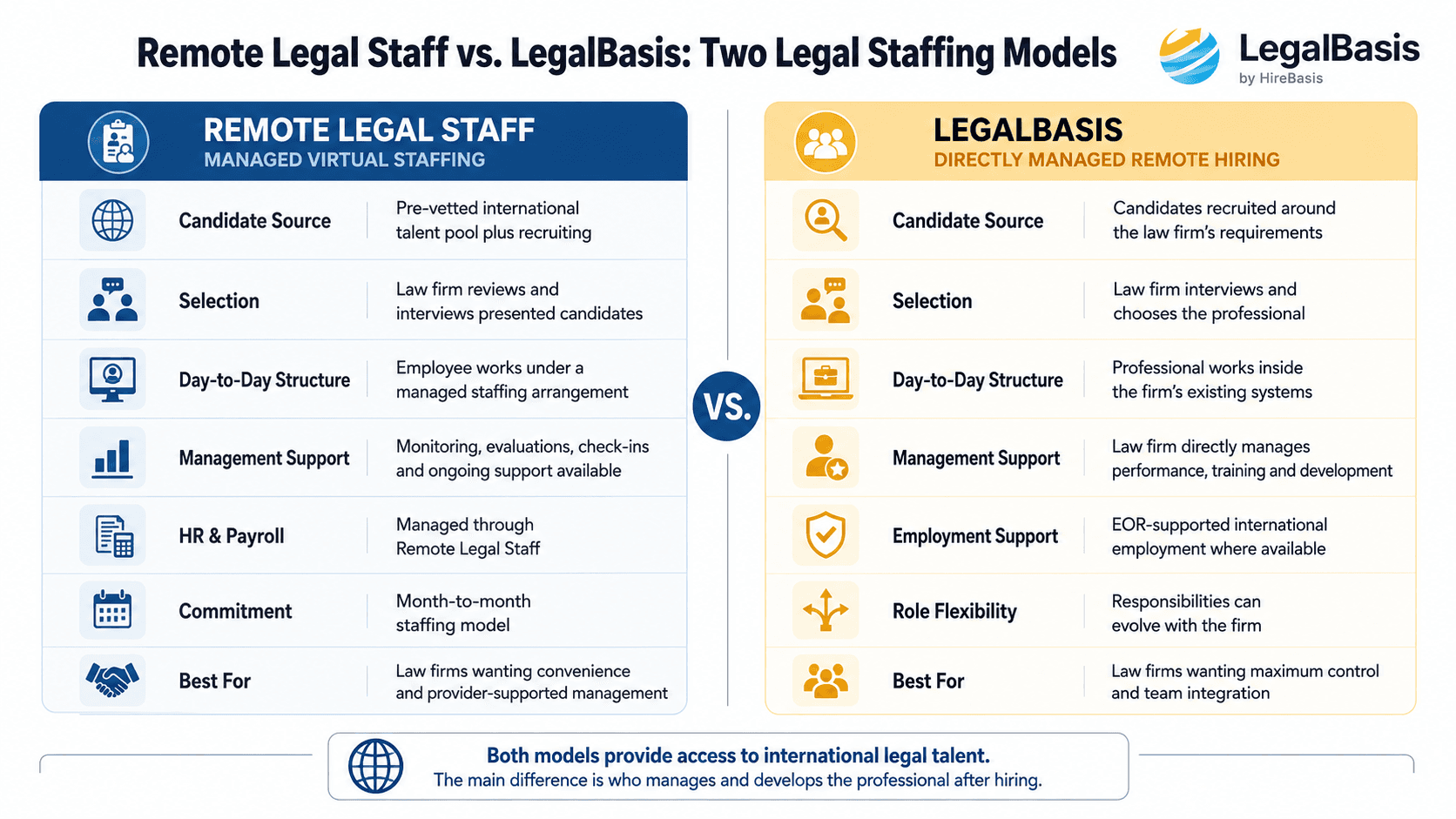
Remote Legal Staff and LegalBasis are not opposites.
Both use international talent to help U.S. law firms add capacity at substantially lower costs than comparable domestic staffing.
Both recruit legal professionals.
Both allow firms to interview candidates.
Both can support roles such as legal assistants, paralegals, intake staff, case managers, marketing professionals, and administrative staff.
The distinction is mainly structural.
Category | Remote Legal Staff | LegalBasis |
|---|---|---|
Model | Managed virtual staffing | Directly managed remote hiring |
Candidate sourcing | Pre-vetted international candidate pool plus recruiting | Candidates recruited around the firm's requirements |
Candidate selection | Firm interviews presented candidates | Firm interviews and chooses |
Day-to-day management | Provider remains actively involved in management and supervision | Law firm manages directly |
Monitoring | RLS advertises monitoring and time tracking | Determined by the law firm's own policies |
Performance management | RLS offers evaluations, one-on-ones and check-ins | Law firm handles performance directly |
Training | Provider offers ongoing training | Firm trains for its specific systems and workflows |
Payroll / employment administration | Handled through RLS structure | EOR-supported employment where available |
Systems | Worker supports the law firm remotely | Professional is integrated into the firm's existing systems |
Role evolution | Generally centered around the staffing placement | Designed for employees whose responsibilities can grow with the firm |
Pricing approach | Advertised hourly all-inclusive rates starting at $12/hr | Candidate compensation plus applicable employment/EOR infrastructure |
Best suited for | Firms wanting a more managed staffing arrangement | Firms wanting global talent with maximum day-to-day control |
The Biggest Difference: Managed Staff vs. Your Staff
This is the most important part of the comparison.
Remote Legal Staff says it fully manages remote law-firm staff.
LegalBasis deliberately goes in the other direction.
LegalBasis recruits and screens potential employees, but:
You interview them.
You choose them.
You train them.
You manage them.
The professional works within the law firm's existing systems and management structure.
LegalBasis supports the hiring infrastructure rather than becoming the employee's day-to-day manager.
Where international employment support is used, an Employer of Record can provide the formal local employment structure while the law firm continues directing the work.
For law firms unfamiliar with that arrangement, What Is an Employer of Record? explains how the structure works.
This distinction is why comparing the two companies solely on hourly price misses much of the point.
They are selling different operating models.
Which Is Better for a Small Law Firm?
It depends heavily on the owner.
Remote Legal Staff may be better if:
You want someone quickly.
You prefer choosing from candidates who are already vetted and available.
You do not want to handle as much HR administration.
You want the staffing company involved in performance monitoring and employee management.
You value month-to-month flexibility and structured replacement support.
You want a fairly turnkey virtual staffing service.
LegalBasis may be better if:
You want the person to become part of your actual operating team.
You want to manage the employee directly.
You want candidates recruited around a specific or unusual position.
You want the employee using your existing processes and systems.
You expect the person's responsibilities to expand as your firm grows.
You want international employment infrastructure without outsourcing everyday management.
Neither philosophy is inherently right or wrong.
They solve different management problems.
What About Paralegals?
This distinction becomes especially important for paralegal positions.
There is a large difference between hiring someone to perform standardized administrative tasks and hiring a paralegal who will become deeply involved in matters, drafting, discovery, client communication, research, case preparation, or litigation support.
The second position often requires greater integration with supervising attorneys.
If that is what your firm needs, see How to Hire a Remote Paralegal, which compares domestic remote employment, virtual staffing, and international hiring structures.
It is also worth understanding the difference between a virtual legal assistant and a remote paralegal before recruiting. Using an inexpensive assistant for work requiring substantive paralegal experience can create false savings.
Ethical and Security Considerations With Remote Legal Staff
Law firms should not assume that using a staffing provider transfers their professional-responsibility obligations to that provider.
It does not.
This applies whether the firm chooses Remote Legal Staff, LegalBasis, an independent contractor, a domestic staffing agency, or another offshore provider.
An ABA cybersecurity discussion notes that Model Rule 5.3's responsibility concerning nonlawyer assistance extends to outside providers, including “outsourced legal services.” Lawyers therefore need appropriate due diligence, supervision, contractual protections, access controls, and confidentiality safeguards.
That means firms should evaluate questions such as:
What information does the remote professional actually need access to?
Are separate user accounts provided?
Is multi-factor authentication enabled?
How is access removed when employment ends?
Can files be downloaded locally?
Is client information being transmitted internationally?
What confidentiality agreements apply?
Who supervises substantive legal work?
What happens if credentials are compromised?
Does the worker use firm-controlled email and software?
These questions matter regardless of which staffing company is involved.
Remote Legal Staff Reviews: What Can We Actually Verify?
There are many testimonials on Remote Legal Staff's own website from attorneys and staff.
Those are useful, but readers should distinguish between provider-published testimonials and independent review platforms.
RLS currently publishes attorney testimonials describing reduced administrative work, increased capacity, bilingual staffing, cost savings, delegation, and firm growth.
Its LinkedIn page is also active and currently has roughly 10,000 followers, with regular posts about candidates, law-firm clients, and staffing.
Glassdoor currently has only a very small public sample for Remote Legal Staff, so it would be misleading to treat its rating as strong evidence either for or against the company.
In other words:
There is enough public evidence to conclude that Remote Legal Staff is an actively operating staffing business. There is not enough independent review volume to treat third-party ratings as definitive evidence of service quality.
That is a much more defensible conclusion than either “this company is amazing” or “this company is suspicious.”
Is $12/Hour Legal Staffing Too Good to Be True?
Not necessarily.
International compensation varies dramatically by country.
A salary that is far below U.S. compensation can still be competitive in another labor market.
The better question is whether the rate produces the level of experience your firm needs.
The latest BLS data puts median U.S. compensation for paralegals and legal assistants at $62,890 annually and legal secretaries and administrative assistants at $55,570.
International hiring can therefore create significant savings even after recruiting, payroll, employment support, and benefits are considered.
LegalBasis illustrates the same economics differently.
Rather than bundling the employee into a managed staffing hourly rate, LegalBasis can structure international hiring around the professional's compensation plus employment support through an Employer of Record where available.
The current LegalBasis example shows an illustrative remote receptionist arrangement of approximately $1,040 in monthly compensation plus approximately $350 in EOR and employment support, or approximately $1,390 per month total.
Actual costs vary by country, responsibilities, experience, benefits, taxes, and employment structure.
For firms considering international employment directly, it is also important to understand the legal risks of hiring overseas workers without the right employment structure.
Should Your Law Firm Use a Managed Virtual Staffing Company?
Managed staffing makes a great deal of sense when the primary goal is convenience.
If your main concern is:
“I need someone capable to take this work off my plate, and I do not want to spend much time managing the employment side,”
then Remote Legal Staff's structure is logical.
You receive recruiting, administration, management services, and replacement support in one package.
For a busy solo practitioner or small practice without an HR function, that can be valuable.
When Direct Remote Hiring May Be Better
Directly managed remote hiring makes more sense when the goal changes from:
“I need outsourced capacity.”
to:
“I want to build my team.”
That means creating the role around your actual workflows, recruiting specifically for that position, choosing the person yourself, training them in your systems, managing their performance, expanding their responsibilities over time, and treating them like a long-term member of the organization.
This is the philosophy behind LegalBasis.
It is also why LegalBasis describes its approach as a hybrid model.
The local team retains:
Attorney judgment
Client relationships
Leadership
Supervision
Work requiring physical presence
Remote employees add capacity in areas such as:
Legal administration
Paralegal support
Case management
Intake
Marketing
Bookkeeping
Operations
The objective is not replacing the law firm.
It is giving the existing law firm more leverage.
Remote Legal Staff Pros and Cons
Pros
Established public operating presence.
There is meaningful evidence that Remote Legal Staff is an active U.S.-focused staffing company.
Legal-industry specialization.
RLS recruits specifically for law firms rather than offering only generic virtual assistants.
Low advertised starting cost.
Rates begin at $12 per hour.
Fast hiring.
A pool of pre-vetted candidates can reduce recruiting time.
Firm interviews candidates.
Law firms are not simply handed an employee without an interview process.
Management included.
Performance reviews, check-ins, payroll, monitoring, and other HR functions are part of the value proposition.
Month-to-month model.
This reduces the commitment required to test offshore staffing.
Replacement guarantee.
RLS advertises continuing replacement support if the placement is unsuccessful.
Potential Drawbacks
Provider involvement in management.
Firms seeking maximum direct control may prefer a more traditional employer-style relationship.
Starting rate does not equal every candidate's rate.
More experienced or specialized employees may cost materially more than $12 per hour.
Pre-vetted pool versus fully customized recruiting.
Some firms may prefer a search conducted around highly specific requirements rather than beginning with available candidates.
External review volume is still limited.
The publicly visible independent employee-review sample is currently small.
Model may not suit firms building deeply integrated teams.
A firm that wants to develop an employee over several years may favor direct management.
Remote Legal Staff vs. LegalBasis: Which Should You Choose?
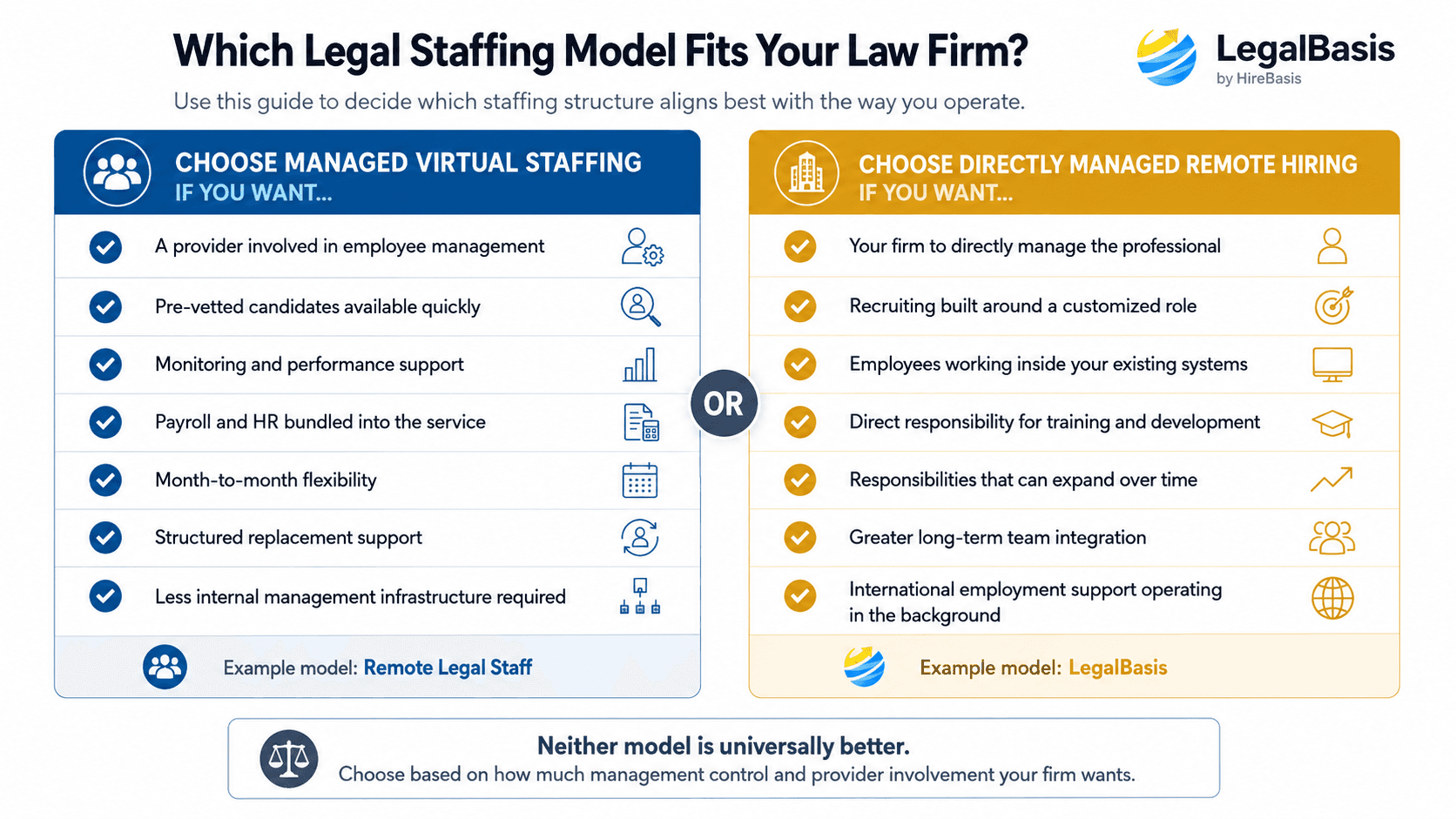
Choose Remote Legal Staff if what you want is essentially:
“Find me capable legal staff and help manage them for me.”
Choose LegalBasis if what you want is:
“Help me find the right person, handle the international hiring infrastructure, and then let me build and manage my own team.”
That is the fundamental difference.
Remote Legal Staff is closer to managed virtual staffing.
LegalBasis is closer to international remote hiring with recruiting and EOR support.
The worker may sit thousands of miles away in both cases.
The organizational relationship is different.
Questions to Ask Remote Legal Staff Before Hiring
Before signing with RLS—or any other remote legal staffing provider—a law firm should ask:
What will this specific candidate cost per month?
How much of the hourly amount goes toward compensation versus provider services?
Who is the worker's formal employer?
Who determines salary increases?
Who conducts performance reviews?
Can our firm give feedback directly?
Who decides when the employee is promoted or given new responsibilities?
What happens if we want to hire the professional directly later?
Are there conversion or buyout fees?
What exactly does the lifetime replacement guarantee cover?
What security controls are mandatory?
What background screening is performed?
Can we recruit outside the existing candidate pool?
What benefits does the professional receive?
What happens when we end a placement?
Ask the same questions of LegalBasis or any other provider you evaluate.
A staffing company should be able to explain clearly where its responsibilities stop and your firm's responsibilities begin.
Final Verdict: Is Remote Legal Staff Legit?
Yes. Based on the public evidence available in 2026, Remote Legal Staff appears to be a legitimate legal staffing company with an active operating presence, real recruiting activity, current candidates, public attorney testimonials, and established staffing services for U.S. law firms.
Its model has several attractive characteristics: affordable international talent, fast access to candidates, legal specialization, month-to-month flexibility, HR administration, ongoing management, and replacement support.
For a law firm that wants a managed staffing service, Remote Legal Staff deserves consideration.
The larger question is whether managed staffing is what your firm wants.
If your goal is instead to recruit a remote professional whom your law firm chooses, trains, directly manages, develops, and integrates into its own team, then a different structure may be more appropriate.
That is what LegalBasis is designed to provide.
LegalBasis begins with the firm's requirements, recruits and screens candidates around those requirements, allows the law firm to interview and make the final selection, and then supports international employment infrastructure through an EOR where available.
The firm manages the work.
The provider supports the hiring infrastructure.
For firms trying to determine which structure makes more sense, explore the LegalBasis hybrid staffing model or review how to hire a remote paralegal.
The best option is not necessarily the company with the lowest advertised hourly rate.
It is the staffing structure that gives your law firm the right combination of talent, cost, control, flexibility, supervision, and long-term fit.
About the Author
Hasan Abdullah is the Founder of LegalBasis and President & Principal Attorney of American Visa Law Group. LegalBasis grew out of his firsthand experience building and managing a U.S. law firm with both local and international team members.
Through that experience, he saw that law firms can expand capacity by recruiting talented professionals globally while still retaining control over who they hire, how those professionals are trained, and how the work is managed.
LegalBasis was built around that model: helping law firms define the roles they need, recruit qualified international professionals, and support compliant international employment structures where appropriate.
Continue Reading
More practical guidance for building a stronger legal team.

Remote Legal Staffing
Is Virtual Staffing Legit? Review and LegalBasis Comparison for Law Firms
Virtual Staffing is a legitimate legal staffing provider offering pre-vetted remote professionals to U.S. law firms. This review examines how its managed staffing model works, what it costs, its key strengths and limitations, and how it compares with LegalBasis for firms deciding between virtual staffing and directly managed global remote hiring.
Read Article →

Remote Legal Staffing
Is Stafi Legit? Remote Legal Staffing vs. LegalBasis
Is Stafi legit? This Stafi review examines its remote legal staffing services, training, 24/7 intake, pricing model, and reputation, then compares Stafi with LegalBasis to help law firms decide between managed virtual staffing and directly managed international remote hiring.
Read Article →

Remote Legal Staffing
Is LegalSoft Legit? Honest LegalSoft Review for Law Firms
Is LegalSoft legit? This LegalSoft review examines its virtual legal staffing model, current pricing, candidate pool, advantages, potential drawbacks, and how LegalSoft compares with LegalBasis for law firms considering international remote talent.
Read Article →
Build the Remote Team Your Law Firm Actually Needs.
Tell us what work your firm needs help with. LegalBasis can help define the role, recruit qualified international candidates, and explore an employment structure that fits your firm.