Remote Legal Staffing
Is Stafi Legit? Remote Legal Staffing vs. LegalBasis
Is Stafi legit? This Stafi review examines its remote legal staffing services, training, 24/7 intake, pricing model, and reputation, then compares Stafi with LegalBasis to help law firms decide between managed virtual staffing and directly managed international remote hiring.
·
Founder, LegalBasis · President & Principal Attorney, American Visa Law Group
·
·
13 min read
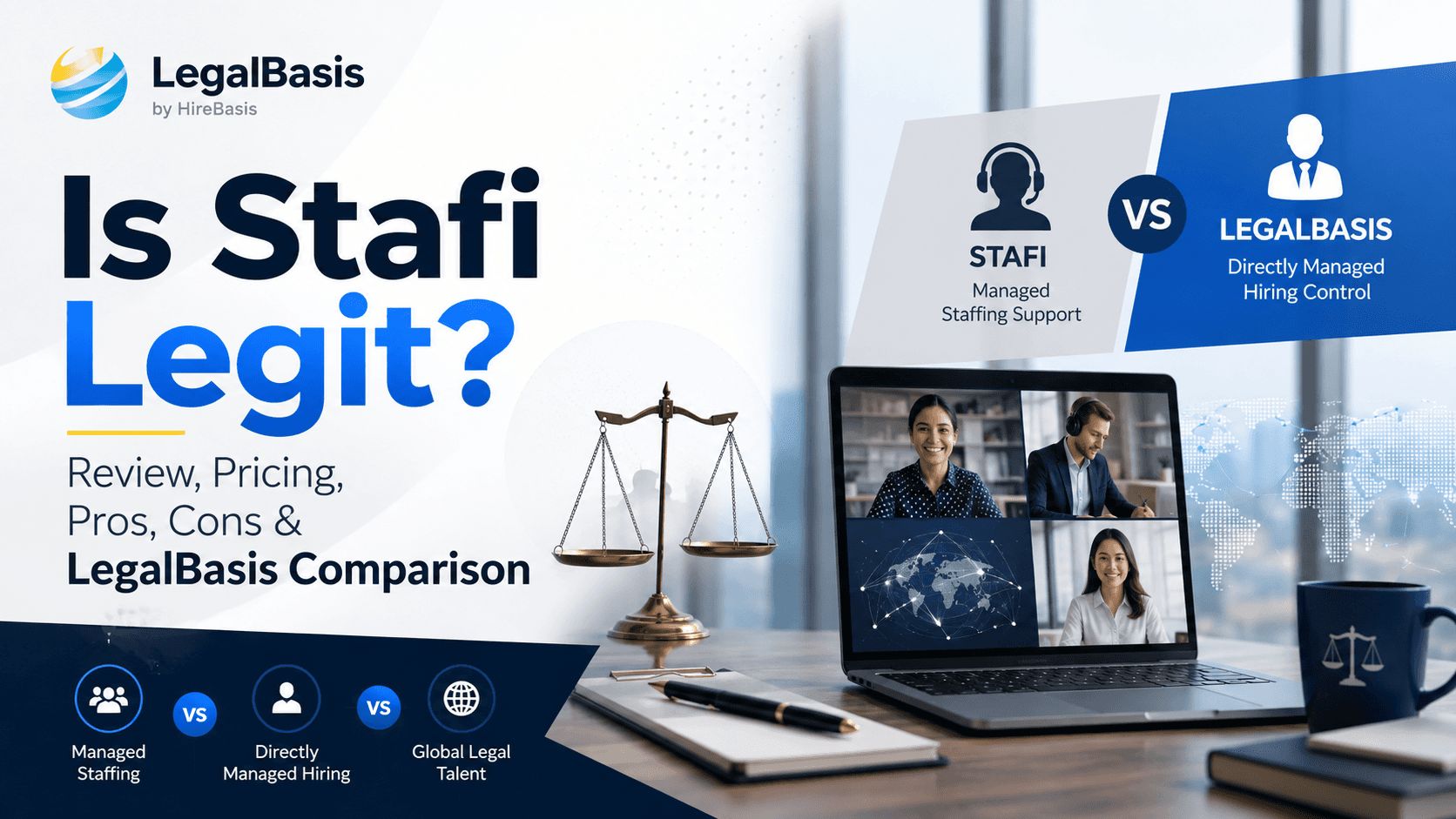
Is Stafi Legit? Remote Legal Staffing vs. LegalBasis
If you are considering Stafi for your law firm, the first question is probably straightforward: Is Stafi legit?
Based on the company’s public presence, leadership, client testimonials, industry appearances, and established legal-staffing services, yes—Stafi appears to be a legitimate remote legal staffing company serving U.S. law firms.
That does not automatically mean Stafi is the right staffing model for every firm.
Stafi and LegalBasis both help law firms access international legal talent at substantially lower costs than traditional domestic hiring. But they approach the problem differently.
Stafi is primarily a managed remote staffing and outsourcing provider. It recruits legal professionals, trains them, matches them with firms, and remains actively involved through coaching, HR support, performance metrics, and other infrastructure.
LegalBasis is designed more like international remote hiring. LegalBasis recruits and screens candidates around the law firm’s requirements, but the firm interviews and chooses the professional, directly manages that person, places them inside its existing systems, and builds the relationship more like an internal employee relationship. Employment infrastructure can then operate in the background through an Employer of Record where available.
Neither approach is inherently better.
Stafi can make more sense for a law firm that wants more provider support, structured training, standardized staffing, or outsourced legal operations.
LegalBasis can make more sense for a firm that wants more hiring control, greater role flexibility, a broader global recruiting pool, and a professional who functions as part of the firm's own team rather than a staffing-provider workforce.
Here is what law firms should know before choosing.
Is Stafi a Legit Company?
There are several publicly verifiable signs that Stafi is an operating legal staffing business rather than an anonymous virtual-assistant marketplace.
Stafi identifies Raquel Gomes and Demetrio Rico as its founders, with Gomes serving as CEO. Its current website lists a Miami address and describes Stafi as a subscription-based remote staffing company specializing in law firms.
The company says it has worked with 430+ law firms and advertises bilingual remote legal staff beginning at $16 per hour, alongside 24/7 legal intake and immigration case outsourcing. Those figures are company claims rather than independently audited numbers, but they indicate that Stafi has moved well beyond the stage of being a generic freelance-placement service.
Stafi CEO Raquel Gomes has also appeared multiple times on PILMMA's Grow Your Law Firm podcast. In a recent episode, PILMMA described Stafi as supporting hundreds of U.S. law firms through virtual assistants, training, and hands-on coaching. The episode discussed Stafi University, coaching, KPIs, cybersecurity, and 24/7 intake—all consistent with the managed-service model presented on Stafi's own website.
Gomes also maintains a Forbes Business Council profile. It is worth making one distinction that is often missed in online reviews: Forbes identifies its Councils program as fee-based membership, so membership should not be interpreted as the same thing as an independent Forbes editorial award or endorsement. It nevertheless adds another publicly identifiable professional presence behind the company.
Third-party reviews are generally favorable as well. At the time of this review, Trustindex displayed a 4.8/5 rating from 117 reviews, including numerous positive comments from firms and workers, although it also displayed negative reviews. As with reviews for any staffing business, these are individual experiences rather than guarantees of what another law firm will experience.
So, is Stafi legit? Yes, the available evidence strongly indicates that Stafi is a real, established legal staffing provider.
The more useful question is whether its particular staffing structure matches what your law firm wants.
What Does Stafi Actually Do?
Stafi currently offers three major service categories.
Its first and most relevant for this review is dedicated remote legal staffing. Stafi advertises professionals including:
Remote paralegals
Case managers
Executive assistants
Intake specialists
Marketing assistants
Stafi says its representatives are primarily based in Latin America, are bilingual in English and Spanish, are college educated, and receive ongoing training and coaching.
The second service is Stafi Live, a 24/7 bilingual legal receptionist and intake operation. This is less like hiring a traditional employee and more like outsourcing a business function: answering calls, qualifying prospects, collecting intake information, and scheduling consultations.
The third is legal process outsourcing, with a particularly developed offering for immigration firms. Stafi advertises assistance with document collection, research and drafting, package preparation, client communication, and case preparation.
That breadth is one of Stafi's biggest strengths.
A law firm that does not simply need another employee—but instead wants an external partner capable of handling staffing, intake, and entire workflows—may find the model attractive.
Why This Type of Staffing Is Becoming More Relevant
This comparison is happening while law firms are under unusual pressure to increase capacity without letting payroll and overhead rise at the same rate.
The timing is important. Reuters reported that revenue across more than 140 large U.S. law firms rose 12.4% during the first half of the year, while lawyer headcount increased only 2.9%. Wells Fargo Legal Specialty Group managing director Owen Burman described it simply: “It’s a very strong market.” The numbers illustrate the capacity problem behind much of the remote-staffing conversation: demand can grow considerably faster than a firm's traditional headcount. Read the Reuters report
And finding the people needed to absorb that growth is not necessarily getting easier. Robert Half's 2026 legal hiring outlook reports that 61% of law firm and legal-department leaders say finding skilled professionals is more difficult than it was a year ago, while 58% plan to increase full-time headcount during the second half of 2026. For firms struggling to recruit specialized talent, the problem is increasingly less about whether a position exists and more about where qualified people can realistically be found. See Robert Half's 2026 legal hiring research Firms facing that problem may also find HireBasis's guide to recruiting for hard-to-fill roles useful when defining the search before selecting a staffing provider.
Law firms are being asked to handle more work, but adding domestic employees at the same rate as demand can quickly increase fixed costs.
Clio reached a similar conclusion in its 2025 Legal Trends Report. One of the report's striking findings was that “Revenues grew 4x faster than headcounts” among growing firms in its cohort. Clio found that successful firms were not simply adding employees; they were finding ways to create substantially greater output from the teams they already had.
That is precisely where remote legal staffing models such as Stafi and LegalBasis enter the conversation.
Rather than asking an attorney to spend part of the day scheduling consultations, following up for documents, updating a CRM, organizing case files, or performing routine administrative work, firms can move appropriate responsibilities to lower-cost remote professionals.
The goal is not merely cheap labor.
It is staffing leverage.
The American Bar Association has described the direction of the profession similarly. In an article on the future of law firms, Jane Oxley wrote that “Humans will always be the primary assets in any legal practice.” The opportunity is therefore not to eliminate people, but to combine people, technology, and better workflows more intelligently.
For firms deciding which responsibilities can realistically move outside the physical office, LegalBasis has also published a detailed guide to law firm roles that can be performed remotely.
How the Stafi Staffing Model Works
The easiest way to understand Stafi is to look at what happens after someone is placed.
Stafi describes its remote professionals as being backed by a larger support structure. Its dedicated staffing page prominently describes the model as:
“Not Just Another Assistant. Legal Support Experts Backed by a Full Team.”
That distinction is important.
According to Stafi, representatives receive:
Stafi coaching
HR support
Continuing training through Stafi University
Performance metrics
Community support
Legal-specific training
Provider involvement during onboarding and beyond
Stafi explicitly says law firms are “never left alone to manage” their remote legal staff because Stafi continues providing support.
For some law firms, that is exactly the attraction.
Perhaps the owner has never managed an international employee. Perhaps the firm's processes are still being developed. Perhaps management does not want to design training from scratch.
A provider-managed framework can reduce that burden.
Stafi's emphasis on structured recruiting also reflects a broader shift among sophisticated law firms toward more deliberate talent acquisition. K&L Gates global managing partner Stacy Ackermann told Bloomberg Law that her firm is “going out into the market” rather than “being in a reactionary mode” and waiting to see which candidates happen to appear. Although K&L Gates operates on an entirely different scale, the underlying principle applies to smaller firms as well: waiting until the workload becomes unbearable usually produces worse hiring decisions than building capacity intentionally. Read Bloomberg Law's report on the legal talent market
Stafi itself has continued emphasizing that idea in 2026. In an August article on training remote legal staff, CEO Raquel Gomes opened with the observation that “Delegation is a double-edged sword.” Her point was that moving work off an attorney's desk only creates leverage when the receiving employee has clearly defined protocols, training, accountability, and workflows. That is a useful way to understand why Stafi invests so heavily in the support infrastructure surrounding its representatives. Read Stafi's August 2026 remote-staff training article
One Stafi client quoted on the company's website described the benefit more personally. Personal-injury attorney Justin Schneider said after his first hire: “I made that first hire and everything sped up. Allowing me to breathe.”
That is arguably the core Stafi value proposition: delegation with a support layer around the person doing the work.
What Makes LegalBasis Different?
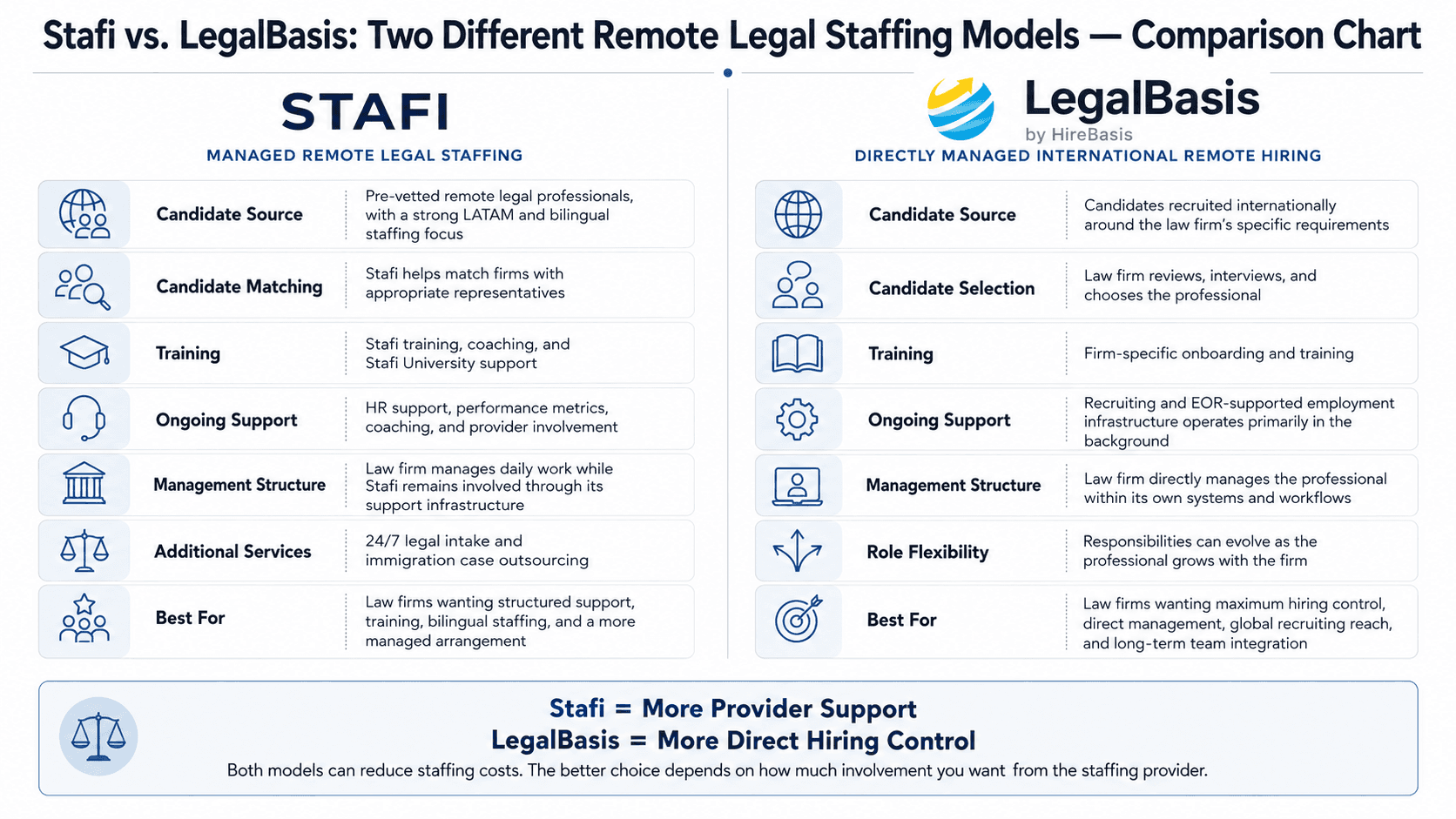
LegalBasis starts from a different assumption.
Instead of asking, “Which Stafi representative should we assign to this firm?”, LegalBasis is structured around the question:
“Who should this law firm hire?”
LegalBasis recruits and screens professionals against the firm's requirements. The firm then reviews the candidates, conducts the interviews, selects the person it wants, trains that person, and manages the professional inside its existing systems.
The provider helps make the match and supports the employment infrastructure.
The law firm builds the team.
That distinction becomes particularly important if the person will eventually handle responsibilities that extend beyond a predetermined virtual-assistant role.
A remote employee might begin by handling intake, for example, but later become responsible for reporting, CRM administration, workflow development, client follow-up, internal operations, or supervising other support professionals.
LegalBasis is designed to allow that relationship to evolve much like an internal hire.
That structure matters even more when a firm is thinking several years ahead rather than filling one immediate vacancy. An American Bar Association article published in 2026 described one midsize managing partner's view of the changing legal talent pipeline as “almost checkmate.” The article explains how AI, changing associate expectations, paralegals, and legal-operations professionals are redistributing work that once followed the traditional law-firm pyramid. The lesson for a smaller firm is that who performs the work—and how that person develops—is increasingly a strategic decision, not merely an administrative one. Read the ABA's 2026 analysis of the legal talent pipeline
That is also why firms building their own international teams should think beyond initial placement. HireBasis's guides on scaling an offshore team without losing quality and virtual team building for remote employers and managers address what happens after the employee is hired: integration, communication, culture, and management become part of the staffing strategy.
If your firm is still deciding whether it actually needs administrative help or more substantive support, see Virtual Legal Assistant vs. Remote Paralegal and the guide on how to hire a remote paralegal.
Stafi vs. LegalBasis: Side-by-Side Comparison
Category | Stafi | LegalBasis |
|---|---|---|
Core model | Managed remote staffing and outsourcing | Directly managed international remote hiring |
Candidate sourcing | Pre-vetted Stafi talent matched with firms | Recruiting around the firm's specific requirements |
Geographic focus | Primarily LATAM remote representatives | Recruiting across 100+ countries |
Candidate selection | Stafi matches firms with appropriate representatives | Firm reviews, interviews, and chooses the professional |
Daily management | Firm works with representative, with Stafi coaching/support remaining involved | Firm directly manages the professional |
Training | Stafi training and Stafi University | Firm-specific training and integration |
Role flexibility | Strong within Stafi's supported legal roles and service structure | Designed for roles that can evolve with the firm |
HR/provider involvement | Significant ongoing Stafi support | Employment support operates primarily in the background |
Systems | Stafi-supported structure and firm workflows | Professional works inside firm's existing systems |
24/7 intake | Dedicated Stafi Live service | Not the core LegalBasis offering |
Case outsourcing | Dedicated immigration outsourcing available | Primarily staffing rather than outsourced case production |
Best for | Firms wanting more managed support | Firms wanting maximum hiring and management control |
The key difference is therefore not remote versus in-person.
Both companies solve a remote staffing problem.
The difference is how much of the employment relationship and management structure remains with the staffing provider.
Management and Supervision Still Matter
Neither model removes a lawyer's responsibility to supervise legal work appropriately.
This point is particularly important because remote staffing is sometimes marketed as though the attorney can simply hand off a workload and forget about it.
That is not how responsible legal delegation works.
In a 2025 ABA Journal discussion about remote work and supervision, ethics attorney Peter Jarvis Pera framed the issue directly: “How do you supervise when you can’t walk down the hall and ask them questions?”
That question applies whether a firm uses Stafi, LegalBasis, a domestic employee, or an independent contractor.
ABA Model Rule 5.3 states that lawyers with supervisory responsibility over nonlawyers must make reasonable efforts to ensure that their conduct is compatible with the lawyer's professional obligations. The ABA commentary specifically discusses nonlawyers working outside the firm and considerations such as confidentiality, experience, reputation, and the environment in which services are performed.
In other words, outsourcing the employment administration does not outsource attorney responsibility.
This is also why system access, permissions, confidentiality policies, training, and quality review should be part of any remote staffing plan.
Direct Management Can Work Extremely Well
There is another reason the distinction between Stafi and LegalBasis matters.
Successful remote teams increasingly operate on outcomes rather than physical visibility.
Family-law attorney Asia Scarlett-Jones, writing for the American Bar Association about operating a remote matrimonial practice, observed that “Building trust with remote employees might require shifting focus from monitoring presence to evaluating outcomes.” She recommended looking at deadlines, work quality, and client satisfaction instead of simply whether someone appears to be online.
That philosophy fits closely with the LegalBasis hybrid staffing model.
The local team retains attorney judgment, leadership, client relationships, and supervision. Remote professionals provide leverage where physical presence is unnecessary.
It is not intended to replace the law firm's core team.
It expands it.
What Does Stafi Cost?
Stafi currently advertises bilingual remote legal staff starting at $16 per hour.
A simple 160-hour month at $16 per hour would equal approximately $2,560, but that calculation should not be treated as a guaranteed Stafi monthly price.
Actual cost may vary depending on the role, service, hours, contract, experience, and other commercial terms.
Stafi also offers services—such as 24/7 reception and full immigration case outsourcing—that cannot fairly be compared with the cost of one full-time employee.
LegalBasis uses a different cost structure.
Its published illustrative example shows a remote legal receptionist with approximately $1,040 in monthly compensation plus $350 in Employer-of-Record and employment support, for an illustrative total of roughly $1,390 per month.
Again, these are not apples-to-apples prices.
Different locations, experience levels, roles, employment structures, and benefits can produce significantly different totals.
The important difference is where the money goes.
With a managed staffing company, the law firm is generally purchasing a staffing service.
With LegalBasis, compensation is more directly connected to the person the law firm selected, while the EOR and employment infrastructure are separate supporting components.
For firms unfamiliar with that structure, LegalBasis explains it in What Is an Employer of Record?.
Stafi Pros
Strong law-firm specialization
Stafi is not trying to be a universal VA marketplace. Its services, training, messaging, and workflows are heavily oriented toward law firms.
Bilingual LATAM talent
For immigration, personal injury, and other firms serving Spanish-speaking clients, Stafi's focus on bilingual English-Spanish professionals can be particularly valuable.
Structured training
Stafi University and the company's continuing coaching infrastructure can reduce the amount of training a law firm must create independently.
24/7 intake
Stafi Live is a particularly attractive offering for firms whose growth depends heavily on inbound leads and after-hours calls.
Legal process outsourcing
Immigration firms with large volumes of repetitive case-production work may benefit from outsourcing an entire process instead of adding one person.
Provider support
Firms that want someone else involved in coaching, monitoring, and supporting a remote professional may prefer Stafi's structure.
Potential Stafi Drawbacks
These are not necessarily flaws; they are primarily trade-offs created by the model.
Less direct than building your own international team
Stafi remains meaningfully involved in the staffing relationship through training, coaching, HR support, monitoring, and its service infrastructure.
A firm specifically looking to build its own global workforce may prefer less provider involvement.
Geographic talent pool
Stafi emphasizes representatives based in Latin America. That can be an enormous strength for firms wanting bilingual Spanish-speaking professionals, but it is narrower than recruiting globally.
LegalBasis says it recruits from more than 100 countries, allowing the search to follow the requirements of the role rather than begin with one region.
Pricing includes the staffing service structure
An hourly staffing-service rate and the underlying compensation of the professional are not necessarily the same thing.
Firms focused primarily on building long-term international employees may therefore want to compare total employment cost rather than simply provider rates.
Some firms may not need continuing provider management
An experienced law-firm operator with strong onboarding, KPIs, SOPs, and management systems may prefer to manage the professional without an additional staffing layer.
That is where LegalBasis's structure becomes especially compelling.
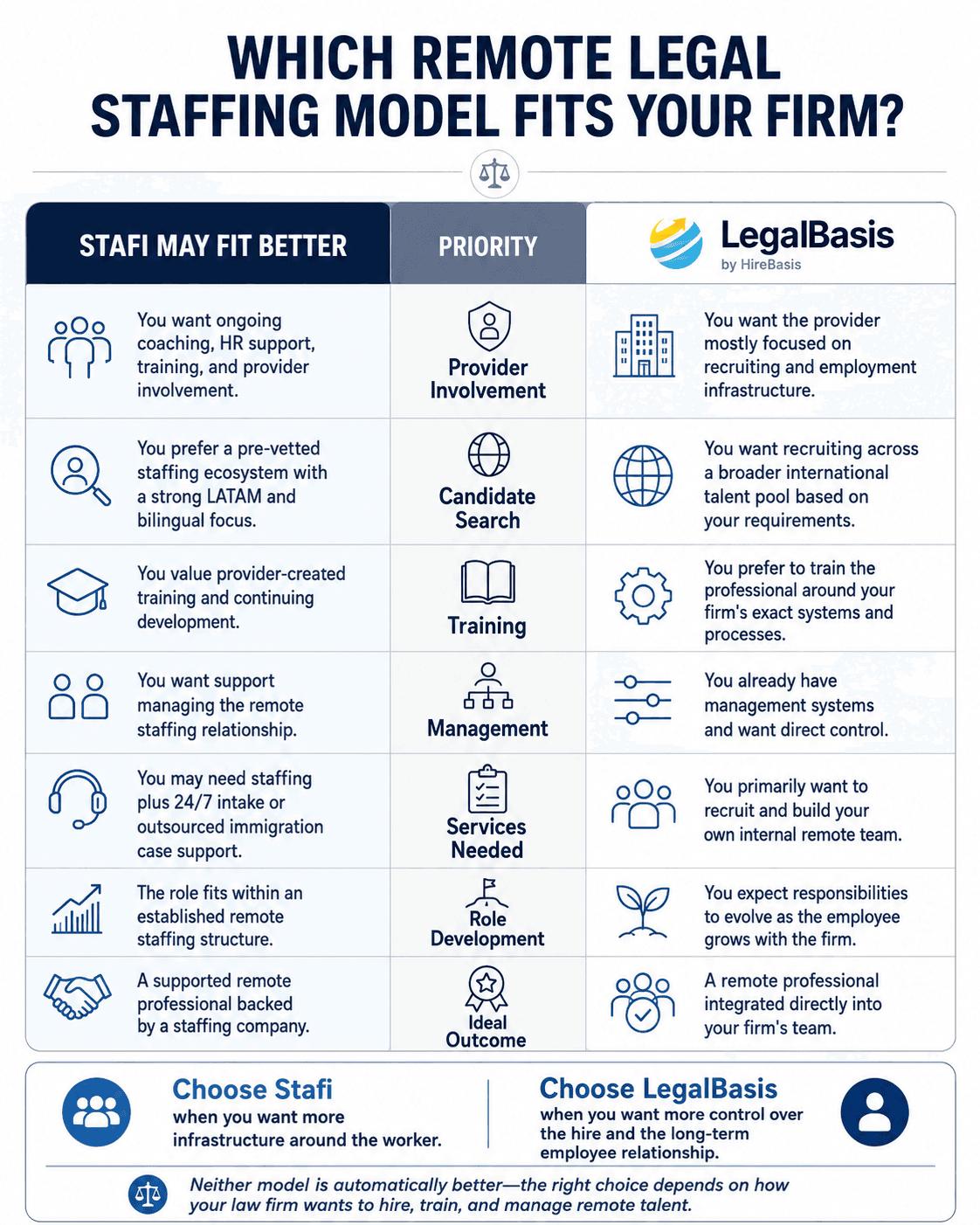
Stafi May Be Better If...
Stafi is likely the stronger fit when:
You want a provider to remain actively involved.
You want bilingual English-Spanish staffing.
You need 24/7 legal reception or intake.
You want an established training system.
You want immigration case outsourcing rather than simply another employee.
You are new to remote staffing and want more guidance.
You prefer choosing from a pre-vetted staffing ecosystem.
For those firms, the additional Stafi infrastructure is a feature rather than a limitation.
LegalBasis May Be Better If...
LegalBasis is likely the stronger fit when:
You want to interview and personally choose your remote employee.
You want recruiting based specifically on your firm's requirements.
You want access to candidates beyond one geographic region.
You want the employee operating entirely inside your existing systems.
You want to control training and performance management.
You expect the person's responsibilities to evolve.
You want someone who feels like part of your firm rather than part of a staffing service.
You already know how you want your team managed.
You want EOR-supported international employment operating behind the scenes.
That model is particularly useful for firms that have moved beyond the question “Can a virtual assistant take these tasks?” and are instead asking “How should we build our firm?”
For a deeper look at that distinction, LegalBasis explains its hiring-support model.
Remote Staffing Is Also Becoming a Response to Burnout
Cost is not the only reason firms are restructuring work.
Bloomberg Law's 2026 Attorney Workload & Hours Survey gathered responses from 1,464 attorneys and legal professionals and continued to find significant burnout and dissatisfaction among segments of the profession. Only around 40% of non-equity partners surveyed said they were satisfied with their jobs.
That helps explain why delegation has become such a recurring theme in both Stafi's messaging and broader law-firm management discussions.
Attorneys performing work that another properly trained professional could perform are not simply increasing staffing costs.
They are consuming scarce attorney capacity.
The strongest staffing strategy therefore usually begins by separating work into categories:
What requires attorney judgment?
What requires an experienced paralegal?
What can be handled by an administrative professional?
What should be automated?
What can be moved to a remote team member?
That exercise is often more important than choosing the staffing provider itself.
Final Verdict: Is Stafi Worth It?
Stafi is a legitimate and established option in the remote legal staffing market, particularly for firms that want a managed solution.
Its law-firm specialization, LATAM talent pool, bilingual staffing, continuing training, 24/7 intake service, coaching, and immigration outsourcing capabilities create a strong offering.
A firm that says:
“I want trained legal support and I want the staffing company to help us manage the relationship.”
may be very happy with Stafi.
LegalBasis serves a somewhat different firm.
A LegalBasis client is more likely to say:
“I want you to find excellent international candidates. Then I want to choose one and build that person into my team.”
That is the fundamental difference.
Stafi helps your firm use a managed remote staffing system.
LegalBasis helps your firm build its own global team.
For law firms that prioritize convenience, ongoing provider support, bilingual LATAM staffing, intake, or process outsourcing, Stafi may be the better option.
For law firms that prioritize hiring control, global recruiting reach, role flexibility, direct management, and long-term integration, LegalBasis may be the better option.
Neither model eliminates the need for good management, proper supervision, secure systems, clearly defined responsibilities, or thoughtful delegation.
But choosing the right model can determine whether remote staffing feels like another vendor relationship—or like adding a genuinely valuable member to your law firm's team.
About the Author
Hasan Abdullah is the Founder of LegalBasis and President & Principal Attorney of American Visa Law Group. LegalBasis grew out of his firsthand experience building and managing a U.S. law firm with both local and international team members.
Through that experience, he saw that law firms can expand capacity by recruiting talented professionals globally while still retaining control over who they hire, how those professionals are trained, and how the work is managed.
LegalBasis was built around that model: helping law firms define the roles they need, recruit qualified international professionals, and support compliant international employment structures where appropriate.
Continue Reading
More practical guidance for building a stronger legal team.

Remote Legal Staffing
Is Virtual Staffing Legit? Review and LegalBasis Comparison for Law Firms
Virtual Staffing is a legitimate legal staffing provider offering pre-vetted remote professionals to U.S. law firms. This review examines how its managed staffing model works, what it costs, its key strengths and limitations, and how it compares with LegalBasis for firms deciding between virtual staffing and directly managed global remote hiring.
Read Article →

Remote Legal Staffing
Is LegalSoft Legit? Honest LegalSoft Review for Law Firms
Is LegalSoft legit? This LegalSoft review examines its virtual legal staffing model, current pricing, candidate pool, advantages, potential drawbacks, and how LegalSoft compares with LegalBasis for law firms considering international remote talent.
Read Article →

Remote Legal Staffing
Is Remote Legal Staff Legit? Review, Pricing, Pros, Cons & LegalBasis Comparison
Remote Legal Staff is a legitimate legal staffing provider offering international legal professionals from $12 per hour. This review examines its pricing, staffing model, pros and cons, and how its managed virtual staffing approach compares with LegalBasis.
Read Article →
Build the Remote Team Your Law Firm Actually Needs.
Tell us what work your firm needs help with. LegalBasis can help define the role, recruit qualified international candidates, and explore an employment structure that fits your firm.