Remote Legal Staffing
Is Virtual Staffing Legit? Review and LegalBasis Comparison for Law Firms
Virtual Staffing is a legitimate legal staffing provider offering pre-vetted remote professionals to U.S. law firms. This review examines how its managed staffing model works, what it costs, its key strengths and limitations, and how it compares with LegalBasis for firms deciding between virtual staffing and directly managed global remote hiring.
·
Founder, LegalBasis · President & Principal Attorney, American Visa Law Group
·
·
13 min read

Is Virtual Staffing Legit? Review and LegalBasis Comparison for Law Firms
If you have been looking for a remote legal assistant, paralegal, intake specialist, case manager, or other offshore legal professional, there is a good chance you have come across Virtual Staffing.
So, is Virtual Staffing legit?
Yes. Virtual Staffing appears to be a legitimate and established legal staffing provider with a substantial public operating footprint, clearly published services and pricing, named law-firm clients, and a business model built specifically around supplying remote professionals to U.S. law firms.
The more important question for a law-firm owner is not really whether Virtual Staffing is legitimate. It is whether its particular staffing model is the right model for your firm.
Virtual Staffing uses what could broadly be described as a managed virtual staffing model. It maintains a pool of pre-vetted remote legal talent, allows firms to interview and select professionals, and remains involved in areas such as HR, onboarding, training, support, and performance.
LegalBasis, by comparison, is structured more like international remote hiring. Rather than beginning with a predefined staffing service, LegalBasis begins with the law firm, recruits around the firm's requirements, lets the firm choose the professional, and then helps establish the employment infrastructure through an employer-of-record arrangement where appropriate.
Both approaches can work extremely well.
They simply solve slightly different problems.
And that distinction has become more important as law firms rethink how they build their teams.
Reuters recently reported that U.S. law-firm leasing increased 17% year over year during the first half of 2026 while firms continued adding lawyers and support staff even as AI created new efficiencies. David Smith of Cushman & Wakefield summarized the mood simply: “Law firms are pretty optimistic about their trajectory.” (Reuters)
That growth creates a practical question for managing partners:
How should the next person at the firm actually be hired?
Should the firm buy staffing capacity through a provider?
Or should it use global recruiting to build its own distributed team?
This Virtual Staffing review looks at both options.
What Is Virtual Staffing?
Virtual Staffing is a legal-focused remote staffing company headquartered in the Los Angeles area.
Its public company profile describes the business as privately held and founded in 2022, with specialties including virtual legal assistants, paralegals, case managers, intake specialists, demand writers, remote attorneys, marketing staff, and other positions used by law firms. Its LinkedIn profile says the company has served more than 1,000 law firms and placed more than 2,000 virtual assistants. (LinkedIn)
Its own website currently reports:
2,500+ virtual assistants placed
1,000+ law firms served
Seven global offices
Legal-specific remote talent
English and bilingual English-Spanish professionals
Integration with systems including Clio, MyCase, Filevine, PracticePanther, Smokeball, LEAP, Rocket Matter, NetDocuments, and LawPay
Those volume figures are company-reported rather than independently audited, but they nevertheless point to an established operation rather than a newly created staffing website.
Virtual Staffing also publishes named client testimonials. Attorney Steven Azizi of Miracle Mile Law Group says: “Their process has been very smooth and they've produced great candidates for us.” (Virtual Staffing)
That is important because Virtual Staffing is not trying to be a general freelance marketplace. Its positioning is specifically around the operational needs of law firms.
How Does Virtual Staffing Work?
Virtual Staffing's process is relatively straightforward.
A law firm begins with a discovery session, gains access to pre-vetted candidates, interviews candidates it likes, selects a professional, and then has Virtual Staffing coordinate onboarding.
The company describes its service as providing professionals who can start quickly and work full-time inside the firm's existing systems.
That includes roles such as:
Legal assistants
Remote attorneys
Paralegals
Demand writers
Intake specialists
Marketing assistants
Bookkeepers
Document collectors
Lien negotiators
Case managers
Its pricing page also makes the model relatively easy to understand.
At the time of this review, Virtual Staffing publicly lists examples including approximately:
$2,227 per month starting price for a full-time legal assistant
$2,922 per month starting price for a full-time paralegal
$3,323 per month starting price for a full-time remote attorney
The broader site advertises staff beginning around $12-$13 per hour depending on the role. (Virtual Staffing pricing)
One particularly important detail for firms considering its remote-attorney offering is that Virtual Staffing expressly states that its remote attorneys do not hold U.S. bar licenses. Firms therefore need to structure responsibilities and attorney supervision appropriately. (Virtual Staffing remote attorney service)
That disclosure is a positive one. International legal professionals can provide substantial value to a U.S. practice, but outsourcing work does not outsource the supervising attorney's professional responsibilities.
Is Virtual Staffing a Virtual Assistant Company?
Broadly, yes, although that description understates how specialized its offering has become.
Virtual Staffing's model starts with a provider-organized pool of remote professionals who have been screened and organized into recognizable law-firm roles.
The law firm can still interview and choose its candidate.
But the infrastructure remains much more provider-managed than conventional direct employment.
Virtual Staffing itself describes the distinction clearly on its website. In comparing its service against in-house employment, it says Virtual Staffing handles “HR, training, support, and performance.”
That is one of the strongest reasons some firms will prefer it.
A managing partner who does not want to build an international recruiting and employment process from scratch may prefer having a staffing company already sitting between the firm and the administrative side of the relationship.
It can be especially attractive when the need is straightforward:
We need an intake specialist.
We need another legal assistant.
We need a case manager.
We need that person soon.
In those circumstances, choosing from professionals who have already been screened for recognizable legal roles can be much more convenient than conducting a broader recruiting search.
Why Remote Legal Staffing Is Growing
Virtual Staffing is benefiting from a much larger change in the economics of legal practice.
The U.S. legal sector reached a record 1,245,200 jobs in July 2026, according to Labor Department figures reported by Reuters. Employment in the sector—which includes lawyers, paralegals and legal assistants—was approximately 8.1% higher than five years earlier. (Reuters)
At the same time, the cost structure of law firms continues to rise. Reuters reported in August that law-firm direct expenses had increased 8.3%, while technology spending rose 11.6% in the second quarter. (Reuters)
Those two trends create a strong incentive to separate work that genuinely requires expensive local talent from work that can be performed effectively by qualified professionals elsewhere.
That is essentially the logic behind the LegalBasis hybrid staffing model.
Keep attorney judgment, leadership, supervision, and important client relationships with the core team.
Then add remote capacity where physical presence is unnecessary.
That can include intake, administrative work, paralegal support, case coordination, bookkeeping, marketing, and other operational functions.
For firms still deciding where that line should be drawn, LegalBasis has also published a broader guide to law-firm roles that can be performed remotely.
Virtual Staffing vs. LegalBasis
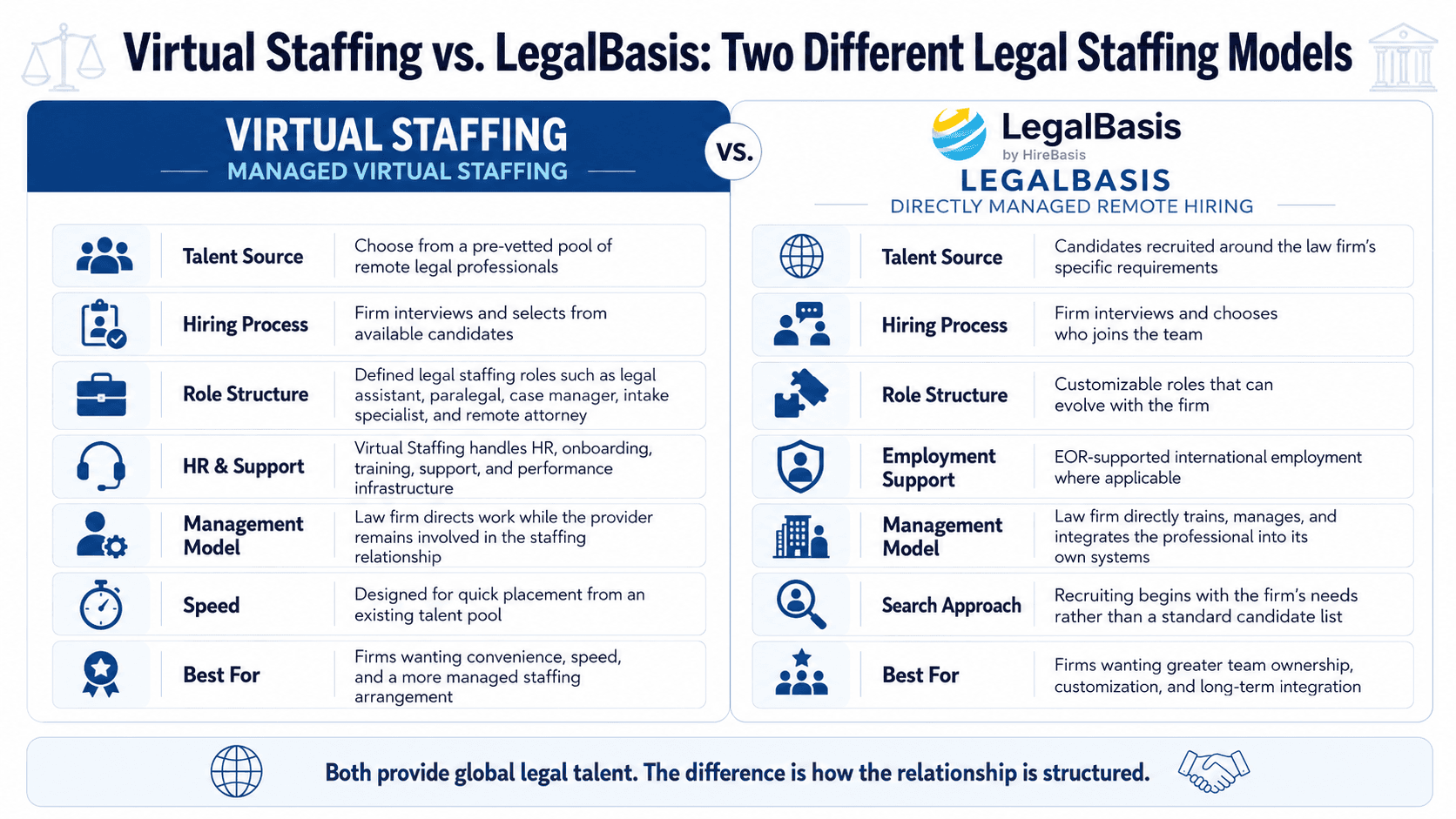
This is where the distinction becomes more meaningful.
Virtual Staffing and LegalBasis both help U.S. law firms access international remote talent.
But they approach the staffing relationship from opposite directions.
Virtual Staffing | LegalBasis | |
|---|---|---|
Primary model | Managed virtual staffing | Directly managed international remote hiring |
Where hiring begins | Existing pool/platform of pre-vetted talent | Firm's specific role and requirements |
Candidate sourcing | Choose from available screened professionals | Candidates recruited around the firm's requirements |
Who interviews? | Law firm | Law firm |
Who chooses the candidate? | Law firm | Law firm |
HR infrastructure | Managed substantially through provider | EOR-supported employment infrastructure where applicable |
Training/support | Provider remains involved | Firm primarily trains and integrates the professional |
Day-to-day work | Performed for the law firm within provider-supported structure | Managed directly by the law firm |
Role flexibility | Typically organized around defined staffing roles | Role can evolve around the firm's needs |
Best for | Firms prioritizing convenience and a managed staffing structure | Firms wanting international talent to operate as an integrated part of their own team |
Neither column is inherently better.
The question is how much of the employment and management relationship the law firm wants to own.
The Biggest Difference: Buying a Service vs. Building a Team
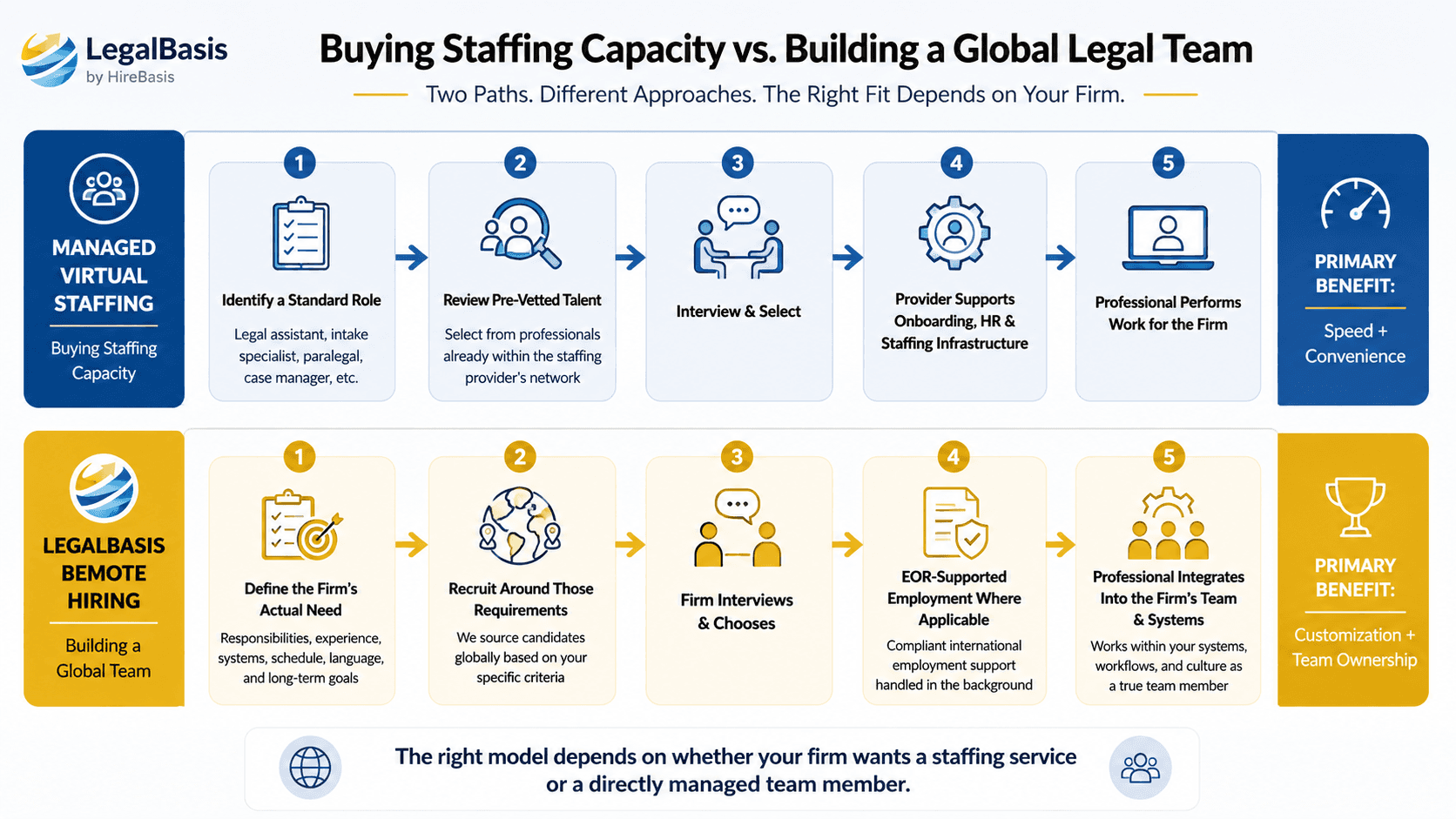
Imagine two firms that both need a paralegal.
Firm A knows exactly what it wants: a full-time remote paralegal with legal research and document-drafting experience who already understands common U.S. legal workflows.
It wants to move quickly.
It would rather browse qualified professionals than conduct an open-ended international search.
Virtual Staffing makes a lot of sense.
Its paralegal service is built precisely for that situation.
Firm B, however, has a different requirement.
Its new employee might begin primarily with paralegal work but gradually take responsibility for client communication, internal process development, document workflows, case coordination, reporting, and possibly training future team members.
The managing partner wants the person recruited specifically for the firm rather than primarily for a predefined staffing category.
That is closer to what LegalBasis was designed to do.
LegalBasis begins with the firm's requirements rather than a generic candidate list.
If you are still determining exactly what type of support your firm needs, the distinction between a virtual legal assistant and a remote paralegal is worth understanding before recruiting.
Virtual Staffing Has an Advantage in Speed and Convenience
One of Virtual Staffing's strongest advantages is that it productizes legal hiring.
Instead of beginning with:
“Let's launch a search.”
the conversation can begin with:
“Here are people who may already fit.”
Virtual Staffing actively promotes rapid placement and says firms can interview pre-vetted professionals and begin onboarding almost immediately.
For standardized roles, that is genuinely useful.
A firm experiencing an intake backlog may care more about getting another trained person into Filevine quickly than designing the perfect long-term organizational structure.
A provider-supported model can reduce administrative friction as well.
That is why managed virtual staffing exists in the first place.
LegalBasis Has an Advantage in Customization and Team Ownership
LegalBasis makes a different tradeoff.
Rather than asking the firm to fit its need into an existing staffing product, LegalBasis recruits around what the firm is trying to build.
The firm then interviews the candidates and decides who actually joins.
Once hired, the professional works within the firm's own systems, workflows, management structure, and training environment.
The intention is for the relationship to resemble building a distributed internal team rather than continually consuming an external staffing service.
LegalBasis provides recruiting and employment infrastructure in the background.
Where appropriate and available, international employment can be established through an Employer of Record, which serves as the legal employer for payroll, documentation, and employment administration while the law firm directs the professional's day-to-day work.
For firms unfamiliar with that structure, this guide explains what an Employer of Record is.
That model can make particular sense once a firm stops thinking:
“I need a VA.”
and starts thinking:
“I need another person on my team.”
Management Still Matters With Either Model
There is a broader lesson here that has little to do with which staffing provider a firm selects.
Remote staff still need management.
A remarkably blunt example emerged in September 2026 when Morgan & Morgan founder John Morgan discussed his firm's approach to employees working from home. Morgan told a podcast audience that remote employees would face unusually aggressive productivity monitoring, including cameras and keystroke tracking. At one point he said, “We're going to have a camera on you.” (People)
Whatever one thinks of that particular approach, the story illustrates the larger point:
Remote work does not eliminate management. It changes management.
A firm using Virtual Staffing still needs expectations, workflows, accountability, communication, and attorney supervision.
A firm using LegalBasis needs the same things—and arguably accepts even more responsibility for building those systems itself because it is deliberately choosing a directly managed structure.
This is why hiring structure should follow management philosophy.
If you want the provider more involved, managed staffing can be valuable.
If you want the professional fully integrated into your organization, direct remote hiring can be more appropriate.
Technology Is Making Human Team Design More Important, Not Less
It might seem strange to expand remote hiring at the same time that AI is automating legal work.
In practice, the two developments are happening together.
Clio's 2025 Legal Trends Report found that growing law firms were taking on substantially more casework without proportional increases in headcount, with technology helping increase per-employee productivity. Clio also found that growing firms used AI in its platform approximately twice as much as stable or shrinking firms. (Clio Legal Trends Report)
The 2026 Thomson Reuters Future of Professionals report pushes the point further. Raghu Ramanathan, president of Legal Professionals at Thomson Reuters, writes: “The firms creating a true competitive advantage today are not the ones talking about AI. They're the ones operationalizing it.” (Thomson Reuters)
That same report found 38% of law-firm professionals already feel financial pressure to move faster on AI, while 34% reported using AI tools their firms had not authorized.
Meanwhile, California lawmakers approved legislation on September 1, 2026 that would prohibit attorneys from delegating the practice of law itself to generative AI and require verification of AI-generated material used by lawyers. Senator Tom Umberg told Reuters lawyers continued to “submit materials that have hallucinations or have some other anomaly.” (Reuters)
In other words, automation can increase capacity.
It cannot eliminate responsibility.
The future law firm is therefore unlikely to consist simply of fewer people.
It is more likely to consist of better-leveraged people—attorneys focused on judgment and client relationships, supported by technology and increasingly distributed teams.
The Compliance Question Matters Too
Law firms hiring internationally should also understand what the underlying worker relationship actually is.
A virtual assistant supplied through a staffing company is not necessarily structured the same way as an international employee, and an overseas independent contractor is not automatically interchangeable with either one.
Those differences affect payroll, local employment law, termination procedures, benefits, documentation, intellectual property, worker classification, and other compliance considerations.
The American Bar Association has also noted the increasingly broad role of outside service organizations in law-firm operations, explaining that these providers may handle everything from technology and marketing to “human resources, and employee staffing.” (American Bar Association)
For firms building their own international teams rather than using a managed staffing provider, LegalBasis's parent company HireBasis has written in more detail about the legal risks of hiring overseas employees without an EOR.
The important point is not that one structure is universally safer than another.
It is that firms should know which structure they are actually buying.
What We Like About Virtual Staffing
Virtual Staffing has several obvious strengths.
1. It specializes in law firms
This is substantially more useful than hiring through a generic virtual-assistant marketplace.
Candidates are organized around roles legal practices actually use.
2. The service is easy to understand
There are recognizable positions, public starting prices, and a defined hiring process.
3. Firms still interview candidates
Virtual Staffing does not appear to simply drop an unknown assistant into the firm. Its process allows the law firm to meet and select the professional.
4. It supports common legal technology
Experience with platforms such as Clio, MyCase and Filevine can materially shorten onboarding.
5. Provider support reduces HR burden
For a managing partner who does not want to become an expert in international employment administration, the managed structure is an advantage.
6. It can be fast
A pre-vetted talent pool naturally makes rapid placement easier than a completely customized recruiting search.
Where Virtual Staffing May Not Be the Best Fit
The limitations mostly come from the same features that make the service convenient.
You may want a broader candidate search
Virtual Staffing's value proposition revolves heavily around its existing pre-vetted talent pool.
Some firms would rather define the exact position first and then recruit specifically for it.
You may want the role to evolve considerably
Provider-organized staffing naturally works best when a position has relatively clear boundaries.
A directly hired remote employee can be easier to develop into an unusual hybrid position over time.
You may want greater organizational ownership
Some managing partners do not want their international staff to feel like people supplied through another company's staffing system.
They want them to identify entirely with the law firm.
That is fundamentally a management preference rather than a criticism of Virtual Staffing.
When Virtual Staffing Is Probably the Better Choice
Virtual Staffing deserves serious consideration if:
You need someone quickly.
The position fits a recognizable legal staffing role.
You prefer choosing from an already screened candidate pool.
You want the staffing provider involved in HR, onboarding, training, support, and performance.
You prefer a predictable staffing-service structure.
You do not want to design an international employment system yourself.
For those firms, Virtual Staffing's managed model is not a disadvantage.
It is the product.
When LegalBasis Is Probably the Better Choice
LegalBasis is more likely to fit if:
You want candidates recruited specifically around your firm's requirements.
You want to compare a broader set of international candidates.
You want the professional integrated into your existing team.
You want to train and manage the person yourself.
You expect responsibilities to evolve significantly over time.
You want an employment structure rather than primarily a managed staffing relationship.
You want EOR-supported international employment where appropriate.
You are building multiple remote positions as part of a long-term organizational strategy.
This distinction becomes particularly important as firms scale.
Hiring one assistant is a staffing decision.
Hiring five, ten, or twenty international professionals starts becoming an organizational-design decision.
Firms approaching that stage may also want to review this guide on how to hire a remote paralegal before deciding whether a placement service or broader recruiting approach makes more sense.
So, Is Virtual Staffing Legit?
Yes.
Based on the company's public operating footprint, active website, published pricing, specialized role pages, public company presence, named law-firm clients, and detailed hiring process, Virtual Staffing appears to be a legitimate legal staffing company.
Its model also makes sense.
There are thousands of law firms that do not want to recruit internationally, determine employment structures, develop offshore hiring pipelines, and administer a distributed workforce themselves.
A managed virtual staffing company exists to remove that complexity.
The question is therefore not:
“Is Virtual Staffing real?”
A more useful question is:
“Do I want virtual staffing, or do I want remote hiring?”
If you want to choose a legal professional from an established pre-vetted pool and have the provider remain involved in HR, support, onboarding, and performance, Virtual Staffing may be the better option.
If you want someone recruited around your firm, selected by your firm, integrated into your systems, managed like a member of your own team, and supported by international employment infrastructure in the background, LegalBasis may be the better fit.
Both give law firms access to global talent.
The difference is what happens after you find it.
Virtual Staffing helps you add virtual staff.
LegalBasis helps you build a global team.
Continue Reading
More practical guidance for building a stronger legal team.
Remote Legal Staffing
Is Stafi Legit? Remote Legal Staffing vs. LegalBasis
Is Stafi legit? This Stafi review examines its remote legal staffing services, training, 24/7 intake, pricing model, and reputation, then compares Stafi with LegalBasis to help law firms decide between managed virtual staffing and directly managed international remote hiring.
Read Article →

Remote Legal Staffing
Is LegalSoft Legit? Honest LegalSoft Review for Law Firms
Is LegalSoft legit? This LegalSoft review examines its virtual legal staffing model, current pricing, candidate pool, advantages, potential drawbacks, and how LegalSoft compares with LegalBasis for law firms considering international remote talent.
Read Article →

Remote Legal Staffing
Is Remote Legal Staff Legit? Review, Pricing, Pros, Cons & LegalBasis Comparison
Remote Legal Staff is a legitimate legal staffing provider offering international legal professionals from $12 per hour. This review examines its pricing, staffing model, pros and cons, and how its managed virtual staffing approach compares with LegalBasis.
Read Article →
Build the Remote Team Your Law Firm Actually Needs.
Tell us what work your firm needs help with. LegalBasis can help define the role, recruit qualified international candidates, and explore an employment structure that fits your firm.