Remote Legal Staffing
Managing Remote Legal Teams: How Law Firms Can Build High-Performing Teams Across Borders
Managing remote legal teams requires clear workflows, strong communication, measurable performance standards, secure systems, and the right hiring structure. This guide explains how law firms can successfully build and manage international remote teams without compromising quality, accountability, or client service.
·
Founder, LegalBasis · President & Principal Attorney, American Visa Law Group
·
·
11 min read

Managing Remote Legal Teams: How Law Firms Can Build High-Performing Teams Across Borders
Managing remote legal teams is becoming less about whether legal work can be done outside a traditional law office and more about how law firms can structure remote work without sacrificing quality, accountability, confidentiality, or client service.
For attorneys and managing partners, that distinction matters.
A remote legal assistant, paralegal, intake specialist, case manager, bookkeeper, or operations professional can be thousands of miles from the firm's physical office and still function as an integrated member of the team. Geography does not determine the quality of someone's work. Hiring standards, role clarity, training, supervision, communication, and accountability do.
That becomes especially important when firms look internationally for talent. International hiring can give a law practice access to experienced professionals while reducing the cost of building its support infrastructure. The objective should not be to find the cheapest person available. It should be to build a stronger operating model at a sustainable cost.
The broader legal market is already being forced to rethink how work gets organized. Raghu Ramanathan, president of Legal Professionals at Thomson Reuters, said in January 2026 that “law firms are facing a fundamental shift in the legal industry's economic landscape.” (Source: Thomson Reuters, January 7, 2026)
For law firms considering remote or international staffing, that shift creates an opportunity. But the firms that benefit most will be those that manage remote employees as real members of the organization rather than treating them as invisible task-takers.
Remote Legal Work Is Not Lower-Quality Legal Work
One of the biggest misconceptions surrounding remote and international staffing is that physical distance automatically means less control or lower-quality work.
It does not.
In January 2026, the Alameda County Bar Association made the point directly: “high-quality legal work does not depend on being in a specific building.” (Source: Alameda County Bar Association, January 15, 2026)
The association argued that effective legal work depends instead on skill, focus, accountability, and systems that enable meaningful collaboration. It also highlighted the ability of remote hiring to expand the talent pool beyond a firm's immediate geographic area.
That distinction is critical.
An attorney sitting twenty feet from a supervising partner is not automatically more organized, more responsive, or better at client communication than an experienced remote employee in another country. Likewise, an international hire should not be assumed to be qualified simply because the compensation is attractive.
The hiring process still matters.
Firms first need to determine which law firm roles can realistically be performed remotely. Some positions are especially suitable for distributed teams because most of the work already takes place inside email, case-management systems, CRMs, document platforms, phone systems, and cloud-based workflows.
Common examples include legal assistants, paralegals, intake specialists, receptionists, case coordinators, administrative professionals, billing staff, and bookkeeping personnel.
Start With the Role, Not the Country
A common mistake in remote hiring is beginning with a country, salary target, or job title before defining the actual operational problem.
Instead, ask what is currently consuming attorney or senior staff time.
Is an attorney spending hours following up with prospective clients? Is a senior paralegal repeatedly handling scheduling and document organization? Are calls going unanswered? Are case-management records incomplete? Is bookkeeping taking time away from revenue-generating legal work?
Once the problem is clear, the role becomes easier to define.
For example, a firm deciding between administrative and substantive support can compare a virtual legal assistant with a remote paralegal. A firm specifically short on paralegal capacity can instead focus on how to hire a remote paralegal.
The same principle applies when the position is difficult to fill locally. HireBasis' guide on recruiting for hard-to-fill roles emphasizes widening sourcing channels and becoming more deliberate about the candidate profile instead of repeatedly searching the same limited talent market.
That is one of the strongest arguments for international legal staffing: the candidate pool becomes substantially broader.
Recent hiring trends also suggest that experience is becoming increasingly valuable. Reuters reported in May 2026 that a Firm Prospects analysis of U.S. law-firm hiring “points to an industry-wide focus on experience,” as firms increasingly sought candidates who could contribute quickly. (Source: Reuters, May 27, 2026)
For a remote position, that can be particularly useful. Hiring someone who already understands professional workflows, deadlines, documentation, client communication, and structured processes can reduce the amount of day-to-day supervision required after onboarding.
Managing Remote Legal Teams Requires Clear Ownership
Remote management breaks down quickly when responsibility is vague.
Every recurring process should have an owner.
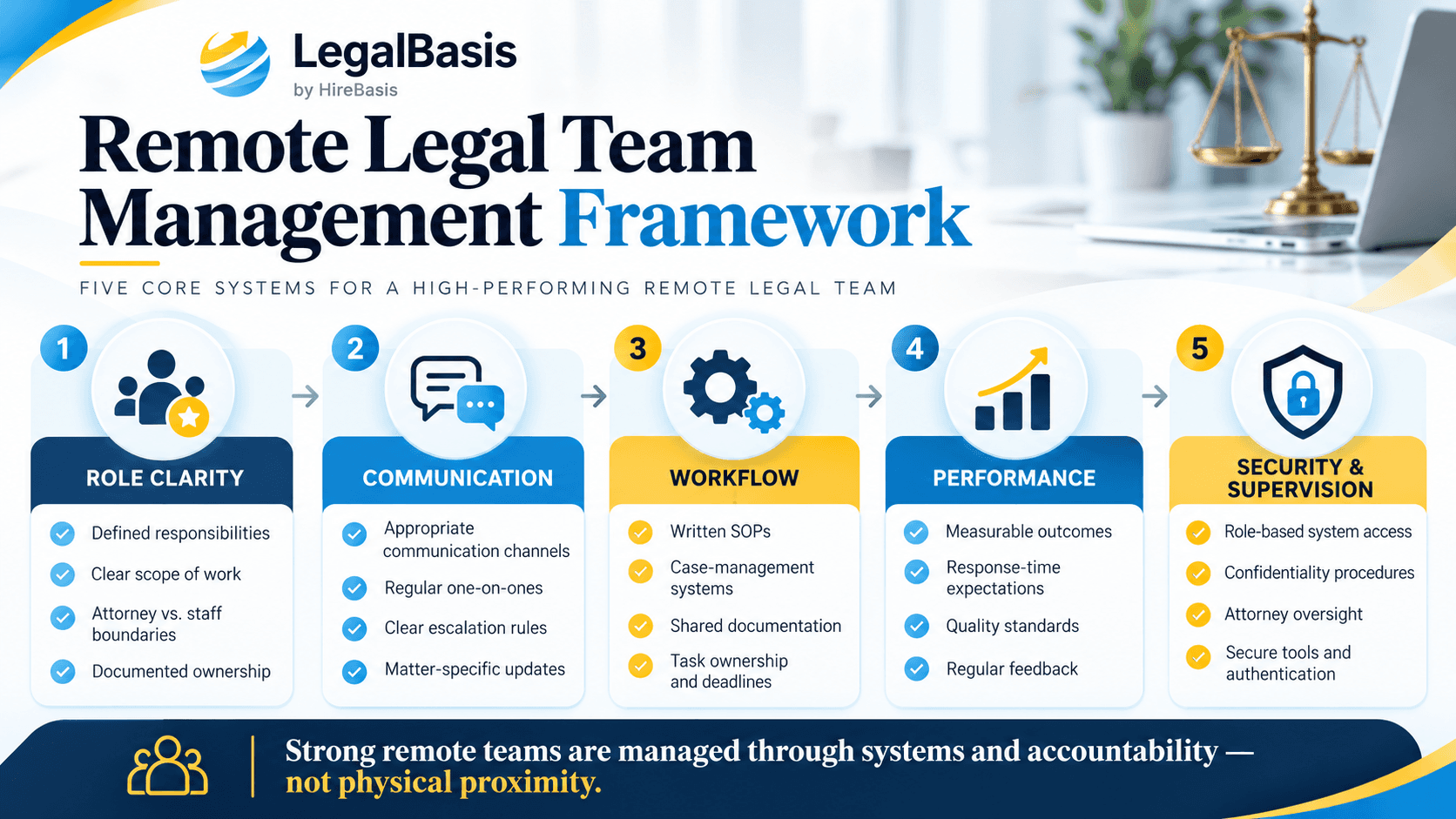
A remote legal employee should know:
what they are responsible for;
what they may handle independently;
what requires attorney review or approval;
when something needs to be escalated;
what deadlines and response-time standards apply;
where information must be documented; and
how performance will be measured.
This is particularly important in legal services because responsibilities cannot simply be delegated without boundaries. Attorneys remain responsible for appropriate supervision, confidentiality, professional obligations, and ensuring that nonlawyer staff do not perform work outside their permitted role.
A useful remote operating model therefore replaces informal office assumptions with written processes.
Instead of assuming that someone knows how intake should be handled because they have overheard other employees doing it, create an intake workflow.
Instead of relying on someone walking into an attorney's office to report an urgent issue, establish escalation criteria.
Instead of storing instructions inside email threads, place them in shared operating procedures.
Remote teams expose weak processes, but that can actually benefit a growing law firm. Once a workflow is documented clearly enough for someone across the world to follow it, the process usually becomes easier for everyone else in the firm to follow as well.
Do Not Manage Remote Employees Through Constant Meetings
More meetings do not necessarily create more control.
One of the best recent examples comes from P4B Law, a specialist employment firm that had operated remotely well before widespread hybrid working. During a 2026 case study about the firm's technology systems, founder Roger Davies explained: “We never had a meeting for the sake of having a meeting.” (Source: Legal Futures, May 28, 2026)
That is a useful principle for managing remote legal teams.
A distributed firm normally needs several different forms of communication rather than one endless stream of video meetings.
Urgent questions may belong in chat. Matter-specific information belongs in the case-management system. Process documentation belongs in a shared knowledge base. Performance issues deserve direct one-on-one conversations. Team meetings should focus on coordination, priorities, obstacles, training, and decisions.
The goal is not maximum communication. It is useful communication.
For teams that need help creating those connections intentionally, HireBasis' guide to virtual team building for remote employers and managers offers practical approaches to keeping distributed employees connected without making remote work feel like a calendar full of forced activities.
Manage Outcomes Instead of Watching Activity
One advantage of managing remote legal teams is that firms are pushed to define what good performance actually looks like.
Presence is an easy but unreliable management metric.
Someone can spend nine hours inside an office and still miss deadlines, fail to update matters, respond slowly to clients, and create additional work for attorneys.
A remote employee may complete the same workload far more efficiently.
James Geary, managing partner of EMW Law, summarized this distinction while discussing his firm's flexible 35-hour working model in June 2026: “We care about how people perform, not how long they sit at a desk.” (Source: Legal Futures, June 11, 2026)
That approach can be adapted to remote legal staff through measurable expectations.
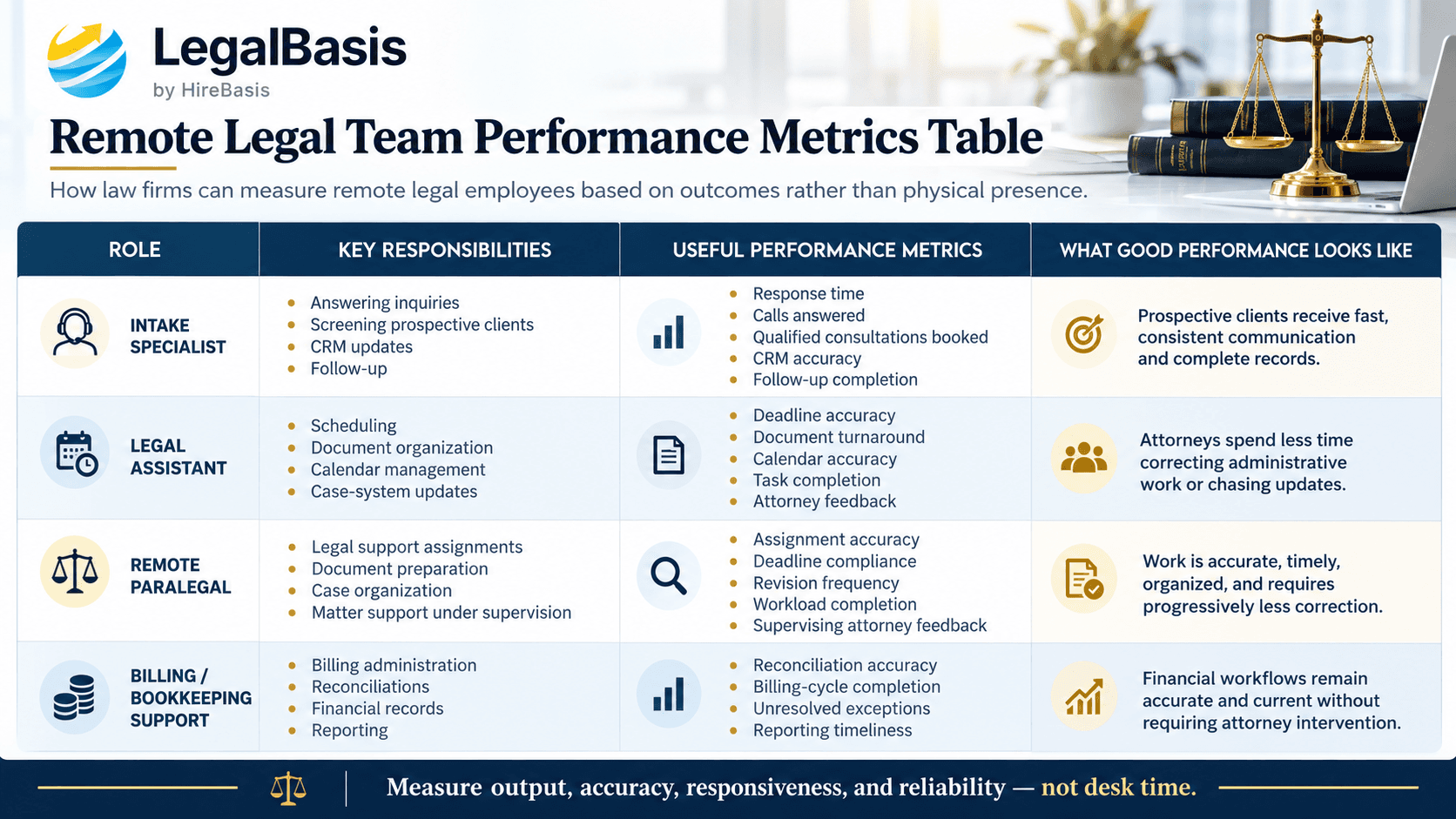
For an intake specialist, that might include response times, calls answered, qualified consultations booked, CRM accuracy, and follow-up completion.
For a legal assistant, it might include deadline accuracy, calendar maintenance, document turnaround, case-system updates, and attorney feedback.
For a paralegal, performance measures may relate to assignments completed, substantive accuracy, deadline compliance, workload management, and the amount of revision required.
For billing or bookkeeping staff, firms can measure timeliness, reconciliation accuracy, unresolved exceptions, billing-cycle completion, and reporting reliability.
Legal operations leader Elizabeth Miller, who manages a remote team spread across the United States at Delta Dental, described her approach to organizational alignment by saying: “We're trying to keep everybody in sync and make sure we're all aligned.” (Source: Coheso, May 5, 2026)
That is ultimately what good remote management should accomplish: employees understand what matters, where their work fits, and how success is evaluated.
Build a Strong Onboarding Process
Remote hires cannot absorb a firm's culture and processes through proximity.
They need structured onboarding.
During the first weeks, a new legal team member should understand the firm's practice areas, organizational structure, communication standards, client-service expectations, case-management platform, document naming conventions, security requirements, escalation procedures, and attorney preferences.
Instead of giving the new employee access to ten systems and expecting them to “figure things out,” firms should provide a sequence.
For example:
Week one can emphasize the firm's structure, systems, security, and standard operating procedures.
Week two can introduce supervised live work.
Week three can expand ownership while maintaining regular review.
Over the following weeks, management can gradually reduce oversight as the employee demonstrates competence.
The objective is autonomy earned through evidence rather than autonomy assumed on day one.
This becomes even more important when scaling beyond the first hire. HireBasis' guide on scaling an offshore team without losing quality explores why standardization becomes increasingly important as distributed headcount grows.
Remote Culture Has to Be Deliberate
A physical office creates incidental interaction.
Remote teams do not.
That means culture, mentoring, recognition, and professional development have to become intentional management responsibilities.
Current research shows why.
A 2026 Obelisk Support survey of in-house lawyers reported that “86% of legal teams now incorporate some form of remote working.” The same research also found maintaining culture and cohesion among the most frequently reported challenges. (Source: Obelisk Support, 2026)
The solution is not necessarily requiring everyone to return to the same building.
It is creating repeated opportunities for people to learn from each other.
Managers can schedule short one-on-ones, matter debriefs, mentoring sessions, peer reviews, training calls, and team discussions around difficult cases or recurring operational issues.
This is especially important for junior employees.
Law Society research discussed by the Law Gazette in July 2026 found widespread use of flexible arrangements while also highlighting that flexible work does not affect everyone equally. Law Society president Mark Evans observed that “flexible working can help, it does not always benefit everyone equally.” (Source: Law Gazette, July 17, 2026)
A strong remote policy therefore gives employees flexibility without confusing flexibility with isolation.
Build Systems That Make Distance Almost Irrelevant
The technology stack should allow a law firm to answer several questions quickly:
Who owns this task?
When is it due?
What happened last?
Which document is current?
What does the client need next?
Does an attorney need to review something?
What work is becoming delayed?
If those answers are buried across personal inboxes, direct messages, spreadsheets, handwritten notes, and individual desktops, adding remote staff will make the problem more visible.
Centralized systems reduce that friction.
Case-management software, secure document platforms, business phone systems, password management, role-based permissions, videoconferencing, shared calendars, task-management tools, and standardized reporting can create visibility without requiring managers to constantly message employees asking for updates.
This principle applies whether the employee is two blocks away or eight time zones away.
The goal of managing remote legal teams should be to build a firm where the workflow itself provides management visibility.
Security and Confidentiality Must Be Designed Into the Workflow
Remote legal staffing should never mean simply sending passwords and client documents to someone's personal laptop.
Law firms handling sensitive information should establish clear policies around devices, passwords, multifactor authentication, document storage, approved communication channels, access permissions, software, network security, and handling of client information.
Access should also follow the principle of least privilege: employees should have the systems and information necessary to perform their responsibilities rather than blanket access to everything in the firm.
When an employee changes roles or leaves the organization, access should be easy to revoke.
The same principle applies to AI and other third-party technology. Remote employees need explicit rules regarding which tools are approved and what client or firm information can be entered into them.
Distance does not reduce the firm's responsibility to supervise how information is handled.
International Hiring Requires an Employment Structure
Finding a talented international employee is only part of the process.
The firm also needs to determine how the employment relationship will work.
Is the person genuinely an independent contractor? Will they become an employee? Does the firm have a local entity in the worker's country? Who handles payroll, withholding, statutory benefits, employment agreements, and local labor requirements?
These questions become more important as a relationship moves from occasional freelance assistance to a permanent team position.
HireBasis provides a useful breakdown of the differences in its contractor vs. employee remote worker compliance guide. Firms that have outgrown occasional contractors may also want to review when it makes sense to switch from freelancers to full-time remote employees.
One option is an Employer of Record. LegalBasis explains what an Employer of Record is and how the structure can support international employment where a business does not have its own local entity.
An EOR can generally become the local legal employer while the law firm directs the employee's day-to-day work. Depending on the country and provider, this may include employment contracts, local payroll, statutory benefits, tax withholding, and certain employment compliance responsibilities.
Law firms considering direct international arrangements should also understand the potential legal risks of hiring overseas employees without an EOR and how to pay remote employees internationally.
The appropriate structure depends on the jurisdiction and circumstances, so firms should obtain appropriate legal and tax advice rather than assuming one model works everywhere.
International Does Not Mean “Outsourced and Forgotten”
One of the most important cultural decisions a law firm can make is how it thinks about an international hire.
If the employee is treated like an external vendor, given isolated tasks, excluded from communication, and provided little context, management should not be surprised when the relationship feels transactional.
If the goal is to build a team, the individual should understand the firm's clients, standards, priorities, processes, and people.
Invite remote employees to relevant meetings.
Give them ownership where appropriate.
Provide feedback.
Explain why processes exist rather than providing instructions without context.
Recognize good work.
Include them in training.
Give experienced team members opportunities to suggest process improvements.
A strong remote employee should gradually become someone the attorneys trust, not someone attorneys need to continuously monitor.
Use Time Zones Strategically
International hiring sometimes creates time-zone differences, but those differences do not automatically create operational problems.
The firm first needs to identify which responsibilities require real-time overlap.
Reception and live intake may require the employee to work the firm's business hours.
Document preparation, research support, bookkeeping, CRM cleanup, reporting, database updates, and certain administrative functions may permit more asynchronous schedules.
In some workflows, time-zone differences can even extend operational coverage. Work prepared near the end of a U.S. attorney's day may be ready for review the following morning.
The key is to establish overlap expectations before hiring rather than discovering afterward that the employee and supervising attorney rarely work simultaneously.
Cost Savings Should Come From the Operating Model, Not Lower Standards
International staffing can materially change the economics of building a legal support team.
Compensation expectations vary across countries because local wages, living costs, taxes, and employment markets differ. That can allow a U.S. law firm to offer competitive compensation in an international employee's local market while still spending less than it might spend filling the same position locally.
But the strongest business case is not simply salary arbitrage.
A successful remote staffing model can also reduce recruiting constraints, office-space requirements, turnover caused by overloaded local staff, and the amount of administrative work performed by expensive attorneys.
The financial value becomes much larger when an attorney who has been spending ten hours every week on administrative work can redirect those hours toward clients, legal strategy, business development, and billable matters.
That is why firms should evaluate total value rather than asking only, “How much cheaper is this employee?”
The Best Model May Be Hybrid
Remote staffing does not require a law firm to become completely virtual.
Some firms may want attorneys in the office while keeping selected support roles remote. Others may combine local and international employees. Another firm may operate almost entirely remotely while maintaining conference space for clients and important meetings.
The best structure depends on the practice.
LegalBasis supports a hybrid staffing model for firms that want to combine traditional team members with remote professionals rather than replace one model completely.
The important question is not whether remote or in-office work is universally better.
It is which responsibilities need physical presence and which do not.
How LegalBasis Helps Law Firms Build Remote Teams
LegalBasis focuses specifically on helping law firms identify and hire remote talent.
Rather than asking attorneys to search through large pools of generic freelance profiles, the objective is to help firms define the position, identify appropriate candidates, evaluate fit, and structure a remote hiring process around the realities of legal work.
Through LegalBasis hiring support, firms can build roles around actual operational needs — whether that means paralegal capacity, administrative assistance, intake, case support, bookkeeping, client communication, or another remote-compatible function.
The result should not feel like outsourcing work to an anonymous person overseas.
It should feel like adding a capable employee to the firm.
Managing Remote Legal Teams Is Ultimately a Management Question
Remote staffing works best when a law firm stops treating location as its primary management control.
Clear expectations replace physical observation.
Documented workflows replace hallway instructions.
Performance metrics replace assumptions about productivity.
Secure systems replace local file access.
Structured feedback replaces incidental office interaction.
And careful hiring replaces geographic limitation.
That is why managing remote legal teams successfully has less to do with where employees are sitting and more to do with how the law firm itself operates.
A poorly managed firm can struggle with employees sitting ten feet apart.
A well-managed firm can coordinate attorneys and legal support professionals across cities, states, and countries while maintaining high standards of service.
For law firms willing to build those systems, international remote staffing does not have to mean compromising quality.
It can mean expanding the talent pool, creating more capacity, reducing unnecessary overhead, and giving attorneys more time to focus on the work that actually requires an attorney.
About the Author
Hasan Abdullah is the Founder of LegalBasis and President & Principal Attorney of American Visa Law Group. LegalBasis grew out of his firsthand experience building and managing a U.S. law firm with both local and international team members.
Through that experience, he saw that law firms can expand capacity by recruiting talented professionals globally while still retaining control over who they hire, how those professionals are trained, and how the work is managed.
LegalBasis was built around that model: helping law firms define the roles they need, recruit qualified international professionals, and support compliant international employment structures where appropriate.
Continue Reading
More practical guidance for building a stronger legal team.

Remote Legal Staffing
Remote vs In-House Legal Staffing: What Makes Sense for a Modern Law Firm?
Remote vs in-house legal staffing is no longer just about where employees work. For modern law firms, the better question is which roles truly require physical presence and which can be performed just as effectively by qualified remote professionals. This guide compares cost, quality, recruiting reach, compliance, role suitability, and hybrid staffing models to help attorneys build efficient, scalable teams without lowering professional standards.
Read Article →

Remote Legal Staffing
Bookkeeper for Attorneys: How to Hire Remote Legal Bookkeeping Talent Without Sacrificing Quality
Hiring a bookkeeper for attorneys no longer means limiting your search to local candidates. This guide explains how law firms can hire qualified remote and international bookkeeping professionals to manage billing, reconciliations, financial records, and recurring accounting tasks while maintaining quality, security, oversight, and trust-account controls.
Read Article →

Remote Legal Staffing
Is Virtual Staffing Legit? Review and LegalBasis Comparison for Law Firms
Virtual Staffing is a legitimate legal staffing provider offering pre-vetted remote professionals to U.S. law firms. This review examines how its managed staffing model works, what it costs, its key strengths and limitations, and how it compares with LegalBasis for firms deciding between virtual staffing and directly managed global remote hiring.
Read Article →
Build the Remote Team Your Law Firm Actually Needs.
Tell us what work your firm needs help with. LegalBasis can help define the role, recruit qualified international candidates, and explore an employment structure that fits your firm.