Remote Legal Staffing
Remote vs In-House Legal Staffing: What Makes Sense for a Modern Law Firm?
Remote vs in-house legal staffing is no longer just about where employees work. For modern law firms, the better question is which roles truly require physical presence and which can be performed just as effectively by qualified remote professionals. This guide compares cost, quality, recruiting reach, compliance, role suitability, and hybrid staffing models to help attorneys build efficient, scalable teams without lowering professional standards.
·
Founder, LegalBasis · President & Principal Attorney, American Visa Law Group
·
·
12 min read

Remote vs In-House Legal Staffing: What Makes Sense for a Modern Law Firm?
For decades, staffing a law firm followed a predictable formula: attorneys worked from an office, paralegals sat nearby, legal assistants handled files and calendars down the hall, and most administrative employees lived within commuting distance of the firm.
That model is no longer the only practical way to build a legal team.
Cloud-based case management, secure document systems, video meetings, electronic filing, and global recruiting have made it possible for many law firm roles to be performed from almost anywhere. At the same time, rising compensation, recruiting competition, employee turnover, and office overhead have pushed firm owners to reconsider whether every position really needs to be filled locally.
That makes remote vs in-house legal staffing less a debate about where people should sit and more a question of how law firms should allocate work.
Some positions benefit considerably from physical proximity. Others can be performed just as effectively remotely. And for many firms, the strongest answer is neither a completely remote firm nor a completely in-office one. It is a carefully designed hybrid team that keeps attorney judgment, leadership, supervision, and important client relationships close to the firm while expanding support capacity through qualified remote professionals.
Remote vs In-House Legal Staffing Is Not an All-or-Nothing Decision
One of the biggest mistakes firms can make is treating remote and in-house staffing as competing philosophies.
The question does not have to be, “Should our law firm become remote?”
A more useful question is: Which responsibilities genuinely require physical presence, and which require skill, reliability, communication, and supervision regardless of location?
The legal industry itself is still working through that distinction.
In March 2025, Reuters reported that firms including Paul Weiss and WilmerHale were moving lawyers toward four-day office schedules. A Paul Weiss spokesperson explained the firm's reasoning: “By being physically present together, we better develop our talent and ensure that we continue to deliver the level of extraordinary service that our clients expect.” Source: Reuters — Four-day office mandates spread at big US law firms
That concern should not be dismissed. Mentorship, spontaneous collaboration, attorney training, sensitive client meetings, courtroom preparation, and firm culture can all benefit from people being physically together.
But the same Reuters report noted that firms such as Quinn Emanuel and Husch Blackwell continued to offer full-time alternatives to in-person work, while Fennemore Craig had launched a program to hire attorneys in places where it did not maintain offices.
The industry is therefore not choosing one model. It is experimenting with several.
Physical Presence Should Have a Purpose
Simply putting an employee in an office does not automatically make the employee more productive.
Anthony Kenny, assistant general counsel at GSK, made that point during a 2025 Law Society discussion about hybrid legal teams: “If you come in and sit in a cubicle or a telephone kiosk for four or five hours doing calls, what’s the point of that?” Source: The Law Society — Making hybrid work in the legal sector
That is an important principle for law-firm staffing.
If an employee spends most of the day working inside Clio, MyCase, Filevine, Microsoft 365, Google Workspace, a CRM, an accounting platform, a document management system, email, and Zoom, their physical location may have relatively little influence on output.
On the other hand, if a position depends heavily on physical files, courthouse runs, in-person consultations, office management, notarization requirements, or continuous face-to-face attorney training, local staffing may make more sense.
The position should determine the working model—not tradition alone.
What Does In-House Legal Staffing Really Cost?
Salary is only the first line of the staffing equation.
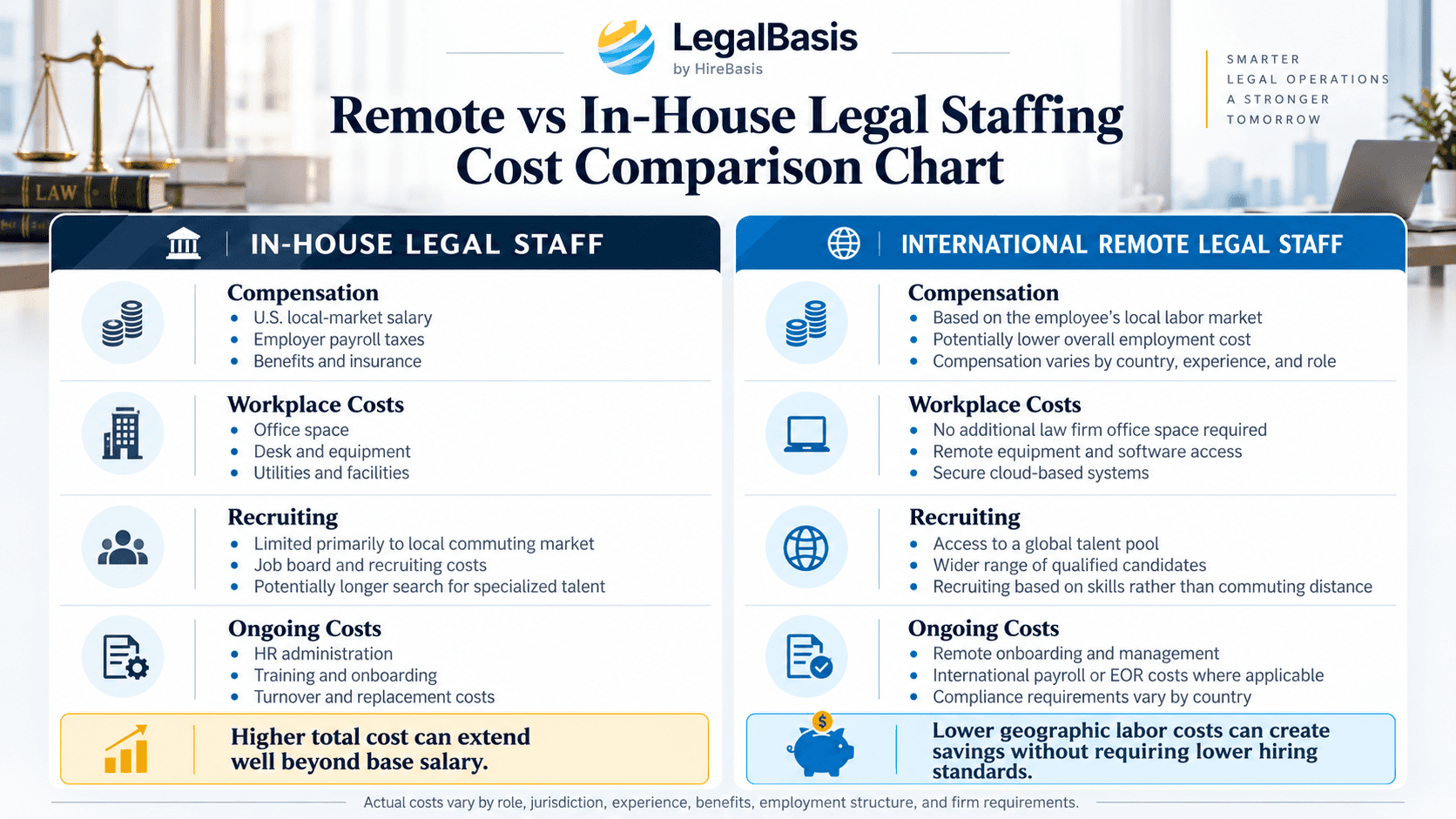
According to updated U.S. Bureau of Labor Statistics data, the median annual wage for paralegals and legal assistants was $62,890 in May 2025, while approximately 40,800 openings are projected annually on average over the following decade, primarily because workers leave the occupation or workforce.
Legal secretaries and administrative assistants had a median annual wage of $55,570 in May 2025.
Those numbers are compensation—not necessarily the firm's fully loaded cost.
An in-house employee may also involve employer payroll taxes, benefits, recruiting expenses, equipment, office space, payroll administration, HR management, workers' compensation, onboarding costs, training, and the financial impact of turnover.
For difficult searches, recruiting itself can become another operational burden. Firms struggling to find specialized local candidates may benefit from using a more deliberate approach to recruiting for hard-to-fill roles rather than repeatedly posting the same position in a limited geographic market.
International recruiting changes that equation because compensation markets vary dramatically from country to country.
LegalBasis, for example, is structured around recruiting and screening international legal professionals while allowing the law firm itself to interview, select, train, and manage the person. Its site describes potential savings of up to 70% compared with comparable domestic hiring, while expressly noting that actual savings depend on the role, country, experience, benefits, and employment arrangement.
The economics are not based on hiring someone “cheaper because they are worse.”
They are based on differences between labor markets.
A highly educated professional living in another country may have compensation expectations that are attractive by local standards while remaining materially below the cost of hiring for the same function in New York, California, Washington, D.C., or another expensive U.S. market.
Can International Remote Legal Staff Really Deliver the Same Quality?
Yes—but location does not guarantee quality in either direction.
An employee sitting ten feet from an attorney can be poorly trained, disorganized, unresponsive, or wrong for the job. A professional working thousands of miles away can be highly experienced, responsive, meticulous, and deeply integrated into a firm's operations.
The reverse can also be true.
Quality depends heavily on candidate selection, relevant experience, English proficiency where required, practice-area familiarity, communication ability, technology skills, onboarding, documented workflows, feedback, supervision, and whether the employee was hired for work that actually matches their capabilities.
Jaime Cage, managing partner of Cage & Miles, described a results-oriented approach in an American Bar Association roundtable in which she said approximately 45% of the firm's workforce was fully remote: “We avoid a ‘face time’ culture: success is measured by performance and results, not hours spent at a desk.” Source: American Bar Association — Managing Partners’ Roundtable
That is arguably the more useful standard for evaluating remote staff.
Was the intake completed correctly? Were deadlines entered? Were documents organized? Was the draft accurate? Were clients followed up with? Were reconciliations completed? Were case notes entered properly? Did the employee respond quickly? Did the supervising attorney have to redo the work?
Those questions measure quality more meaningfully than an office badge scan.
The International Talent Pool Changes Who a Firm Can Hire
Remote staffing also removes one of the oldest constraints in recruiting: commuting distance.
A traditional firm may effectively search within 20, 30, or 50 miles of an office.
A global search can involve candidates across dozens of countries.
Forbes Business Council contributor Hamid Kohan argued in 2025 that the expanded labor pool was already influencing legal staffing, writing: “A paralegal or intake specialist in Latin America, for example, can deliver the same or higher quality work at a significantly reduced cost.” Source: Forbes Business Council — The End of Traditional Law Firms? Virtual Staffing Is on the Rise
That is an opinion from an executive in the virtual legal staffing industry rather than proof that every offshore hire will outperform a domestic one. But the underlying recruiting principle is important: expanding the search geography creates a larger candidate pool.
The objective should be to use that larger pool to increase selection quality, not simply to locate the lowest salary.
Firms considering this strategy can review which law-firm roles can be performed remotely before deciding which positions belong in a global search.
Which Law Firm Roles Are Best Suited to Remote Staffing?
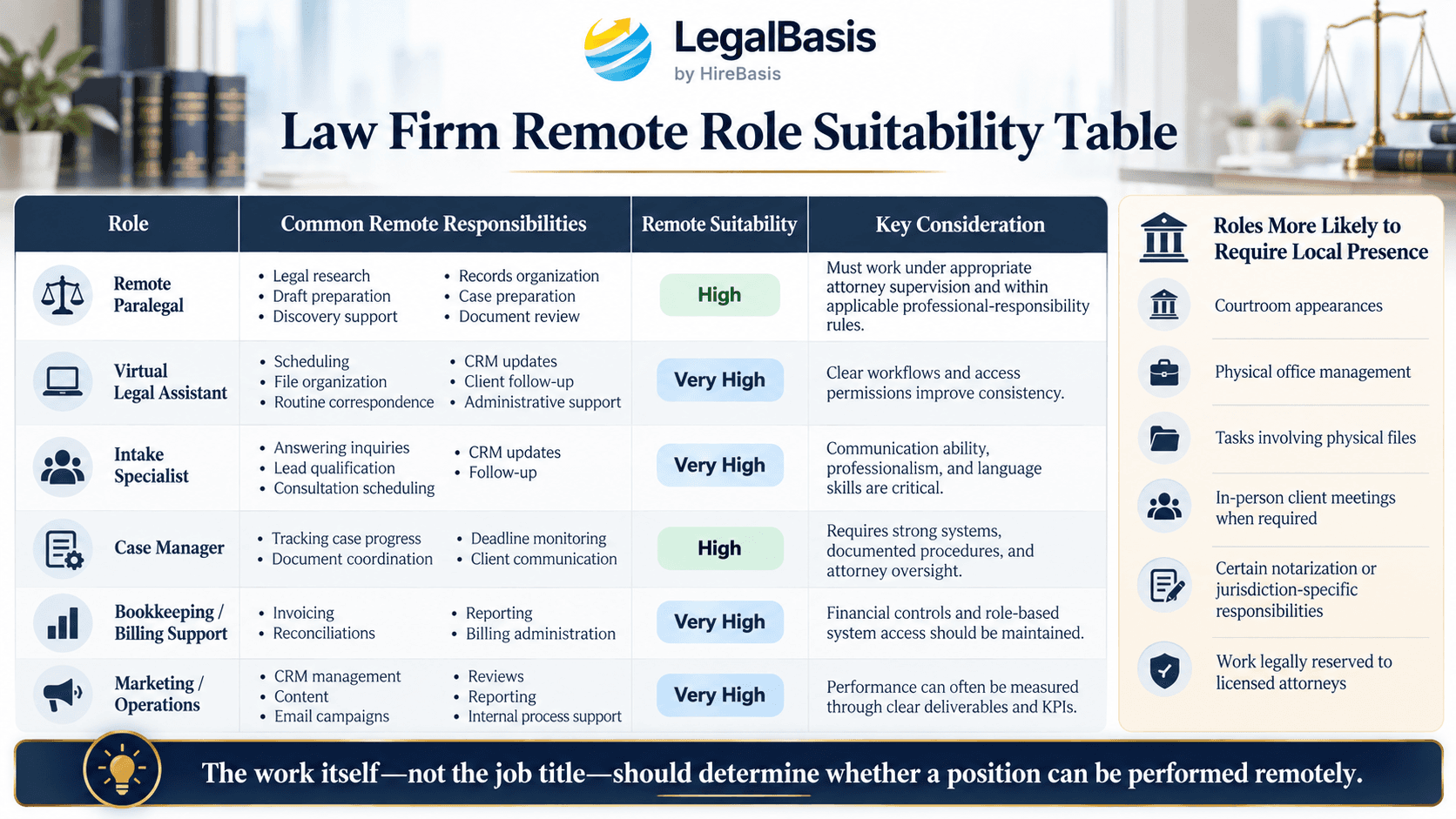
Not every job should be moved offshore, but a surprisingly large portion of law-firm operations can be performed remotely when the right systems and supervision are in place.
Common possibilities include:
Remote paralegals, supporting research, drafting, discovery, records, case preparation, document review, and other substantive support under attorney supervision; virtual legal assistants, handling calendaring, file organization, correspondence, client follow-up, and routine administration; intake specialists and reception staff, managing calls, leads, consultations, CRM updates, and follow-ups; case managers, coordinating documents, deadlines, client communications, and case progress; bookkeepers and billing support professionals, assisting with invoicing, reconciliations, reporting, and financial administration; and marketing and operations staff, supporting CRM management, content, email campaigns, reviews, website administration, reporting, and internal processes.
For firms deciding between two of the most common positions, LegalBasis has a separate breakdown of a virtual legal assistant vs. a remote paralegal.
And when the need is specifically paralegal support, the firm's guide to hiring a remote paralegal compares domestic remote employment, traditional virtual staffing, and international hiring.
Some Legal Work Still Benefits From Being Local
Remote staffing should not become an excuse to delegate work that should remain with attorneys or experienced local professionals.
Lara Shortz, Los Angeles office managing partner at Michelman & Robinson, wrote about this balance in 2025. She noted that “remote or hybrid work models are gaining popularity for good reason: They can reduce commuting time and offer greater flexibility for personal commitments.” Source: Reuters — Managing the midsize law firm: meeting today's challenges head-on
But Shortz also emphasized the importance of direct interaction for junior lawyers, particularly when they need mentorship from senior attorneys.
That distinction matters.
High-level legal judgment, strategy, attorney-client counseling, courtroom advocacy, supervision, and work reserved to licensed lawyers should remain under appropriate attorney control. Firms must also comply with applicable professional-responsibility rules concerning supervision, confidentiality, competence, unauthorized practice of law, and technology.
The purpose of remote support should be to give attorneys more time for attorney work, not to blur the line between attorney and non-attorney responsibilities.
Remote vs In-House Legal Staffing: Side-by-Side
Factor | Traditional In-House Staffing | International Remote Staffing |
|---|---|---|
Talent pool | Primarily local | Potentially global |
Compensation | Domestic market rates | Based on worker's local labor market |
Office requirement | Usually requires workspace | Usually none |
Recruiting reach | Geographic limitations | Significantly wider |
Face-to-face collaboration | Easy | Requires intentional virtual communication |
Direct management | Yes | Yes, depending on model |
Client-facing suitability | Strong | Depends on role, communication skills, language and workflow |
Scaling | May require additional space and local recruiting | Can expand without additional office capacity |
Employment complexity | Familiar domestic structure | International employment compliance must be addressed |
Best use | Physical, relationship-heavy or locally dependent work | Digitally deliverable support and operational work |
The important point is not that one column is universally superior.
A sophisticated staffing strategy can use both.
The Hybrid Legal Staffing Model
For many firms, a hybrid structure offers the most practical compromise.
LegalBasis describes its hybrid model as keeping attorney judgment, leadership, client relationships, and supervision with the local team while adding remote capacity for legal administration, paralegal support, intake, marketing, and operations.
That can mean a five-attorney firm keeps its attorneys and senior paralegal locally while adding a remote intake specialist, legal assistant, bookkeeper, and additional paralegal capacity.
The local team does not disappear.
It becomes more leveraged.
Interestingly, distributed legal models are already being used at a much larger scale. In 2025, FisherBroyles continued expanding its distributed law-firm model internationally, including growth in Mexico. Cofounder and managing partner Kevin Broyles said, “Earlier this year, we expanded into Mexico in direct response to the growing demand for our unique distributed model and exceptional client service.” Source: FisherBroyles — International expansion announcement
The American Bar Association has similarly examined distributed law firms, noting that modern technology and remote work can enable firms to handle sophisticated cross-border matters with less reliance on traditional office infrastructure.
Remote Staffing Still Requires Culture
Lower operating costs mean very little if turnover is constant.
International employees should not be treated like anonymous task processors simply because they work remotely.
They need onboarding, context, feedback, access to the right information, regular communication, performance expectations, professional respect, and opportunities to understand how their work contributes to the firm.
A 2026 Thomson Reuters Institute discussion on legal talent captured the broader issue well. One panelist said: “People need to want to be part of your team, they need to feel prized once they’re there.” Source: Thomson Reuters Institute — Law firms need to play the long game on talent
That principle applies just as much to an employee in Bogotá, Sarajevo, Manila, Buenos Aires, Johannesburg, or Cairo as it does to someone working inside the firm's U.S. office.
Firms building distributed teams should therefore invest in deliberate communication and virtual team-building practices, particularly as the remote headcount expands.
The objective is not to create a separate “offshore team.”
The objective is to create one law-firm team whose members happen to work from different locations.
The Counterargument: Offshore Staffing Can Fail
There are legitimate criticisms of international staffing, and firms should take them seriously.
Australian law-firm principal Blair McNamara wrote in February 2026 that offshore staffing had not worked well for his practice, particularly for complicated work. He wrote: “I don’t think it works well, certainly for complex legal work - I don’t think it provides great staff and client interactions.” Source: Blackburn Lawyers — Offshore staffing in law firms, why it hasn't worked for us
That experience highlights an important point: remote staffing is not automatically successful simply because the economics look attractive.
A firm that hires the cheapest available person, provides minimal training, delegates poorly defined work, offers weak supervision, and expects instant results may end up disappointed.
The same would be true of a badly managed local hire.
The answer is better role design, better recruiting, better screening, better onboarding, and better management.
HireBasis provides a broader framework for scaling an offshore team without losing quality. For law firms specifically, the principle is straightforward: standardize repeatable processes before distributing them.
International Hiring Also Creates Employment Questions
There is another major difference between hiring someone remotely in another U.S. state and hiring someone in another country: employment infrastructure.
Worker classification, payroll, tax withholding, statutory benefits, employment agreements, termination requirements, leave rules, and other obligations vary by jurisdiction.
Simply calling someone an “independent contractor” does not necessarily make the classification legally correct.
Firms should therefore examine the difference between a contractor and an employee in remote hiring and understand the potential risks of hiring overseas employees without appropriate employment infrastructure.
One option is an Employer of Record.
An EOR generally becomes the formal employer in the worker's country and handles functions such as local payroll, employment documentation, statutory requirements, and routine employment administration while the client company directs the employee's day-to-day work.
LegalBasis has a dedicated explanation of what an Employer of Record is and how it can fit into international law-firm hiring.
An EOR is not necessary or appropriate in every situation, but firms considering long-term international employees should evaluate the employment structure rather than treating compliance as an afterthought.
The Real Question Is Where Attorney Time Creates the Most Value
Ultimately, remote vs in-house legal staffing should be evaluated through attorney leverage.
Every hour an attorney spends scheduling consultations, chasing documents, cleaning up a CRM, organizing digital folders, sending routine reminders, formatting documents, reconciling administrative information, or repeatedly updating case-management records is an hour that cannot be spent advising clients, developing case strategy, appearing in court, negotiating, supervising legal work, or developing new business.
Hiring more support capacity can solve that problem.
Hiring that capacity internationally can sometimes solve it at a substantially lower total cost.
And keeping selected positions local can preserve the face-to-face interaction, mentorship, and physical presence that the firm considers important.
Those ideas are compatible.
How LegalBasis Approaches Remote Legal Staffing
LegalBasis by HireBasis is designed around that hybrid philosophy.
Instead of simply assigning a generic virtual assistant to a law firm, LegalBasis helps firms define the position and recruit and screen candidates from a global talent pool. The law firm then reviews the candidates, conducts interviews, selects the person it wants, manages the employee's day-to-day work, and keeps the professional inside the firm's existing systems and workflows. EOR-supported employment is available where applicable.
The distinction is important.
The remote professional is meant to become part of the firm's operating team—not an anonymous outsourced task service.
Firms that are unsure where to begin can use LegalBasis's hiring support process to determine which responsibilities belong in a remote position and what type of candidate the firm should actually recruit.
Final Thoughts: Build the Team Around the Work, Not the ZIP Code
The traditional law office is not disappearing.
Neither is remote work.
The more useful development is that law firms now have more options for deciding where and how work gets done.
A strong in-house employee can be invaluable. A strong international remote employee can be invaluable. A poor hire can become expensive regardless of where that person sits.
The opportunity is therefore not simply to replace domestic workers with lower-cost international workers.
It is to redesign the firm's staffing structure intelligently.
Keep work local when physical presence, licensing, direct mentorship, attorney judgment, sensitive client interaction, or office operations make that valuable. Use remote professionals when the work is digitally deliverable and the firm can provide the systems, supervision, training, and accountability necessary for excellent performance.
Done correctly, international remote staffing can deliver substantially lower employment costs without requiring a law firm to accept lower standards. In some cases, access to a much larger talent pool may even allow the firm to find a stronger candidate than it could recruit locally.
The winning model may therefore be neither “remote” nor “in-house.”
It may simply be the right person, doing the right work, in the right staffing structure—regardless of geography.
About the Author
Hasan Abdullah is the Founder of LegalBasis and President & Principal Attorney of American Visa Law Group. LegalBasis grew out of his firsthand experience building and managing a U.S. law firm with both local and international team members.
Through that experience, he saw that law firms can expand capacity by recruiting talented professionals globally while still retaining control over who they hire, how those professionals are trained, and how the work is managed.
LegalBasis was built around that model: helping law firms define the roles they need, recruit qualified international professionals, and support compliant international employment structures where appropriate.
Continue Reading
More practical guidance for building a stronger legal team.

Remote Legal Staffing
Is Virtual Staffing Legit? Review and LegalBasis Comparison for Law Firms
Virtual Staffing is a legitimate legal staffing provider offering pre-vetted remote professionals to U.S. law firms. This review examines how its managed staffing model works, what it costs, its key strengths and limitations, and how it compares with LegalBasis for firms deciding between virtual staffing and directly managed global remote hiring.
Read Article →
Remote Legal Staffing
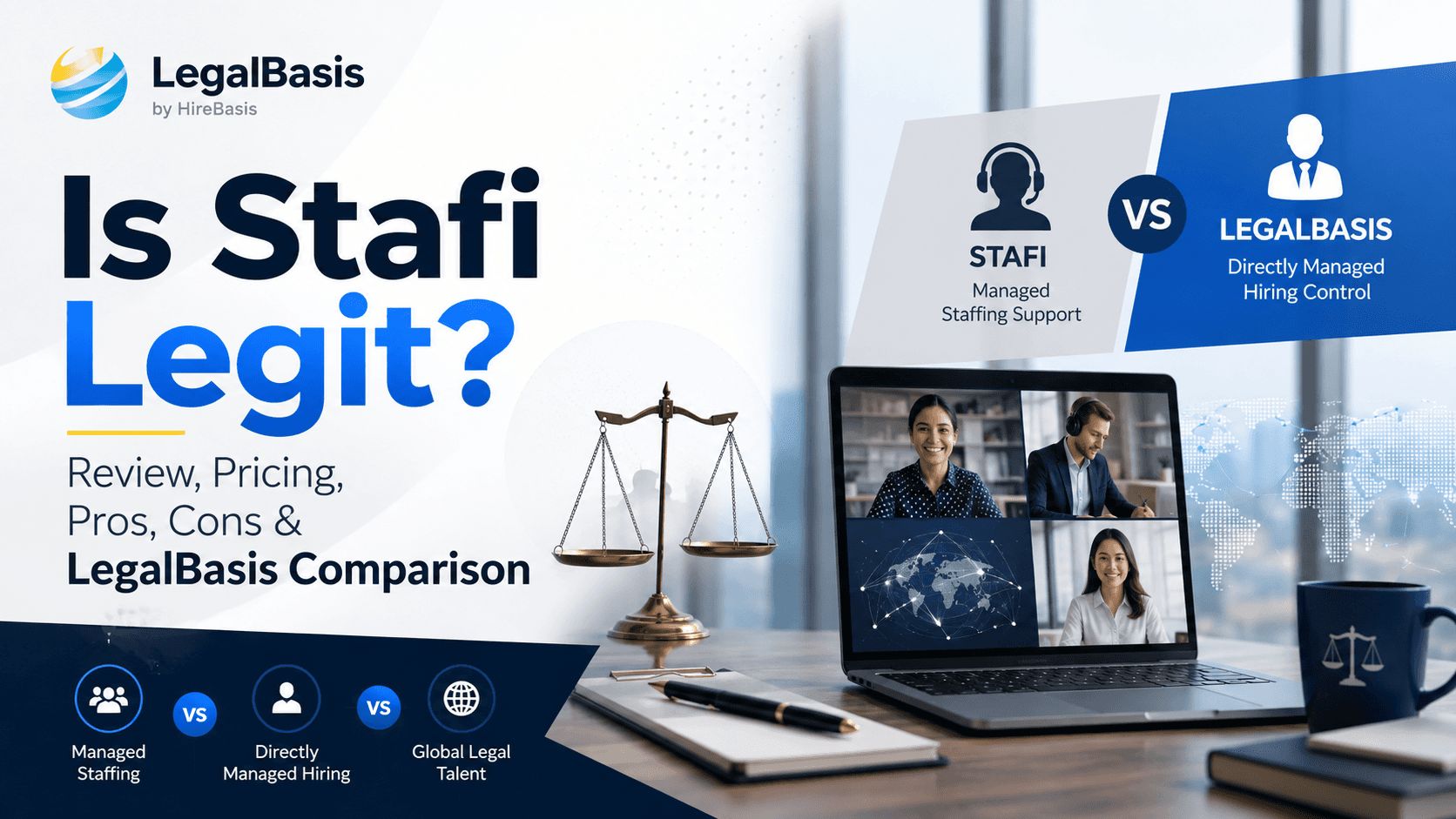
Is Stafi Legit? Remote Legal Staffing vs. LegalBasis
Is Stafi legit? This Stafi review examines its remote legal staffing services, training, 24/7 intake, pricing model, and reputation, then compares Stafi with LegalBasis to help law firms decide between managed virtual staffing and directly managed international remote hiring.
Read Article →

Remote Legal Staffing
Is LegalSoft Legit? Honest LegalSoft Review for Law Firms
Is LegalSoft legit? This LegalSoft review examines its virtual legal staffing model, current pricing, candidate pool, advantages, potential drawbacks, and how LegalSoft compares with LegalBasis for law firms considering international remote talent.
Read Article →
Build the Remote Team Your Law Firm Actually Needs.
Tell us what work your firm needs help with. LegalBasis can help define the role, recruit qualified international candidates, and explore an employment structure that fits your firm.