Remote Legal Staffing
Virtual Assistant for Attorneys: How Law Firms Can Hire Remote Support Without Sacrificing Quality
A virtual assistant for attorneys can help law firms delegate administrative and legal-support work, reduce staffing costs, and free attorneys to focus on higher-value legal work. This guide explains what virtual legal assistants can handle, how international hiring can maintain strong quality, and how to structure remote legal support effectively.
·
Founder, LegalBasis · President & Principal Attorney, American Visa Law Group
·
·
12 min read

Virtual Assistant for Attorneys: How Law Firms Can Hire Remote Support Without Sacrificing Quality
Running a law firm creates an unusual staffing problem: attorneys generate the greatest value when they are practicing law, advising clients, developing strategy, and handling work that requires an attorney’s judgment. Yet a significant part of the average workday can disappear into scheduling, client follow-up, document organization, intake, billing coordination, file management, and other recurring tasks.
A virtual assistant for attorneys can change that equation.
For many law firms, the right virtual legal assistant is not simply an outsourced person completing occasional tasks. They can become a dedicated member of the firm’s support team, working remotely alongside attorneys, paralegals, intake staff, and administrators.
And increasingly, that person does not necessarily need to live in the United States.
International hiring gives law firms access to a much larger pool of professionals, including experienced candidates who may work at materially different compensation levels than comparable U.S. hires. The important distinction is that lower labor cost does not automatically mean lower-quality work. A carefully selected international professional with strong communication skills, relevant experience, good systems, and proper supervision can provide excellent support.
The goal is not to find the cheapest person available.
It is to stop paying premium local labor costs for every responsibility in the firm when some of those responsibilities can be performed effectively by a qualified remote professional.
What Is a Virtual Assistant for Attorneys?
A virtual assistant for attorneys is a remote professional who supports the operational, administrative, client-service, or legal-support functions of a law practice.
The exact role varies substantially between firms.
A solo attorney may need someone primarily for scheduling, inbox management, intake, and client follow-up. A growing immigration, personal injury, family law, estate planning, or business law practice may need a dedicated professional managing case files, preparing routine documents, coordinating records, updating a case-management system, or supporting attorneys with recurring matter administration.
Typical responsibilities can include:
Scheduling appointments and consultations
Managing attorney calendars
Organizing digital case files
Client follow-up and routine communication
New-client intake
Updating CRM and case-management systems
Preparing correspondence from approved templates
Document formatting and proofreading
Gathering and organizing records
Billing and invoice administration
Data entry
Monitoring routine deadlines
Preparing internal reports
Following up on missing documentation
Managing email and administrative workflows
Marketing and CRM administration
Depending on a person’s experience and the permitted scope of the position, a remote professional may also perform more substantive legal-support responsibilities under attorney supervision.
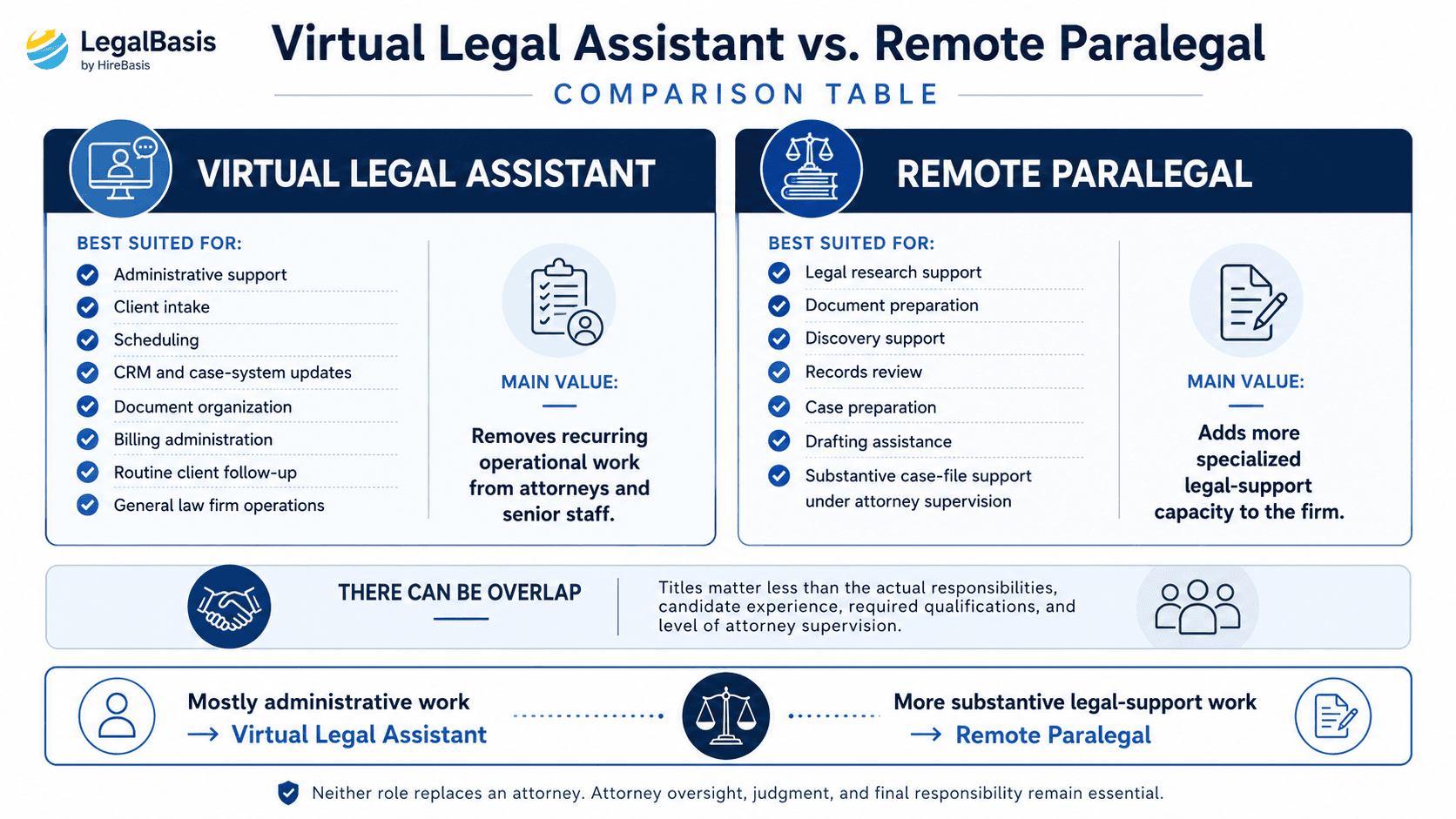
That distinction matters. A virtual legal assistant and a paralegal are not automatically interchangeable. Firms deciding between the two should review the differences between a virtual legal assistant vs. remote paralegal.
Why Attorneys Need More Leverage, Not Simply More Hours
There is a simple question every law firm owner should periodically ask:
What work is an attorney doing today that does not actually require an attorney?
The pressure to allocate legal work more intelligently is visible even inside sophisticated firms. Litigation partner Jennie Bennett described the reality of working on a lean team to Reuters: “I am sometimes doing things a paralegal would do, and some things a senior partner would do, and that's my day.” Her comment is a useful reminder that when highly compensated attorneys repeatedly absorb support-level work, the issue is not necessarily effort—it may be staffing design.
Calendar coordination does not normally become more valuable because a lawyer performs it.
Neither does chasing a missing document, updating a CRM field, organizing an electronic file, confirming an appointment, preparing a routine report, or sending an approved follow-up message.
Clio's updated 2026 law-firm staffing guidance specifically identifies remote legal assistants as an option for firms and highlights functions including scheduling, billing, contract management, document review, and legal research depending on the position.
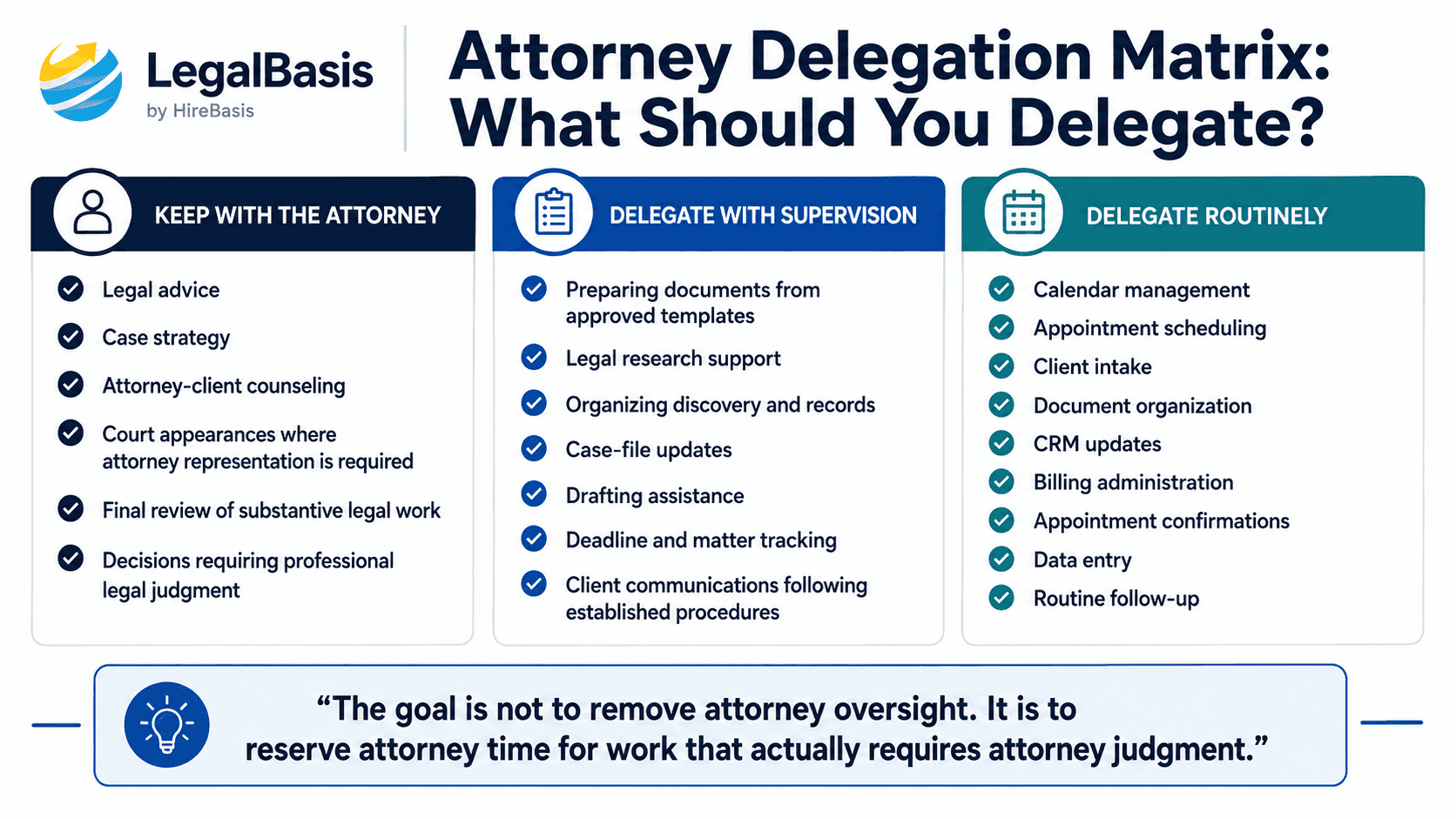
Delegation allows a firm to move the right work to the right level of the organization.
Instead of asking an attorney to somehow become more productive within the same number of hours, the firm increases the amount of productive capacity surrounding that attorney.
That is one reason firms should look broadly at law firm roles that can be performed remotely, rather than evaluating remote hiring only for one position.
Can an International Virtual Assistant Really Deliver the Same Quality?
Yes, depending on the person, responsibilities, hiring process, training, and supervision.
Nationality is not a measure of work quality.
A poorly screened local employee can be a bad hire. A highly capable international employee can be an excellent one. What matters is whether the candidate can actually perform the work the firm needs.
For a virtual assistant for attorneys, that means evaluating factors such as:
Written and Verbal Communication
If the person will communicate with attorneys, staff members, prospective clients, or existing clients, their English needs to match the responsibilities of the position.
Do not simply ask a candidate whether they speak English.
Interview them live. Give them written exercises. Evaluate grammar, comprehension, tone, professionalism, and their ability to explain information clearly.
Relevant Experience
Someone who has previously worked with lawyers, professional-services firms, case-management systems, document-heavy workflows, customer intake, or administrative operations may require less ramp-up than a general-purpose assistant.
For more specialized work, relevant legal-support experience becomes increasingly important.
Ability to Follow Procedures
Law firms depend on consistency.
A candidate should be able to follow checklists, naming conventions, communication protocols, escalation procedures, templates, approval requirements, and confidentiality rules without improvising where they should not.
Technology Skills
Remote professionals should be comfortable working inside the systems the firm actually uses.
That could include practice-management software, cloud document platforms, Microsoft 365, Google Workspace, CRMs, VoIP systems, scheduling software, secure password managers, e-signature platforms, and internal communication tools.
Judgment About Escalation
One of the most valuable qualities in support staff is knowing when not to act independently.
A good assistant recognizes the difference between routine work that follows an established procedure and something requiring an attorney’s review or judgment.
That is especially important in a law firm.
The broader legal hiring market is also putting more weight on demonstrated experience. Reuters reported that U.S. firms had shifted toward more experienced attorney hires, with the underlying Firm Prospects report describing firms' preference for people who can “hit the ground running” and contribute more quickly. The same principle is useful when recruiting international support: geography should be secondary to whether the candidate can demonstrate the communication, judgment, skills, and experience required for the position.
International Hiring Should Be About Value, Not the Lowest Possible Rate
There is a legitimate economic reason U.S. law firms are interested in international hiring.
Compensation levels differ significantly between labor markets.
For context, the U.S. Bureau of Labor Statistics reported a median annual wage of $61,010 for paralegals and legal assistants in May 2024, while legal secretaries and administrative assistants had a median wage of $54,140. Those figures represent wages and do not capture every additional employer cost associated with hiring.
International compensation can be materially different.
LegalBasis currently lists compensation beginning at $6 per hour for select entry-level administrative and support roles, plus employment support beginning at $350 per month. Its published example shows an illustrative starting monthly total of approximately $1,390 for one such entry-level position. LegalBasis explicitly notes that experienced legal assistants, paralegals, case managers, intake professionals, and specialized staff generally require higher compensation and that actual costs vary by country, experience, schedule, benefits, and hiring arrangement.
That distinction is important.
A law firm should not try to turn an experienced $30-per-hour position into a $6-per-hour position simply because the employee is overseas.
Instead, international hiring allows the firm to ask:
What is competitive compensation for a genuinely capable person in the labor market where we are hiring?
When the answer is substantially below the cost of a comparable U.S. hire, the firm can create savings while still offering attractive employment to the professional in their own market.
That is a healthier and more sustainable model than treating international recruiting as a race to the lowest hourly rate.
What Should a Virtual Assistant for Attorneys Handle?
The best approach is to design the position around recurring responsibilities rather than starting with a vague request for “an assistant.”
Client Intake
A virtual assistant may:
Respond to incoming inquiries
Collect preliminary information
Enter information into the firm's intake system
Schedule consultations
Send approved follow-ups
Confirm appointments
Track leads that require another contact attempt
This can be particularly valuable because a marketing campaign is only useful if the firm responds effectively to the people it generates.
Administrative Support
This can include:
Calendar management
Inbox organization
Document management
Data entry
Internal reporting
Appointment confirmations
Billing administration
File creation and maintenance
Case Administration
Under the firm's procedures and appropriate attorney supervision, the employee might:
Organize records
Maintain matter files
Track outstanding documents
Update internal case information
Prepare documents from approved forms
Format correspondence
Coordinate routine client communications
Marketing and Business Development
Some attorneys need operational help outside case work.
A remote employee can also support:
CRM maintenance
Email campaigns
Website updates
Social media administration
Referral follow-up
Content coordination
Review-request workflows
Lead tracking
Not every responsibility belongs in the same role. Firms should define the actual job before recruiting.
If the role has become heavily substantive rather than administrative, the firm may be better served by following a structured process for how to hire a remote paralegal.
Virtual Assistant vs. Remote Paralegal
A virtual legal assistant generally focuses more heavily on administrative, operational, communication, intake, and document-management work.
A remote paralegal may have deeper experience performing substantive legal-support work under attorney supervision, such as research, discovery support, document preparation, records review, case preparation, or drafting assistance.
There can be significant overlap.
The appropriate title should follow the actual responsibilities and qualifications of the position rather than being used simply because one title sounds more attractive.
For firms struggling to determine what they actually need, LegalBasis offers law-firm hiring support focused on defining the role before recruiting candidates.
What Should Not Simply Be Handed to a Virtual Assistant?
Remote staffing does not remove an attorney's professional responsibilities.
The ABA has been clear that outsourcing itself is not the problem; responsibility is. Discussing ABA Formal Opinion 08-451, the American Bar Association summarized the rule this way: “a lawyer may outsource legal or nonlegal support services provided the lawyer remains ultimately responsible …” That distinction is fundamental to international legal staffing: remote professionals can provide meaningful support, but the supervising attorney cannot outsource the attorney's own professional obligations.
Lawyers should establish clear boundaries around tasks involving legal advice, independent legal judgment, representation, court appearances, or other activities that may constitute the practice of law.
The ABA's Model Rule 5.3 requires lawyers supervising nonlawyer assistance to make reasonable efforts to ensure that the person's conduct is compatible with the lawyer's professional obligations. ABA guidance on outsourced legal services also emphasizes attorney responsibility, confidentiality, supervision, competence, and unauthorized-practice concerns.
Applicable requirements can vary by jurisdiction and by the work being performed, so firms should evaluate their own professional obligations rather than assuming that a remote employee can perform every task simply because it can technically be completed online.
Good remote staffing does not eliminate attorney oversight.
It makes attorney oversight more valuable by removing work that does not require attorney judgment.
Contractor, Employee, or Employer of Record?
Hiring internationally also creates an employment-structure question.
A person working remotely from another country does not automatically become an independent contractor simply because they are overseas.
The appropriate structure depends on the working relationship and applicable laws.
Firms comparing the classifications can review HireBasis's contractor vs. employee guide.
There are generally several ways a company might engage international talent.
Independent Contractor
This can work for genuinely independent service providers, particularly project-based relationships, but classification should reflect the real working arrangement.
Employment Through the Firm's Own Foreign Entity
Larger organizations may establish local entities and employ workers directly, although doing so creates additional payroll, HR, tax, employment, and administrative requirements.
Employer of Record
An Employer of Record, or EOR, can employ a worker locally while the law firm manages that person's day-to-day responsibilities.
Firms unfamiliar with the model can start with what an Employer of Record is.
HireBasis also covers the legal risks of hiring overseas employees without an EOR and practical considerations around how to pay remote employees internationally.
Employment requirements differ between countries, so firms should evaluate the appropriate arrangement for the specific hire rather than relying on a single model everywhere.
How to Hire a High-Quality Virtual Assistant for Attorneys
Hiring remotely should not mean lowering the hiring standard.
In many cases, it should allow you to raise it.
1. Audit the Attorney's Workload
Start by identifying recurring work currently performed by attorneys or senior staff.
Look for:
Repeated administrative tasks
Client follow-up
Scheduling
Intake
File organization
Document administration
Reporting
CRM work
Billing coordination
Do not begin recruiting until you know what the employee will own.
2. Build a Specific Job Description
Specify:
Core responsibilities
Required experience
Working hours
Time-zone overlap
Communication expectations
Software used
English requirements
Who supervises the employee
What requires attorney approval
For unusually difficult positions, the principles in HireBasis's guide to recruiting for hard-to-fill roles can also be applied to legal recruiting.
3. Screen Beyond the Resume
A resume tells you what someone claims to have done.
Testing shows you what they can do.
Depending on the position, consider:
Writing samples
Email-response exercises
Proofreading tests
Document-formatting exercises
Mock intake scenarios
Research exercises
Software assessments
Live communication interviews
4. Interview the Candidate Yourself
A staffing company can recruit and screen candidates.
The law firm should still make the hiring decision.
At LegalBasis, the firm interviews candidates, evaluates them, selects whom it wants to hire, trains the professional in its systems, and manages their work. LegalBasis supports the recruiting and employment process rather than making the person an invisible outsourced resource.
That distinction helps create accountability.
5. Build a Structured Onboarding Process
Remote employees need context.
Do not hand someone a login and expect them to reverse-engineer how your practice works.
Create:
Written SOPs
Example work
Checklists
Communication rules
Approval requirements
Escalation procedures
Access permissions
Training sessions
Quality-review processes
Good virtual team building is also operational, not merely social. Remote employees perform better when they understand who owns what, how the team communicates, and where to go when they need an answer.
6. Review Quality Early
Use the first 30, 60, and 90 days to evaluate:
Accuracy
Responsiveness
Communication
Reliability
Work volume
Ability to follow procedures
Client interaction
Attorney time saved
Recurring mistakes
Additional responsibilities the employee could reasonably absorb
The objective is not simply to confirm that the employee is busy.
It is to determine whether the firm has gained useful capacity.
Law firms are no longer debating whether technology belongs in legal work as much as how to use it well. At LegalWeek 2026, McCarthy Tétrault partner Susan Wortzman described how dramatically client expectations had changed: “Now they are saying you must use it.” For staffing, the more interesting model may therefore be neither human-only nor automation-only, but technology-enabled professionals who can use modern systems while taking responsibility for the work those systems cannot manage by themselves.
The Best Model May Be a Hybrid Law Firm
International hiring does not require replacing your local employees.
In many firms, that would be the wrong goal.
Some responsibilities benefit significantly from local knowledge, physical presence, established client relationships, jurisdiction-specific experience, or attorney-level expertise.
Other responsibilities can be performed extremely well remotely.
That creates a different model:
Keep the local team where local presence adds value. Add international remote capacity where location does not.
LegalBasis describes this as a hybrid staffing model: local leadership and core personnel supported by strategically selected remote professionals.
A five-person firm does not need to suddenly replace three employees overseas to benefit from global hiring.
It may simply need one excellent virtual assistant who removes 25 or 30 recurring responsibilities from attorneys and senior staff.
If that works, the model can grow gradually. Firms considering additional international hires can use the same principles outlined in HireBasis's guide to scaling an offshore team without losing quality.
Cheap Labor Is Not the Goal. A Better Cost Structure Is.
The strongest argument for a virtual assistant for attorneys is not that somebody in another country will work for less money.
That is only one component of the economics.
The stronger question is:
How much valuable attorney and senior-staff capacity can the firm recover by putting recurring work in the hands of the right person?
Suppose an attorney spends ten hours every week on scheduling, intake follow-up, document administration, email coordination, and file management.
Replacing those ten hours with support does not merely reduce administrative work.
It gives the attorney ten hours that can potentially be redirected toward clients, matters, business development, strategy, or simply a more sustainable workload.
That is leverage.
And when the person providing that support is recruited from a broader international labor market, the economics can become particularly attractive.
How LegalBasis Helps Law Firms Hire Remote Professionals
LegalBasis was built specifically around remote staffing for law firms and is powered by HireBasis.
The process begins with the firm's workload rather than a generic list of available candidates.
LegalBasis helps firms:
Understand the staffing need
Define the position
Recruit and screen potentially suitable remote professionals
Allow the law firm to interview and select candidates directly
Coordinate hiring and onboarding
Support an appropriate international employment structure, including EOR-supported employment where available
The law firm remains responsible for training, assigning work, supervising the employee, reviewing legal work where required, and integrating that person into the team.
That is ultimately what makes international staffing work.
The objective is not to buy anonymous outsourced labor.
It is to hire a capable person.
Frequently Asked Questions
Can attorneys hire virtual assistants?
Yes. Attorneys can use remote administrative and legal-support professionals, subject to applicable ethical rules, confidentiality obligations, supervision requirements, employment laws, and limits on unauthorized practice. ABA guidance expressly recognizes outsourcing of legal and nonlegal support while maintaining the supervising lawyer's professional responsibilities.
Can a virtual assistant work for a law firm from another country?
Many law-firm responsibilities can be performed remotely from another country. The firm should evaluate the employee's responsibilities, confidentiality and security procedures, working hours, supervision, and appropriate employment structure.
How much does a virtual assistant for attorneys cost?
The cost varies substantially by country, experience, responsibilities, schedule, language ability, and hiring structure. Entry-level administrative support can cost considerably less than experienced paralegal or specialized legal support. The goal should be to hire the right level of talent rather than simply selecting the lowest rate.
Is an international virtual assistant lower quality than a U.S. employee?
Not inherently. Quality depends on the individual candidate, their experience, communication ability, screening, training, procedures, technology, management, and the work assigned to them. A strong international candidate can match or exceed the performance of a local candidate for an appropriately designed remote role.
Can a virtual legal assistant give legal advice?
A nonlawyer virtual assistant should not independently perform work that constitutes unauthorized practice of law. Firms should establish clear role boundaries and provide appropriate attorney supervision based on applicable professional rules.
Should I hire a virtual assistant or a paralegal?
Hire according to the work. If the primary need is scheduling, intake, client communication, document organization, billing administration, and operations, a virtual legal assistant may be appropriate. If the position requires more substantive legal-support work, an experienced remote paralegal may make more sense.
Final Thoughts: Hire for Capability, Not Geography
A law firm does not become better because its staff works in the same building.
It becomes better when capable people have clearly defined responsibilities, strong systems, appropriate supervision, and accountability for their work.
That is what makes a virtual assistant for attorneys valuable.
International hiring can materially reduce the cost of building that support structure, but the real advantage is broader than savings. It gives law firms access to a larger talent pool and creates an opportunity to reorganize work around what actually requires an attorney.
Keep attorneys focused on attorney work.
Keep the local team where local presence matters.
And when a responsibility can be performed effectively by a qualified remote professional, hire the best person you can find—not simply the closest one.
About the Author
Hasan Abdullah is the Founder of LegalBasis and President & Principal Attorney of American Visa Law Group. LegalBasis grew out of his firsthand experience building and managing a U.S. law firm with both local and international team members.
Through that experience, he saw that law firms can expand capacity by recruiting talented professionals globally while still retaining control over who they hire, how those professionals are trained, and how the work is managed.
LegalBasis was built around that model: helping law firms define the roles they need, recruit qualified international professionals, and support compliant international employment structures where appropriate.
Continue Reading
More practical guidance for building a stronger legal team.

Remote Legal Staffing
Is Virtual Staffing Legit? Review and LegalBasis Comparison for Law Firms
Virtual Staffing is a legitimate legal staffing provider offering pre-vetted remote professionals to U.S. law firms. This review examines how its managed staffing model works, what it costs, its key strengths and limitations, and how it compares with LegalBasis for firms deciding between virtual staffing and directly managed global remote hiring.
Read Article →
Remote Legal Staffing
Is Stafi Legit? Remote Legal Staffing vs. LegalBasis
Is Stafi legit? This Stafi review examines its remote legal staffing services, training, 24/7 intake, pricing model, and reputation, then compares Stafi with LegalBasis to help law firms decide between managed virtual staffing and directly managed international remote hiring.
Read Article →

Remote Legal Staffing
Is LegalSoft Legit? Honest LegalSoft Review for Law Firms
Is LegalSoft legit? This LegalSoft review examines its virtual legal staffing model, current pricing, candidate pool, advantages, potential drawbacks, and how LegalSoft compares with LegalBasis for law firms considering international remote talent.
Read Article →
Build the Remote Team Your Law Firm Actually Needs.
Tell us what work your firm needs help with. LegalBasis can help define the role, recruit qualified international candidates, and explore an employment structure that fits your firm.