Remote Legal Staffing
Outsource Legal Assistants: How Law Firms Can Cut Staffing Costs Without Sacrificing Quality
Law firms can outsource legal assistants without sacrificing quality. Learn which tasks can be handled remotely, how international hiring compares with traditional staffing, and how to build a secure, supervised remote legal team.
·
Founder, LegalBasis · President & Principal Attorney, American Visa Law Group
·
·
13 min read

Outsource Legal Assistants: How Law Firms Can Cut Staffing Costs Without Sacrificing Quality
For many law firms, growth creates an uncomfortable problem: more clients and more matters do not automatically create more attorney capacity.
Someone still needs to answer prospective-client inquiries, organize files, update case management systems, prepare routine correspondence, coordinate calendars, follow up on documents, maintain records, manage intake, and keep dozens of small administrative tasks from becoming bottlenecks.
The traditional answer has been to hire another person locally. But local hiring can be expensive, slow, and unnecessarily restrictive when much of the work can now be performed securely from almost anywhere.
That is why more firms are beginning to outsource legal assistants and other support functions to qualified remote professionals, including international employees.
The important distinction is this: outsourcing legal support should not mean finding the cheapest person available.
The objective should be to identify work that does not require an attorney to perform it, recruit the strongest person for that role, create appropriate controls and supervision, and build that person into the firm's existing workflow.
When done correctly, an international legal assistant can become a dedicated member of the firm rather than a disconnected freelancer. The firm can gain additional capacity at a potentially lower employment cost while maintaining high expectations for accuracy, responsiveness, confidentiality, and professionalism.
And the broader legal industry is already moving in this direction.
Why Law Firms Are Rethinking How They Staff Legal Support
For decades, the default law-firm staffing model was geographic. Attorneys worked in an office, so assistants, paralegals, receptionists, and other support professionals generally needed to live within commuting distance of that office.
Technology has weakened that connection.
Cloud-based case management systems, VoIP phone systems, secure document platforms, electronic signatures, video meetings, digital intake systems, and online collaboration tools have made many law-firm responsibilities location-independent.
Jane Oxley, writing for the American Bar Association about the law firm of the future, put it simply: “Technology allows many legal tasks to be accomplished anywhere.” That does not mean every legal responsibility should be remote, but it does mean geography is no longer a sensible first filter for many support positions.
Source: American Bar Association — The Law Firm of the Future Is More Human
This shift is also visible beyond traditional staffing. Thomson Reuters estimated the alternative legal services provider market at $28.5 billion in its 2025 industry research and found that 57% of corporate legal departments were already using ALSPs for services ranging from flexible resourcing to litigation support.
The 2026 Future Ready Lawyer Survey from Wolters Kluwer points in the same direction: 51% of respondents expected work such as legal research, document automation, and contract drafting to be increasingly allocated to alternative legal service providers.
Martin O'Malley, CEO of Wolters Kluwer Legal & Regulatory, described the speed of the transition by saying, “What’s most striking this year is how rapidly legal professionals are accelerating to meet that change.”
Source: Wolters Kluwer — 2026 Future Ready Lawyer Survey
Law firms considering international support are therefore not experimenting with an isolated staffing trend. They are participating in a much broader restructuring of how professional legal work gets allocated.
What Does It Mean to Outsource Legal Assistants?
To outsource legal assistants means moving appropriate legal-administrative or support responsibilities outside the firm's traditional local hiring structure.
There are several ways to do that.
A firm can use independent contractors for defined assignments. It can use a virtual staffing company that supplies personnel. It can hire a dedicated international professional and integrate that employee directly into the firm's team. It can also use an Employer of Record to support compliant employment in another country.
These models should not be treated as interchangeable.
An occasional freelancer may make sense for temporary projects. A shared virtual assistant may work well for basic administrative tasks. A firm that needs someone handling client intake, case-system updates, attorney calendars, file organization, billing administration, and daily follow-up may instead benefit from a dedicated long-term employee.
Firms unsure whether they need administrative support or more substantive legal help should first compare a virtual legal assistant with a remote paralegal. The simplest distinction is that a legal assistant generally helps operate the firm, while a paralegal may perform more substantive legal-support work under attorney supervision.
For firms already certain they need paralegal-level support, LegalBasis also provides a detailed guide on how to hire a remote paralegal.
Which Legal Assistant Tasks Can Be Outsourced?
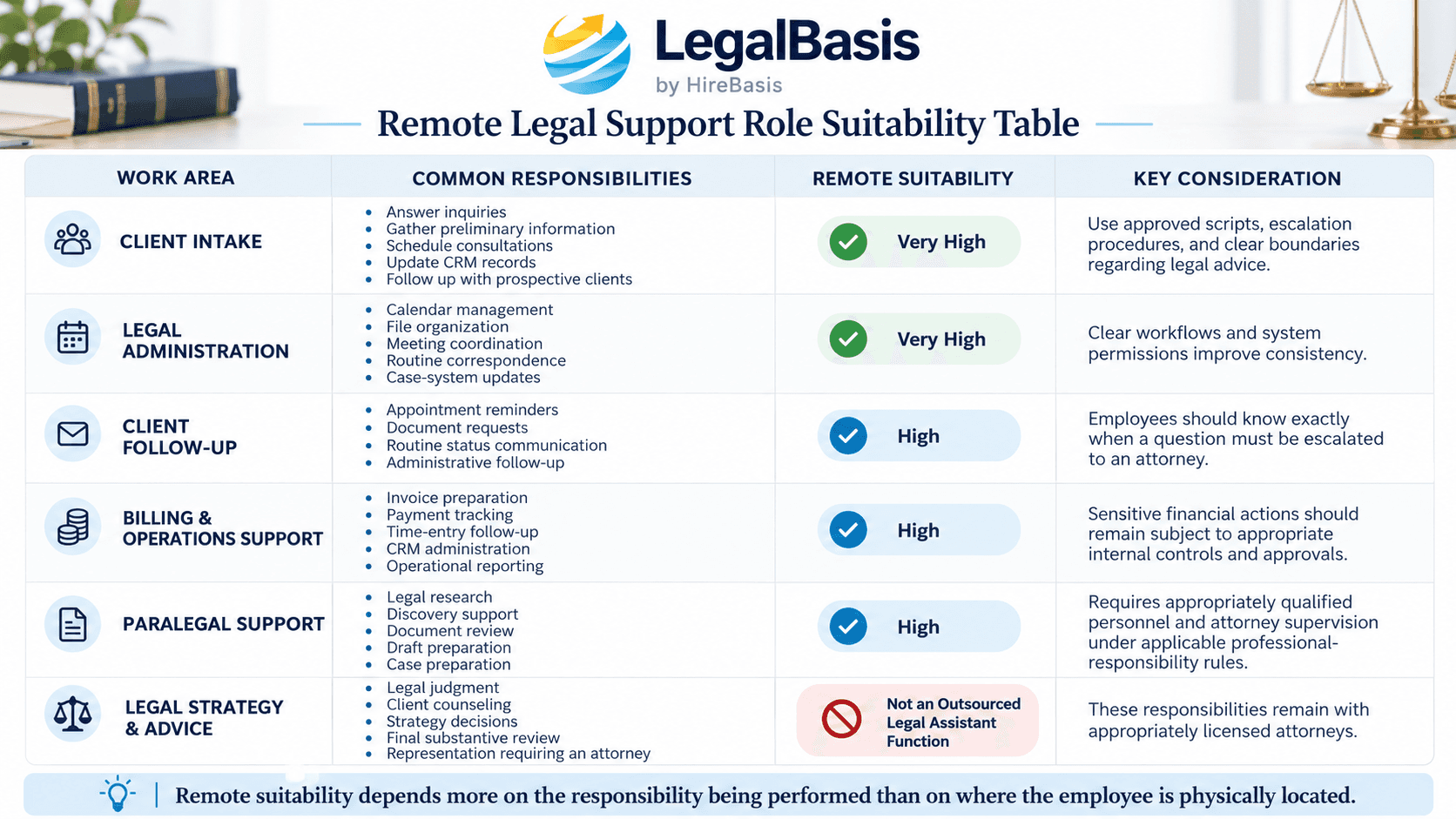
The appropriate scope depends on the firm's practice area, jurisdiction, internal policies, employee qualifications, and required level of attorney supervision.
A useful starting point is to separate work according to the level of judgment required.
Area | Examples of Remote Responsibilities | Typical Oversight |
|---|---|---|
Client intake | Answering inquiries, collecting preliminary information, scheduling consultations, CRM updates | Firm-defined scripts, escalation rules and attorney review where needed |
Administrative support | Calendar management, inbox support, file organization, meeting coordination | Operational supervision |
Case management | Updating matter records, tracking deadlines, organizing documents, obtaining records | Attorney or senior staff oversight |
Client communication | Routine status follow-up, appointment reminders, document requests | Approved procedures and clear limits |
Billing support | Invoice preparation, time-entry follow-up, payment tracking, account organization | Financial controls and management review |
Document support | Formatting, standardized forms, template preparation and document organization | Attorney review where legal substance is involved |
Paralegal support | Research, discovery assistance, document review and drafting support where permitted | Appropriate attorney supervision |
Firm operations | CRM administration, reporting, workflow management and process documentation | Management oversight |
Firms evaluating a wider staffing plan can review which law firm roles can be performed remotely rather than assuming the only remote position available is a generic virtual assistant.
The Real Business Case Is Capacity, Not Cheap Labor
The weakest argument for international staffing is simply that salaries can be lower.
The stronger argument is that a law firm can potentially purchase more operational capacity for the same staffing budget while reserving expensive attorney time for work that genuinely requires an attorney.
Consider a lawyer who spends several hours each week arranging consultations, chasing documents, cleaning up a CRM, reorganizing files, updating matter statuses, and answering routine emails.
The attorney may be perfectly capable of doing every one of those tasks.
That does not mean the attorney should be doing them.
An excellent story appeared in a 2026 American Bar Association article by attorney Diane Chubb. When she opened her firm, a marketing professional advised her: “Draw an organization chart. List every role—from CEO to the cleaning crew. Put your name in every single box.” The goal was then to progressively replace herself in roles that did not require her highest-level contribution.
Source: American Bar Association — Your First Hire Is an Investment, Not an Expense
That concept applies directly to firms considering whether to outsource legal assistants.
The right question is not simply, “How much does an assistant cost?”
It is, “What becomes possible when attorneys stop functioning as their own receptionist, scheduler, administrator, file manager, intake coordinator, and collections assistant?”
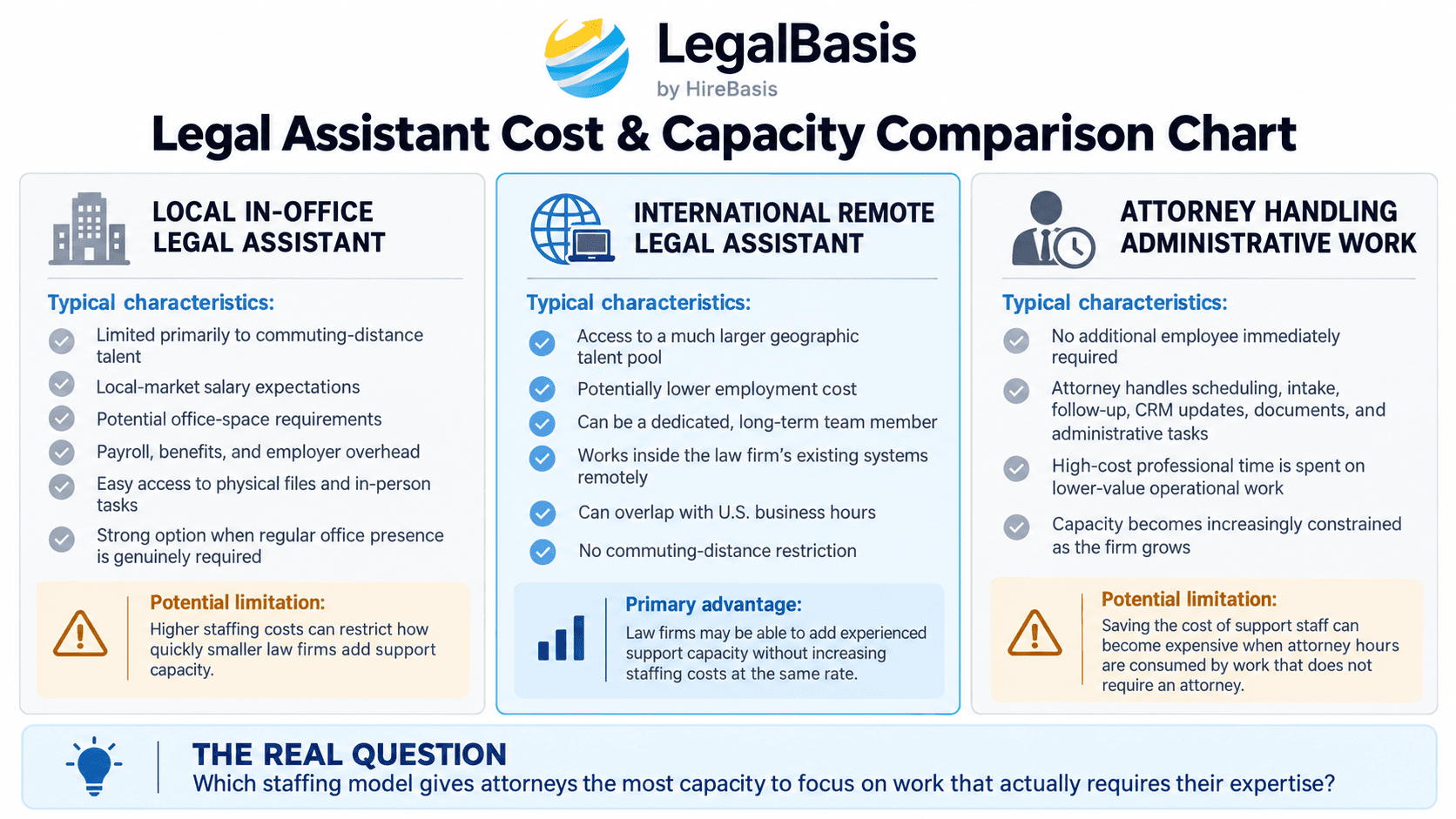
A skilled support professional may create value by freeing attorneys to handle consultations, legal strategy, negotiations, hearings, drafting, case development, business development, and other responsibilities with considerably greater economic value.
Can an International Legal Assistant Really Match Local Quality?
Yes—but international does not automatically mean qualified, just as local does not automatically mean qualified.
Quality is primarily a hiring and management problem.
A strong candidate with relevant experience, excellent written communication, careful attention to detail, appropriate training, dependable internet and equipment, clearly defined processes, strong supervision, and familiarity with the firm's systems can outperform a poorly selected employee sitting twenty feet from the attorney.
The reverse is equally true.
The industry already provides evidence that high-quality professional services are not geographically confined. Chambers' 2026 NewLaw research, for example, quotes one client discussing an alternative legal services provider: “AWL has five-star consultants as part of its network, which is reassuring.”
Source: Chambers NewLaw Guide 2026
The key issue is therefore not whether a candidate lives in California, Texas, Bosnia, South Africa, Argentina, the Philippines, or another talent market.
The issue is whether that individual can perform the specific responsibilities the law firm needs at the level the firm expects.
That requires structured recruiting.
Firms should define the role before beginning a search, establish non-negotiable skills, test writing and communication where relevant, verify professional history, assess software familiarity, evaluate judgment through realistic scenarios, check references where appropriate, and make sure the candidate understands the boundaries between administrative work and legal judgment.
The same discipline is useful when recruiting domestically. HireBasis' guide to recruiting for hard-to-fill roles provides a broader framework for building searches around competencies rather than simply publishing a job description and hoping the right applicant appears.
Remote Work Does Not Automatically Reduce Performance
One persistent objection to outsourcing is the assumption that somebody outside the office cannot perform as effectively as somebody inside it.
Research on remote work makes that assumption difficult to sustain as a general rule.
Stanford economist Nicholas Bloom has spent years studying distributed work. Discussing newer international evidence in 2025, he noted that hybrid work is attractive to companies because “it reduces recruitment and retention costs without any productivity impact.”
Source: Stanford Institute for Economic Policy Research — WFH: An International Sensation
His randomized research at Trip.com found that hybrid employees performed comparably while turnover fell significantly.
Law firms obviously present different confidentiality, supervision, and professional-responsibility issues than a technology company. But the research challenges the idea that physical presence itself creates productivity.
The American Bar Association has documented just how normal remote legal support has become. Research published through the ABA's paralegal section reported that 82% of surveyed paralegal and legal-assistant participants worked remotely in some capacity.
For law-firm leaders, the implication is important: performance should be judged by results rather than visibility.
Attorney Jaime Cage described that approach in an ABA managing-partner discussion: “We avoid a ‘face time’ culture: success is measured by performance and results, not hours spent at a desk.”
Source: American Bar Association — Managing Partners’ Roundtable
That is a useful management principle whether an employee works ten feet away or ten time zones away.
Why Outsourcing Can Be Especially Valuable for Small Law Firms
Large firms can distribute administrative work among several people. Solo attorneys and small firms often cannot.
A single lawyer may simultaneously act as attorney, business developer, supervisor, collections manager, intake manager, recruiter, and de facto office administrator.
That creates an obvious capacity ceiling.
Clio's Joshua Lenon summarized the structural problem well: “Solo and small law firms make up a large part of legal services in North America, yet face unique constraints.”
Source: Clio — 2025 Legal Trends for Solo and Small Law Firms
Clio's broader 2025 Legal Trends research also found that growing firms increased revenue much faster than lawyer headcount, suggesting that successful growth does not simply come from hiring more attorneys. Firms also improve the systems and support surrounding those attorneys.
For a smaller practice, outsourcing one well-defined role can therefore have an outsized effect. A dedicated intake specialist might prevent qualified leads from disappearing. A legal assistant might return hours of attorney time every week. A bookkeeper or billing coordinator might accelerate collections. A remote paralegal might increase the amount of substantive casework a lawyer can supervise.
The objective is not to build the biggest possible staff.
It is to remove the firm's most expensive bottlenecks.
Outsourcing Should Not Mean Sharing One Assistant With Ten Firms
There is also an important distinction between outsourced work and a dedicated employee.
Some virtual staffing models place workers across several clients. This may be appropriate when a law firm needs only a small number of hours or highly standardized support.
However, a growing practice may want something different: a professional who learns its clients, terminology, practice area, attorneys, software, communication style, templates, and procedures over time.
That person can become part of the institutional knowledge of the firm.
At that point, the relationship begins to resemble a distributed employee much more than traditional outsourcing.
Firms that have outgrown ad hoc contractor relationships may want to review when it makes sense to switch from freelancers to full-time remote employees.
Similarly, firms planning several international hires should think about the systems necessary to scale an offshore team without losing quality.
How to Outsource Legal Assistants Without Sacrificing Quality
The process should begin before a job advertisement is ever published.
Start With the Bottleneck
Track where attorneys and senior employees are losing time.
If lawyers repeatedly spend time scheduling consultations, updating records, sending routine reminders, organizing files, obtaining documents, or maintaining the CRM, those activities may form the basis of a legal-assistant position.
If the bottleneck involves research, discovery, drafting, or substantive matter preparation instead, the firm may need a paralegal rather than an assistant.
Write the Job Around Outputs
“Help the attorney with administrative duties” is not a useful job description.
Define what successful performance actually means.
For an intake professional, success might mean prompt response times, complete intake records, accurate conflict-check information, consistent follow-up, and consultations scheduled correctly.
For a legal assistant, it might mean calendar accuracy, properly organized matter files, completed follow-ups, timely case-system updates, and fewer administrative interruptions for attorneys.
Clear outputs improve recruiting and make remote performance easier to manage.
Test Relevant Skills Before Hiring
A strong interview is not enough.
Candidates can be asked to organize a mock client file, respond to a sample client email, prioritize several competing tasks, identify errors in a document, update a fictional matter record, or explain how they would handle a difficult client interaction.
For higher-level roles, the evaluation should become more sophisticated.
Technology can assist in this process too. Firms exploring recruiting automation can review HireBasis' overview of AI recruiting tools for smarter hiring, although human evaluation remains especially important for positions involving judgment, confidentiality, and client communication.
Build Repeatable Processes
Remote employees expose undocumented processes very quickly.
If the only explanation for a workflow is “Sarah knows how we do it,” the problem is not remote work. The problem is that the firm's procedure exists only in Sarah's head.
Good remote operations rely on documented workflows, templates, responsibility boundaries, checklists, escalation rules, and defined communication channels.
This is also where deliberate virtual team building for remote employers and managers matters. Remote employees should know who they report to, how they ask questions, how frequently they receive feedback, and how their responsibilities connect to the rest of the practice.
Attorney Supervision Still Matters
Outsourcing does not outsource professional responsibility.
Attorneys remain responsible for supervising work appropriately, protecting confidential information, complying with applicable ethics rules, and preventing nonlawyers from engaging in unauthorized practice.
Remote work can make that supervision less informal.
Peter Pera, quoted in an ABA Journal discussion of remote supervision, raised the practical question directly: “How do you supervise when you can’t walk down the hall and ask them questions?”
Source: ABA Journal — Remote Work and the Duty to Supervise
The answer is not to avoid remote workers. It is to replace informal supervision with deliberate supervision.
That can mean scheduled check-ins, written procedures, defined approval levels, task-management systems, document-review processes, recorded training, quality-control checks, and clear escalation procedures.
The same ABA discussion also emphasizes secure systems and appropriate data-security practices for remote personnel.
A remote employee should therefore receive no more system access than necessary for the role. Firms should consider firm-controlled accounts, multi-factor authentication, secure password management, encryption, device policies, role-based permissions, secure cloud platforms, and procedures for removing access immediately when employment ends.
International does not need to mean insecure.
Poorly managed access is insecure regardless of whether the employee sits across the world or across the hallway.
Employment Structure Matters Too
Another issue appears when a long-term international worker is called a “contractor” even though the actual working relationship may resemble employment under the relevant country's laws.
International employment classification can involve tax, payroll, benefits, termination, and labor-law obligations that differ by jurisdiction.
Firms should therefore understand the difference between a contractor and an employee in a remote working relationship rather than assuming a contractor agreement automatically resolves the question.
HireBasis also explains the broader legal risks of hiring overseas employees without an Employer of Record.
An Employer of Record can be useful when a firm wants a dedicated employee in a country where it does not maintain its own legal entity. The EOR generally becomes the legal employer locally and handles responsibilities such as payroll, statutory benefits, tax withholding, employment agreements, and local employment administration, while the law firm directs the person's day-to-day work.
LegalBasis has a separate explanation of what an Employer of Record is and how the model works.
Firms managing workers internationally should also understand the mechanics of paying remote employees internationally and legally.
The appropriate structure depends on the particular country, relationship, responsibilities, duration, and applicable law, so firms should obtain jurisdiction-specific advice when necessary.
International Hiring Should Expand the Talent Pool, Not Lower the Bar
Cost savings can make global hiring attractive, but price should be one criterion rather than the primary hiring standard.
A law firm should be looking for professionals who communicate clearly, understand confidentiality, demonstrate judgment, learn quickly, handle deadlines, accept feedback, use the firm's technology effectively, and can grow with the practice.
The goal is not:
“Who is the cheapest legal assistant we can find overseas?”
It is:
“Can we access a larger talent market and hire somebody excellent at a cost structure that makes sense for our firm?”
That is a very different hiring philosophy.
International labor markets contain graduates, experienced administrators, legal professionals, accountants, customer-service specialists, bilingual employees, technology professionals, and individuals who may have previously supported U.S. or international businesses.
Restricting a job search to people within commuting distance of a physical office can exclude most of that talent before an interview even occurs.
Measure the Employee Like Any Other Member of the Firm
Remote employees should not be judged by whether a green status light appears next to their name in Microsoft Teams.
Measure meaningful outcomes.
For an intake professional, examine response times, follow-up completion, record accuracy, and qualified consultations scheduled.
For a legal assistant, look at deadline accuracy, task completion, attorney feedback, communication quality, file organization, and whether attorneys are actually spending less time on administrative work.
For a remote paralegal, evaluate work quality, turnaround time, research accuracy, document quality, deadline performance, and required revisions.
This creates accountability without requiring constant surveillance.
It also aligns with a broader change in legal operations: firms are increasingly looking at processes, technology, staffing models, and measurable outcomes as parts of the same operating system.
When Should a Firm Not Outsource a Legal Assistant Role?
Not every job belongs outside the office.
A position may be better suited to a local employee if it regularly requires handling physical originals, appearing at an office or courthouse, coordinating physical evidence, interacting extensively with walk-in clients, performing jurisdiction-specific tasks requiring local credentials, or completing responsibilities that cannot practically be performed remotely.
The same is true when a firm simply lacks the systems necessary to manage distributed staff.
Remote hiring magnifies unclear workflows.
If assignments are communicated verbally, passwords are shared informally, documents live on individual desktops, nobody knows who is responsible for reviewing work, and the firm's cybersecurity controls are weak, adding an international employee will not solve those problems.
Operational maturity should accompany geographic flexibility.
What About Time Zones?
Time-zone differences can be either a problem or an advantage.
For client-facing positions, firms can specifically recruit employees whose schedules overlap U.S. business hours.
For back-office responsibilities, partial overlap may be sufficient.
Some firms can even take advantage of time-zone differences. Work assigned near the end of one person's day may be prepared before the next business morning begins.
The appropriate schedule should be determined by the responsibilities of the role rather than by a blanket rule that every international worker must maintain the same hours.
What About Communication and Client Experience?
Communication should be part of candidate screening whenever a legal assistant will interact with clients.
That includes spoken and written English, tone, professionalism, listening skills, clarity, cultural awareness, and the ability to explain administrative processes without offering legal advice.
A strong international candidate may communicate more effectively than a mediocre local candidate.
Again, geography is a weak proxy for competence.
The correct approach is to test the skill that actually matters.
How LegalBasis Helps Law Firms Hire International Legal Talent
LegalBasis is built specifically around remote staffing and employment support for law firms.
Rather than treating international legal talent as anonymous outsourced labor, the objective is to help firms identify the work they need performed, define the appropriate role, recruit qualified professionals, and create an arrangement in which the firm retains meaningful control over whom it hires and how that employee works.
For practices still determining where the staffing gap exists, LegalBasis hiring support is designed around defining the position and identifying suitable candidates rather than forcing every firm into the same generic virtual-assistant package.
Some firms also want a combination of local and international support rather than an all-or-nothing offshore strategy. LegalBasis' hybrid legal staffing model is built around that idea: keep responsibilities local when local presence creates real value, and recruit globally where the work can be performed effectively from anywhere.
The result can be a legal team designed around responsibilities rather than ZIP codes.
Outsource Legal Assistants, but Keep Ownership of the Work
The strongest outsourcing strategy is not really about giving work away.
It is about distributing work intelligently.
Attorneys should remain responsible for legal judgment, client strategy, supervision, and the responsibilities that truly require their expertise.
Qualified legal-support professionals can handle the repeatable administrative and operational work that consumes enormous amounts of firm capacity.
Technology makes that division increasingly independent of location.
The firms that benefit most will not be the ones that simply search for the lowest overseas salary. They will be the ones that combine global recruiting with strong hiring standards, well-designed workflows, appropriate attorney oversight, cybersecurity controls, deliberate onboarding, and measurable performance expectations.
Done correctly, the decision to outsource legal assistants can give a law firm access to a much larger pool of talent, reduce unnecessary staffing overhead, and create more capacity for attorneys and senior team members to focus on the work that generates the most value.
Location alone does not determine quality.
Hiring, training, systems, supervision, and accountability do.
And for a growing law firm, widening the search beyond commuting distance may be one of the simplest ways to discover how much stronger its team can become.
Frequently Asked Questions
Can a law firm outsource legal assistants overseas?
Yes. Law firms can use international professionals for many administrative and legal-support responsibilities, subject to applicable ethics rules, supervision requirements, data-security obligations, employment laws, and restrictions concerning unauthorized practice of law.
Is outsourcing a legal assistant the same as hiring a virtual assistant?
Not necessarily. A general virtual assistant may perform basic administrative work, while a legal assistant typically works within law-firm workflows and may have relevant legal-industry experience. A dedicated international employee can also be considerably more integrated into the firm than a shared virtual assistant.
Can international legal assistants provide the same quality as U.S.-based employees?
They can. Work quality depends on individual qualifications, communication ability, experience, hiring standards, training, technology, management, and supervision rather than physical location alone.
What should law firms outsource first?
Look for recurring responsibilities consuming attorney or senior-staff time without requiring their level of expertise. Intake, scheduling, file organization, routine client follow-up, CRM maintenance, calendar management, billing administration, and records coordination are common starting points.
Can a remote legal assistant perform paralegal work?
That depends on the person's qualifications, the nature of the assignment, applicable rules, and attorney supervision. Firms needing substantive legal support should clearly distinguish between legal-assistant and paralegal responsibilities.
Is an Employer of Record required?
Not always. The appropriate structure depends on the worker's country, relationship with the firm, and local employment law. An EOR can simplify compliant employment when a firm wants to hire an international employee without establishing its own foreign entity.
Is outsourcing legal assistants only useful for large firms?
No. Solo practitioners and small firms may benefit substantially because administrative work often consumes a greater proportion of attorney capacity when there are fewer employees available to absorb it.
How can a firm maintain quality with international employees?
Use the same or stronger standards you would use locally: detailed job definitions, structured interviews, work-sample testing, reference checks, secure systems, documented workflows, training, regular feedback, attorney supervision, and performance metrics.
About the Author
Hasan Abdullah is the Founder of LegalBasis and President & Principal Attorney of American Visa Law Group. LegalBasis grew out of his firsthand experience building and managing a U.S. law firm with both local and international team members.
Through that experience, he saw that law firms can expand capacity by recruiting talented professionals globally while still retaining control over who they hire, how those professionals are trained, and how the work is managed.
LegalBasis was built around that model: helping law firms define the roles they need, recruit qualified international professionals, and support compliant international employment structures where appropriate.
Continue Reading
More practical guidance for building a stronger legal team.

Remote Legal Staffing
Outsourcing Virtual Legal Processes: How Law Firms Can Cut Costs Without Sacrificing Quality
Outsourcing virtual legal processes is no longer simply about sending administrative work overseas. Law firms can build dedicated international remote teams that increase capacity, reduce staffing costs, and maintain high standards—provided hiring, supervision, security, and professional responsibility remain firmly under the firm's control.
Read Article →

Remote Legal Staffing
Virtual Legal Assistant Services: How Law Firms Can Build Better Remote Support Teams
Virtual legal assistant services can help law firms increase capacity, reduce administrative pressure, and access experienced international talent without sacrificing quality. Learn what virtual legal assistants can handle, how they differ from remote paralegals, what firms should consider around supervision and security, and how to build a successful remote legal support team.
Read Article →

Remote Legal Staffing
Managing Remote Legal Teams: How Law Firms Can Build High-Performing Teams Across Borders
Managing remote legal teams requires clear workflows, strong communication, measurable performance standards, secure systems, and the right hiring structure. This guide explains how law firms can successfully build and manage international remote teams without compromising quality, accountability, or client service.
Read Article →
Build the Remote Team Your Law Firm Actually Needs.
Tell us what work your firm needs help with. LegalBasis can help define the role, recruit qualified international candidates, and explore an employment structure that fits your firm.