Remote Legal Staffing
Bookkeeper for Attorneys: How to Hire Remote Legal Bookkeeping Talent Without Sacrificing Quality
Hiring a bookkeeper for attorneys no longer means limiting your search to local candidates. This guide explains how law firms can hire qualified remote and international bookkeeping professionals to manage billing, reconciliations, financial records, and recurring accounting tasks while maintaining quality, security, oversight, and trust-account controls.
·
Founder, LegalBasis · President & Principal Attorney, American Visa Law Group
·
·
13 min read

Bookkeeper for Attorneys: How to Hire Remote Legal Bookkeeping Talent Without Sacrificing Quality
For many growing law firms, bookkeeping becomes a problem long before anyone formally decides to hire a bookkeeper.
Invoices need to go out. Expenses need to be categorized. Payments have to be recorded. Accounts need to be reconciled. Attorneys need financial reports they can actually understand. Client funds may require additional recordkeeping and oversight. Meanwhile, attorneys, office managers, and senior staff are often spending valuable time doing financial administration that does not require a law degree.
Hiring a bookkeeper for attorneys can solve that problem, but the traditional assumption that the person must sit inside the law firm's physical office is increasingly outdated.
Much of modern bookkeeping already happens through cloud accounting software, legal billing platforms, banking portals, document-management systems, email, and shared workflows. That means a qualified remote professional can often perform the recurring bookkeeping work of a law firm from another city—or another country—without materially changing how the work itself gets done.
The important distinction is not local versus international.
It is qualified versus unqualified, well-managed versus poorly managed, and controlled versus uncontrolled.
For the right law firm, an international remote bookkeeper can provide the same level of accuracy, consistency, communication, and accountability expected from a domestic employee while giving the firm access to a substantially larger talent market and potentially very different staffing economics.
Why Law Firms Are Rethinking How They Hire Financial Support
Law firms are growing, but the cost of operating them is also growing.
The Thomson Reuters Institute reported in August 2026 that direct law-firm expenses increased 8.3% year over year in Q2, while overhead increased 7.7%. Technology and knowledge-management spending increased 11.6%. Its description of the operating environment was concise: “The waters haven’t calmed down.”
Source: Thomson Reuters Institute — Q2 2026 LFFI analysis
That matters for staffing decisions. A firm can have a healthy caseload and rising revenue while still allowing its margins to erode because every new layer of capacity is expensive.
Demand remains strong as well. Reuters reported that the U.S. legal sector reached a record 1,245,200 jobs in July 2026, up 8.1% from five years earlier. Milbank even offered incoming associates earlier start dates because it was experiencing “exceptionally strong client demand.”
Source: Reuters — U.S. legal sector employment grew again in July
For a growing practice, the question therefore is not simply whether to hire. It is where expensive local capacity is truly necessary and where work can be reassigned to capable professionals at another level or in another labor market.
That is one reason bookkeeping is particularly well suited to a remote staffing model.
LegalBasis explores the same distinction across other positions in its guide to law firm roles that can be performed remotely.
What Does a Bookkeeper for Attorneys Actually Do?
A law firm bookkeeper is responsible for recurring financial administration rather than the legal work of the practice.
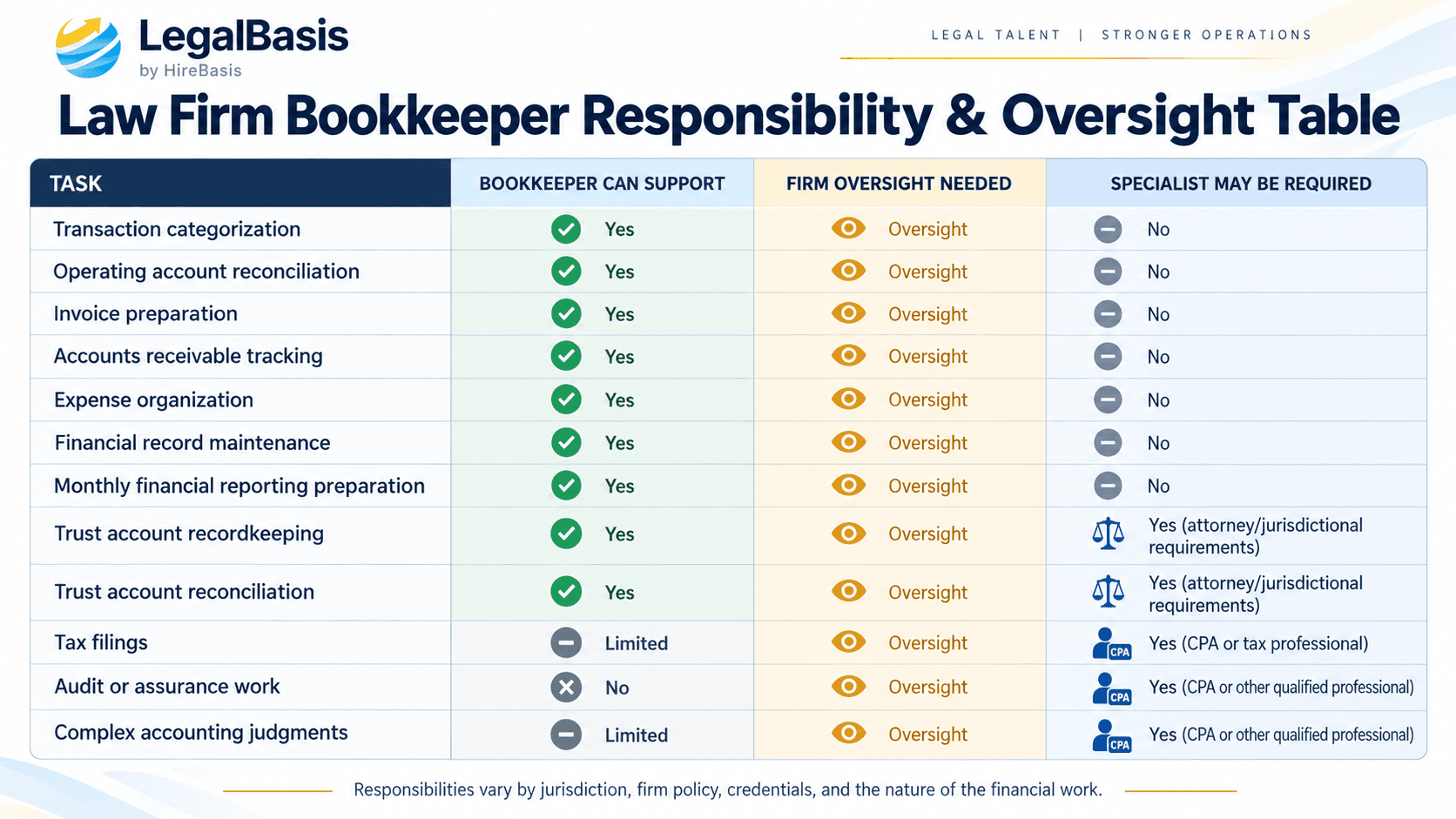
Depending on the firm's systems and the professional's experience, that may include maintaining bookkeeping records, categorizing transactions, recording revenue and expenses, preparing invoices, supporting billing workflows, tracking accounts receivable, matching payments, reconciling operating accounts, organizing vendor records, preparing routine internal reports, following up on missing financial documentation, and keeping information organized for firm leadership and outside accountants.
A bookkeeper may also assist with law-firm-specific financial workflows involving matter-based billing, retainers, client payments, time-entry follow-up, legal practice-management software, and other processes that a general bookkeeper may not encounter as frequently.
This is also where role definition becomes important.
A bookkeeper is not automatically a CPA, tax adviser, auditor, controller, or financial adviser. A law firm should verify credentials independently and define which responsibilities belong to the bookkeeper, which remain with firm leadership, and which require an appropriately licensed accounting professional.
That separation allows the firm to move recurring administrative work to the right person without improperly moving professional judgment with it.
The Accounting Talent Market Is Getting Tighter
Law firms are not the only organizations reconsidering where financial talent comes from.
The Controllers Council's 2026 Corporate Finance & Accounting Talent Study reported a 77% Talent Shortage Index and a 134% Hiring Index, alongside accelerating compensation. Executive Director Neil Brown said the study identified “significant trends in accountant shortages, hiring, compensation and AI adoption.”
Source: Controllers Council — 2026 Corporate Finance & Accounting Talent Research Study
That changes the economics of recruiting.
If a law firm searches only within commuting distance of its office, it is competing for financial talent in one specific labor market. A remote position allows the same firm to recruit nationally. International remote hiring expands that market again—potentially to professionals with bookkeeping, accounting, billing, reconciliation, or professional-services experience who live in places where compensation structures differ significantly from those in major U.S. legal markets.
That is particularly valuable for roles that are already difficult to fill. HireBasis has a broader guide on how to recruit for hard-to-fill roles that explains why widening the talent pool can be more effective than repeatedly recruiting from the same constrained market.
The objective, however, should not be to find the cheapest available person.
It should be to find a good bookkeeper in a larger market.
International Does Not Mean Lower Quality
One of the biggest misconceptions about international hiring is that lower employment cost automatically implies lower-quality work.
The two are not directly connected.
Compensation is influenced by local labor markets, cost of living, supply and demand, taxation, benefits, currency, and many other geographic factors. Professional ability is determined by the individual.
International accounting teams are already common across the professional-services industry. In March 2026, Allinial Global—the world's second-largest accounting association—announced a partnership designed to help its member firms build offshore teams. Allinial Global President and CEO Tony Sacre explained the problem simply: “People are at the heart of every firm, and finding the right talent is a top concern.”
Source: Allinial Global — Partnership to build high-performing offshore teams
The lesson for law firms is not that every overseas professional will be good. That would be no more accurate than assuming every local candidate will be good.
Quality comes from recruiting.
A strong hiring process evaluates actual bookkeeping experience, communication, attention to detail, knowledge of the firm's software, experience working with professional-services organizations, ability to explain discrepancies, reference history, reliability, and the candidate's understanding of financial controls.
The law firm should interview the professional itself.
That philosophy is central to the LegalBasis hybrid model: the firm does not simply receive an anonymous outsourced worker. It interviews candidates, determines whom it wants to hire, trains that person in its systems, and manages the professional directly.
A Remote Bookkeeper Should Become Part of the Firm's Operating Team
There is an important difference between outsourcing isolated bookkeeping tasks and adding a dedicated remote bookkeeper to the law firm's team.
With task outsourcing, work can move back and forth between different people. Context may have to be re-explained. Responsibility can become fragmented.
A dedicated professional learns how the firm operates.
They learn which partners need which reports, how invoices are approved, how expenses are categorized, how clients normally pay, what the month-end process looks like, which matters require attention, how the firm's accounting and practice-management systems interact, and when something looks unusual.
That institutional knowledge has value.
It is one reason LegalBasis approaches remote hiring differently from a traditional virtual-staffing model. The goal is not simply to send work elsewhere. It is to help the firm recruit someone who can operate within the firm's existing systems.
A similar distinction appears when firms decide between a virtual legal assistant and a remote paralegal. The correct title follows the work. Bookkeeping should be treated the same way: first define what needs to be owned, then recruit the person whose experience matches it.
For firms building multiple international positions over time, HireBasis also explains how to scale an offshore team without losing quality.
Technology Is Making Location Less Important—but Human Accountability More Important
Law firms increasingly operate through digital systems regardless of where their employees sit.
Invoices may be generated in practice-management software. Transactions flow through online banking. Documents live in secure cloud environments. Meetings happen through video calls. Financial reports are shared electronically.
Even an employee sitting 20 feet away from the managing partner may spend most of the day working inside exactly the same online systems a remote professional would use.
At the same time, technology does not eliminate the need for people who understand the workflow.
Clio CEO Jack Newton described the current transformation of legal practice as “a once-in-a-generation opportunity to redefine how they work.”
Source: Clio — AI in Law: How Artificial Intelligence Is Changing the Legal Profession
Software can automate transaction imports, reminders, matching, document handling, and parts of billing. AI will undoubtedly automate more.
But a growing firm still needs someone to investigate inconsistencies, maintain records, follow up when information is missing, communicate with attorneys, monitor recurring processes, and determine when something should be escalated.
The future of bookkeeping is therefore unlikely to be purely manual or purely automated. It is more likely to involve capable financial professionals working with increasingly sophisticated software.
Trust Accounting Requires a Different Level of Oversight
Bookkeeping for attorneys also carries responsibilities that ordinary small-business bookkeeping may not.
Client and trust funds can be governed by strict professional rules that vary by jurisdiction. Firms may need separate ledgers, reconciliations, records of receipts and disbursements, and other controls.
Delegating the bookkeeping work does not necessarily delegate the attorney's professional responsibility.
The American Bar Association made this unusually explicit in a September–October 2026 article on IOLTA risk. Discussing responsibility for trust accounts, the article states that “‘my bookkeeper did it’ is not going to work.”
Source: American Bar Association — What Solo and Small Firms Need to Know to Reduce IOLTA Risk
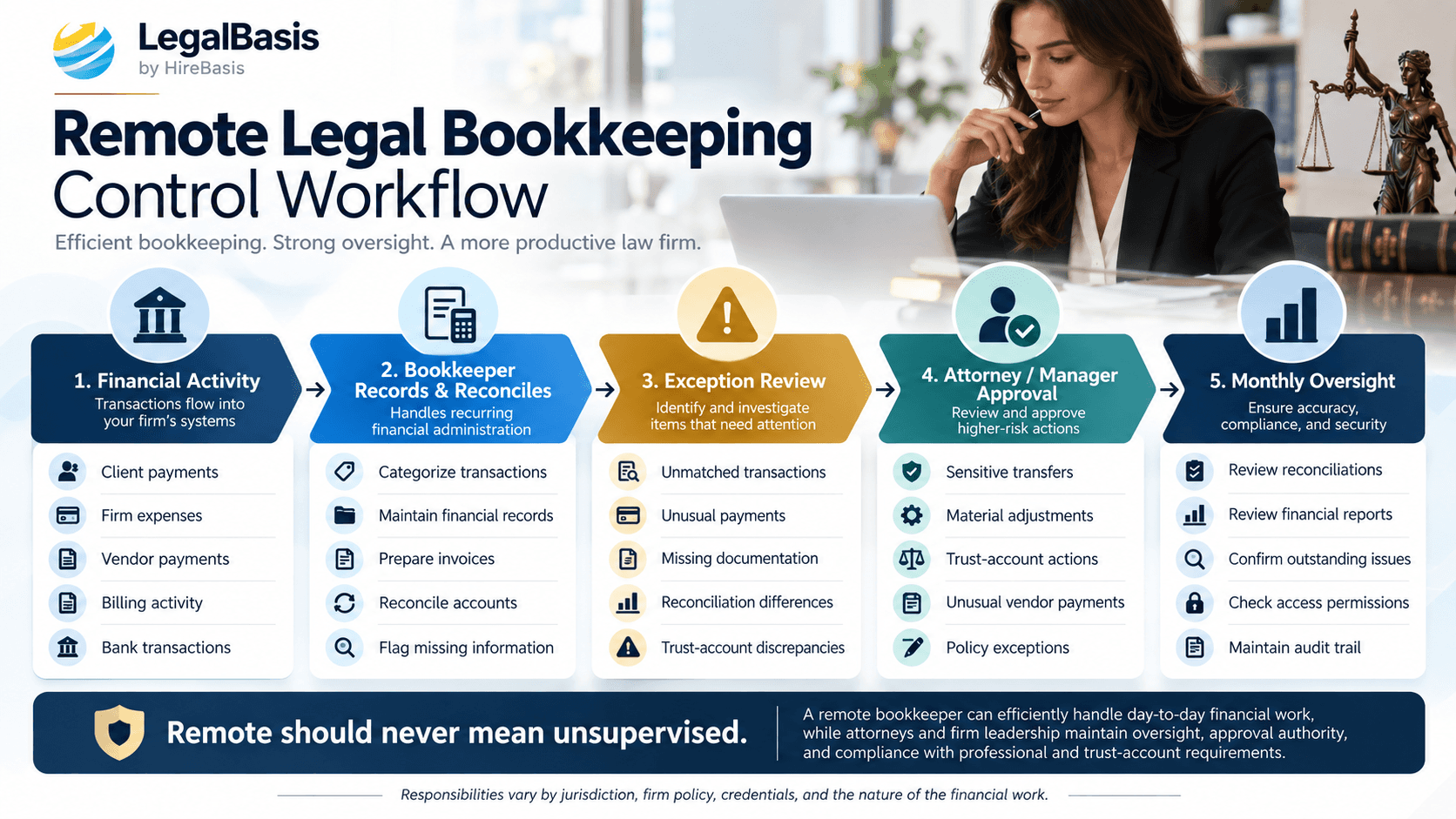
That should not discourage firms from hiring bookkeeping support. It should encourage them to build better controls around it.
A remote bookkeeper should operate within clearly defined permissions, approval procedures, reconciliation requirements, escalation rules, and review processes. Firm leadership should understand what is happening in its accounts, and attorneys should comply with the professional obligations applicable in their jurisdiction.
Remote should never mean unsupervised.
A 2026 Disciplinary Case Shows Why Oversight Matters
A recent Colorado disciplinary decision provides a useful example.
In People v. Morrow II, summarized by the Colorado Lawyer in August 2026, an attorney discovered that a longtime bookkeeper and office manager had made “dozens of unauthorized transfers” and had “stolen hundreds of thousands of dollars.” The misconduct went undetected for years in part because required fiduciary-account reconciliations were not being performed.
The attorney ultimately received a six-month suspension, stayed subject to successful completion of probation and other conditions.
Source: Colorado Lawyer — People v. Morrow II
There is an important lesson here for remote hiring: the underlying risk was not that the bookkeeper was remote.
The bookkeeper had worked with the attorney for more than a decade.
The risk was excessive authority combined with inadequate controls and inadequate review.
A well-designed system should therefore separate recordkeeping from approval authority where appropriate, require recurring reconciliations, restrict access to what the employee needs, preserve audit trails, and give firm leadership visibility into financial activity.
Those controls matter whether the employee works in Manila, Sarajevo, Buenos Aires, Chicago, or in the office next door.
Cybersecurity Is a Firm-Wide Issue, Not a Remote-Worker Issue
Financial employees inevitably handle sensitive information, so security should be part of the hiring and onboarding process.
But cybersecurity risk should not be framed as something created by international employees.
In September 2026, Reuters reported that Greenberg Traurig faced proposed class actions after a breach involving sensitive information. In a statement referenced by Reuters, the firm said its “firm systems were not compromised or breached,” while acknowledging that an unauthorized actor had accessed a limited number of documents.
Source: Reuters — Greenberg Traurig faces class actions after cyber breach
Large firms with sophisticated technology departments can experience security incidents. Small local firms can experience them. Remote firms can experience them.
The appropriate response is a security architecture that assumes every user—local or remote—should have only the access necessary to perform their job.
For a bookkeeper, firms should consider role-based permissions, multifactor authentication, password-management policies, secure devices, documented workflows, restrictions on downloading sensitive records, prompt account deactivation when employment ends, and attorney or management approval for sensitive transactions.
Geography is not a substitute for access control.
What Should a Law Firm Look for When Hiring a Remote Bookkeeper?
A strong bookkeeper for attorneys should be evaluated on more than whether they have used QuickBooks.
The firm should understand what type of bookkeeping they have performed, how frequently they have completed reconciliations, whether they have supported billing and accounts receivable, whether they have worked with professional-services organizations, what legal or accounting platforms they know, how they investigate discrepancies, and how clearly they communicate financial issues.
Experience in a law firm can be valuable because legal billing and trust-account workflows can differ from those of an ordinary business. But firms should distinguish between skills that are truly law-firm-specific and skills that a strong accounting professional can learn through training.
Candidates should also be assessed through practical interviews rather than résumés alone.
Give the candidate a realistic scenario. Ask how they would investigate a discrepancy between the bank and accounting software. Ask what they would do when an attorney has not entered time before invoices are due. Ask how they would handle a transaction they cannot categorize. Ask how they would escalate an unusual payment.
The goal is to evaluate judgment, not memorization.
LegalBasis applies the same candidate-selection principle across legal roles. Its guide on how to hire a remote paralegal illustrates why employers should define the role, screen for the work, interview candidates directly, and build the successful hire into the existing team.
Cost Savings Should Come From Labor-Market Economics, Not Lower Standards
An international hiring strategy works best when the firm approaches cost savings correctly.
The wrong question is:
“How little can we pay someone to do our books?”
The better question is:
“Where can we find a professional who meets our standard at a sustainable total employment cost?”
Those are very different strategies.
International compensation varies dramatically by country, experience, responsibilities, benefits, schedule, and employment arrangement. That can allow a U.S. law firm to offer highly competitive compensation in the employee's local market while spending materially less than it might spend on a comparable hire in a high-cost U.S. city.
The savings should create room for better hiring—not excuse weaker hiring.
A firm may be able to screen more candidates, require stronger experience, hire someone full time rather than relying on sporadic help, provide better training, and retain the employee longer because the economics are more sustainable.
That is why international staffing can sometimes produce not merely comparable work, but a stronger operating arrangement.
Employee, Contractor, or EOR?
Hiring somebody abroad also creates questions that do not exist when hiring an employee down the street.
Worker classification, payroll, benefits, taxes, local labor rules, statutory employment obligations, termination requirements, and other responsibilities depend on the country and arrangement.
A law firm should not assume that calling someone an independent contractor automatically makes the relationship compliant.
HireBasis provides a detailed contractor-vs.-employee guide for remote workers, as well as an overview of the legal risks of hiring overseas employees without an EOR.
An Employer of Record can be one option when the firm wants an employee in a country where it does not maintain its own legal entity. LegalBasis explains the structure in its guide to what an Employer of Record is.
The EOR generally operates in the background as the local employment infrastructure while the law firm directs the employee's day-to-day work, subject to the particular arrangement.
Firms evaluating international payroll can also review HireBasis's guide to paying remote employees internationally.
Do Not Treat a Long-Term Bookkeeping Need Like a Temporary Gig
If a law firm needs someone to reconcile accounts every month, support billing every week, maintain records every day, learn its systems, communicate with attorneys, and become accountable for recurring processes, it may no longer be solving a freelance project.
It may be designing a position.
That distinction matters because continuity improves as the employee accumulates knowledge about the firm's operations.
HireBasis discusses this transition in its guide on when to switch from freelancers to full-time remote employees.
For many firms, the strongest remote model is not “send tasks offshore.”
It is “hire the right person globally and make them part of the team.”
Managing a Remote Bookkeeper Is Still Management
Hiring internationally does not remove the firm's responsibility to onboard, train, communicate, review, and manage performance.
During onboarding, the employee should understand the firm's chart of accounts, billing cycle, financial calendar, approval hierarchy, reporting expectations, software, document locations, communication channels, and escalation procedures.
Recurring meetings are particularly important early in the relationship.
Over time, good documentation makes those meetings less about explaining how to perform routine tasks and more about reviewing exceptions and improving processes.
Remote employees should also be integrated socially into the organization. They should know who the attorneys are, who approves expenses, who handles billing questions, and who they can ask when something does not make sense.
HireBasis's guide to virtual team building for remote employers and managers covers the broader challenge of making distributed employees feel like members of the same organization rather than disconnected outsiders.
The Best Model Keeps Attorneys in Control
LegalBasis is built around a straightforward principle: international hiring should add capacity to a law firm without removing the firm's control over its team.
Attorneys still lead the practice.
The firm still owns client relationships.
The firm still determines its financial controls.
The firm still chooses the candidate.
The firm still trains the employee.
The firm still manages performance.
The difference is that recruiting is no longer limited by the distance someone can commute to the office.
That is the logic behind LegalBasis's hybrid staffing approach: keep the local core that requires attorney judgment, leadership, supervision, and physical presence while adding qualified remote professionals where work can be performed effectively from anywhere.
Firms that want help defining the position can explore LegalBasis's remote hiring support for law firms.
Frequently Asked Questions About Hiring a Bookkeeper for Attorneys
Can a law firm bookkeeper work remotely?
Yes. Many recurring bookkeeping responsibilities can be performed remotely because modern accounting, billing, banking, document, and practice-management systems are accessible digitally. The firm should still establish appropriate access controls, security procedures, supervision, and review.
Does a remote bookkeeper need to live in the United States?
Not necessarily. Many bookkeeping functions can be performed by qualified international professionals. The firm should evaluate the candidate's actual experience, communication, schedule, software knowledge, security environment, and ability to perform the defined responsibilities rather than making quality assumptions based on geography.
Is an international bookkeeper as good as a U.S. bookkeeper?
Nationality does not determine bookkeeping ability. A strong international candidate may have more relevant experience than a weaker domestic candidate, and the reverse can also be true. Quality depends on candidate selection, experience, training, systems, controls, communication, and management.
Can a bookkeeper handle a law firm's trust account?
A bookkeeper may support trust-account recordkeeping and reconciliation where appropriate, but attorneys remain responsible for complying with the professional and financial rules that apply in their jurisdiction. Firms should determine appropriate access, authority, review, and segregation of duties before assigning any trust-account responsibilities.
Is a bookkeeper the same as a CPA?
No. Bookkeeping typically concerns recurring financial recordkeeping and administration. Tax advice, audits, assurance work, complex accounting judgments, and other specialized services may require a CPA or another appropriately qualified professional. Credentials should always be independently verified.
Why hire a dedicated remote employee instead of outsourcing bookkeeping?
A dedicated employee can become familiar with the firm's systems, attorneys, billing practices, reporting expectations, and recurring workflows. That continuity can be valuable for firms that need ongoing support rather than an occasional bookkeeping project.
How much can a law firm save by hiring internationally?
There is no universal percentage. Total cost depends on country, experience, responsibilities, schedule, benefits, employment structure, EOR fees where applicable, and other factors. International labor markets can nevertheless create materially different staffing economics from comparable hiring in some U.S. markets.
A Bookkeeper Should Give Attorneys Time Back—not Create Another Management Problem
The strongest argument for hiring a bookkeeper for attorneys is not simply lower payroll.
It is leverage.
Attorneys should spend their limited time advising clients, developing strategy, appearing in court, negotiating, building relationships, supervising legal work, and growing the practice—not repeatedly chasing invoices, matching bank transactions, organizing receipts, or preparing routine financial records.
A capable bookkeeper takes ownership of recurring financial administration.
A capable international bookkeeper can do the same thing.
The professional's passport does not determine whether the books are accurate. The hiring process, experience, systems, controls, training, and management do.
For law firms willing to recruit beyond their immediate geography, that creates an opportunity to combine access to a much larger talent market with materially different staffing economics—without giving up the ability to choose, train, supervise, and directly manage the people doing the work.
LegalBasis helps law firms define remote positions, recruit international professionals, interview candidates, and build dedicated remote capacity around the firm's existing systems and workflows.
The goal is not simply to hire farther away.
It is to build a better team.
About the Author
Hasan Abdullah is the Founder of LegalBasis and President & Principal Attorney of American Visa Law Group. LegalBasis grew out of his firsthand experience building and managing a U.S. law firm with both local and international team members.
Through that experience, he saw that law firms can expand capacity by recruiting talented professionals globally while still retaining control over who they hire, how those professionals are trained, and how the work is managed.
LegalBasis was built around that model: helping law firms define the roles they need, recruit qualified international professionals, and support compliant international employment structures where appropriate.
Continue Reading
More practical guidance for building a stronger legal team.

Remote Legal Staffing
Remote vs In-House Legal Staffing: What Makes Sense for a Modern Law Firm?
Remote vs in-house legal staffing is no longer just about where employees work. For modern law firms, the better question is which roles truly require physical presence and which can be performed just as effectively by qualified remote professionals. This guide compares cost, quality, recruiting reach, compliance, role suitability, and hybrid staffing models to help attorneys build efficient, scalable teams without lowering professional standards.
Read Article →

Remote Legal Staffing
Is Virtual Staffing Legit? Review and LegalBasis Comparison for Law Firms
Virtual Staffing is a legitimate legal staffing provider offering pre-vetted remote professionals to U.S. law firms. This review examines how its managed staffing model works, what it costs, its key strengths and limitations, and how it compares with LegalBasis for firms deciding between virtual staffing and directly managed global remote hiring.
Read Article →
Remote Legal Staffing
Is Stafi Legit? Remote Legal Staffing vs. LegalBasis
Is Stafi legit? This Stafi review examines its remote legal staffing services, training, 24/7 intake, pricing model, and reputation, then compares Stafi with LegalBasis to help law firms decide between managed virtual staffing and directly managed international remote hiring.
Read Article →
Build the Remote Team Your Law Firm Actually Needs.
Tell us what work your firm needs help with. LegalBasis can help define the role, recruit qualified international candidates, and explore an employment structure that fits your firm.